
Festa Majors in Barcelona: the complete guide
Last updated 26 October 2026
Barcelona holds around 90 festa majors a year. Every neighbourhood was once a separate village, or still behaves like one, and once a year each of them throws its "main festival": roughly a week of concerts, parades, communal dinners and fire in honour of the local patron saint. The city council lends a hand with logistics, but the heart of every festa major is the comissió de festes, a volunteer committee of neighbours who spend months planning it. Nearly everything is free, and none of it is staged for tourists. If you want to see how Barcelona actually enjoys itself, this is the calendar to follow.
The festes share a common vocabulary that is worth learning once. Gegants are giant papier-mâché figures, often a king and a queen, that dance through the streets to pipe and drum; the capgrossos (big heads) trail behind them. Castellers build human towers up to nine or even ten levels high, a Catalan tradition inscribed on UNESCO's intangible heritage list. The correfoc (fire run) is the loudest of the lot: drummers and costumed devils work through the streets spraying fountains of sparks over anyone who cares to dance underneath. Add sardanes (the circular Catalan dance), havaneres (sea shanties, traditionally followed by burnt rum), open-air dinners that take over whole streets, and a stage in every square, and you have the standard kit.
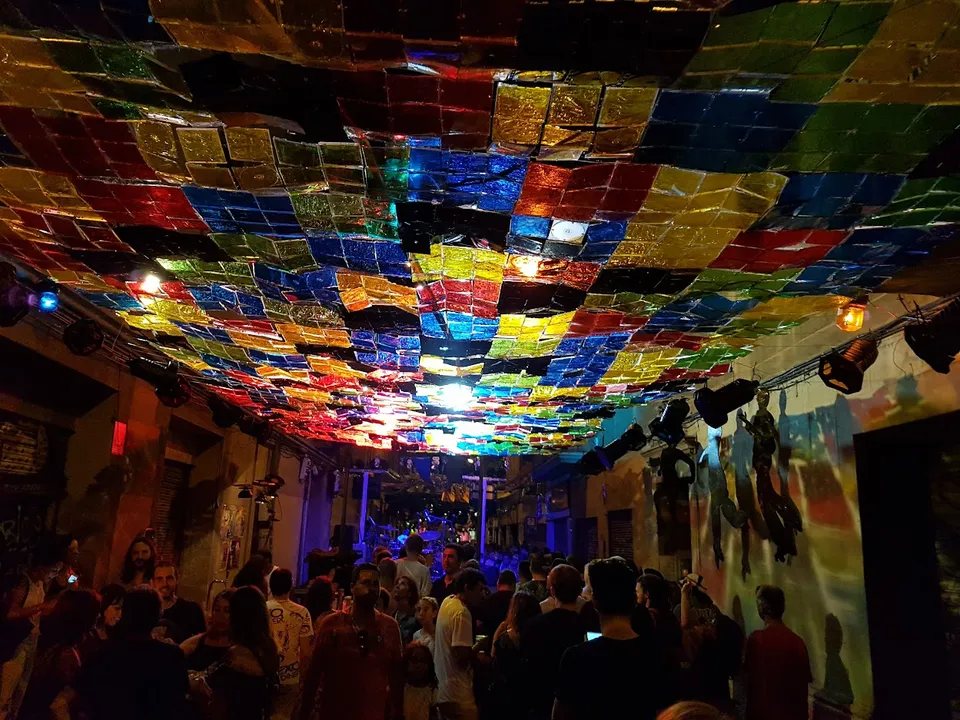
Two neighbourhoods add something extra. In Gràcia and Sants, residents spend the best part of a year building street decorations by hand, then compete for a jury prize. The results, entire streets roofed in themed sculpture made largely from recycled material, are the single most impressive free sight of the Barcelona summer.
How a festa major week works
Most festes follow the same arc. The pregó, an opening speech from a balcony or a stage, kicks the week off, usually with the giants in attendance. The first weekend carries the big traditional acts: a cercavila (parade) of gegants and capgrossos, a castellers performance, often a communal dinner running the length of the main street. Weekdays are quieter and more local: children's workshops in the mornings, talks, sardanes, dance nights, bingo run by the pensioners' association at full volume. The second weekend builds towards the close, and the close is nearly always fire: a correfoc through the main streets, sometimes followed by fireworks. If you only have one evening to spend, pick the final Saturday or the closing correfoc.
La Mercè, in late September, is the exception on this list. It is the whole city's festa major rather than a neighbourhood's, run by the council on an entirely different scale, with international acts, street arts and the piromusical, a music-and-fireworks finale at the Magic Fountain on Montjuïc. Everything else here is a neighbourhood affair, and usually better for it.
Happening now and next up
Next up: Festa Major del Clot-Camp de l'Arpa, 30 October to 15 November 2026; then Festa Major de Sant Andreu, 27 November to 8 December 2026 (dates to confirm).
The 2026 calendar
Every row below is generated from our own registry rather than typed out, and each one records where its dates came from. Rows confirmed by two independent sources are stated plainly; anything resting on a single source, or not yet announced at all, is marked. The table updates itself as programmes are released.
| Festa | Where | 2026 dates | Character |
|---|---|---|---|
| Festa Major de Sant Antoni | Sant Antoni | 16 to 25 January (held) | The year opener, built around the Tres Tombs, a horse-drawn parade with an animal blessing; calçots and a correfoc round it off. |
| Festes de Santa Eulàlia | City-wide | 12 to 15 February (held) | The winter festa for Laia, the city's first patron saint; giants, castellers and light displays pitched squarely at families. |
| Festa Major del Raval | El Raval | 9 to 12 July (held) | Compact and multicultural, with open days at the Liceu, MACBA and the Filmoteca alongside the street programme. |
| Festa Major del Poble-sec | El Poble-sec | 17 to 26 July (held) | Ten days around the Carrer de Blai tapas strip; strong family programme, closing correfoc. |
| Festa Major de la Clota | La Clota | 24 to 26 July (held) | A weekend rather than a week: one of the smallest festes in the city, in a pocket of Horta-Guinardó that still looks like a village. |
| Festes de Sant Roc | Barri Gòtic | 12 to 16 August (held) | Held in and around Plaça Nova and billed by the organisers as its 437th edition, which makes it the oldest festa on the calendar. |
| Festa Major de Gràcia | Vila de Gràcia | 15 to 21 August (held) | Barcelona's biggest neighbourhood festival: 23 decorated competition streets and concerts until the small hours. |
| Festa Major de Sants | Sants | 22 to 30 August (held) | Takes the baton the day after Gràcia ends, with its own eleven decorated streets and thinner crowds. |
| Festa Major de la Bordeta | La Bordeta | 2 to 12 September (held) | A neighbourhood festa in Sants-Montjuïc, run from the local entitats rather than staged for visitors. |
| Festa Major de Vallcarca | Vallcarca i els Penitents | 3 to 10 September (held) | Up the hill behind Gràcia, small and steeply residential. |
| Festa Major d'Horta | Horta | 4 to 13 September (held) | Old village squares below Collserola; sardanes, castellers and one of the most local atmospheres in the city. |
| Festa Major del Farró | El Putxet i el Farró | 5 to 13 September (held) | A compact uptown festa centred on Vil·la Urània. |
| Festa Major del Poblenou | El Poblenou | 10 to 20 September (held) | Running since 1872; giants, correfocs and a closing fireworks display over Bogatell beach. |
| Festa Major de Vallvidrera | Vallvidrera | 10 to 20 September (held) | Up in Collserola, reachable by funicular, and cooler than the city below. |
| Festa Major de Verdun | Verdun | 15 to 20 September (held) | A Nou Barris festa with a long tradition of street decoration workshops. |
| La Mercè | City-wide | 23 to 27 September (held) | Barcelona's official festa major, around the feast of La Mercè on 24 September: hundreds of events, MAC street arts, BAM concerts, castellers, correfoc and the closing piromusical. Shanghai is the 2026 guest city. |
| Festa Major de la Barceloneta | La Barceloneta | 25 September to 4 October (held) | Maritime festa for Sant Miquel on 29 September: the cannon parade, havaneres on the sand and decorated streets in the old fishermen's grid. |
| Festa Major de Sarrià | Sarrià | 2 to 12 October (held) | A former town with its own high street; giants, castellers and long communal meals. |
| Festa Major de les Corts | Les Corts | 2 to 12 October (held) | Village-scale festa around the feast of the Mare de Déu del Remei; concerts and correfoc without the crowds. |
| Festa Major de Vilapicina i la Torre Llobeta | Vilapicina i la Torre Llobeta | 2 to 12 October (held) | A Nou Barris festa that keeps its own gegants and a busy children's programme. |
| Festa Major del Clot-Camp de l'Arpa | El Clot | 30 October to 15 November | One of the longest festes, run by a strong federation of local entitats. |
| Festa Major de Sant Andreu | Sant Andreu de Palomar | 27 November to 8 December To confirm | Closes the year around Sant Andreu's day on 30 November; very much a former town celebrating itself. |
22 festes, in date order. 17 of them have dates confirmed by two independent sources (Barcelona City Council open data, betevé and the organisers themselves); the rest are marked. Dates for the smaller festes are set by their own comissió de festes and can move, so check the neighbourhood before travelling for one.
Practical tips
It costs nothing. Entry to every festa major is free, concerts included. You pay for food and drink, usually at street bars run by the festival committees themselves; in Gràcia and Sants the takings fund next year's decorations, so drinking locally counts as sponsorship.
Take the children, early. Mornings and early evenings are built for families: workshops, foam parties, children's shows and junior correfocs held before the adult one. After about 22:00 the squares turn into open-air concerts, and after midnight they are simply crowded parties.
Respect the correfoc. If you plan to dance under the sparks, do it in cotton: long sleeves, closed shoes and a hat. Watching from the side needs no preparation beyond looking after your ears; the drums are serious, and small children are usually happier with ear protection.
Noise is part of the deal. Concerts commonly run until around 02:00 at weekends. If you are booking a flat in Gràcia in mid-August or Sants in late August, understand what you are signing up for; a room over a decorated street will not be a quiet one.
Watch your pockets. Dense, distracted crowds are exactly what pickpockets like, and the crowds at Gràcia and La Mercè are the densest of the year. Front pockets, zipped bags, no phone on the table, and be especially alert in the crush straight after a correfoc.
Getting home is easiest on Saturdays. The metro runs all night on Saturdays, until 02:00 on Fridays and until midnight the rest of the week; after that the NitBus network covers most of the city. In Gràcia, taxis are less useful than you might think, because half the streets are closed.
Plan the rest of your week
Our Festa Major de Gràcia guide and our Festa Major de Sants guide cover this year's confirmed dates, the decorated streets competitions and how to plan a visit. For everything else on in the city, day by day, see What's On in Barcelona.
Some ticket links are affiliate links: Barna.News may earn a small commission if you buy through them, at no extra cost to you.