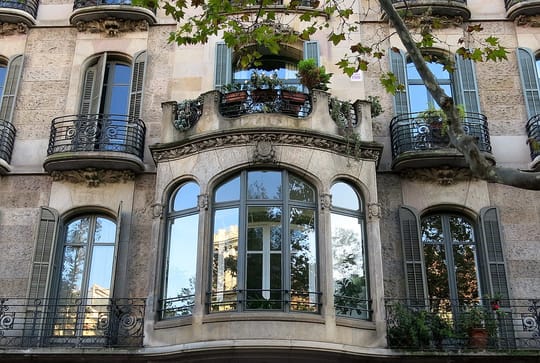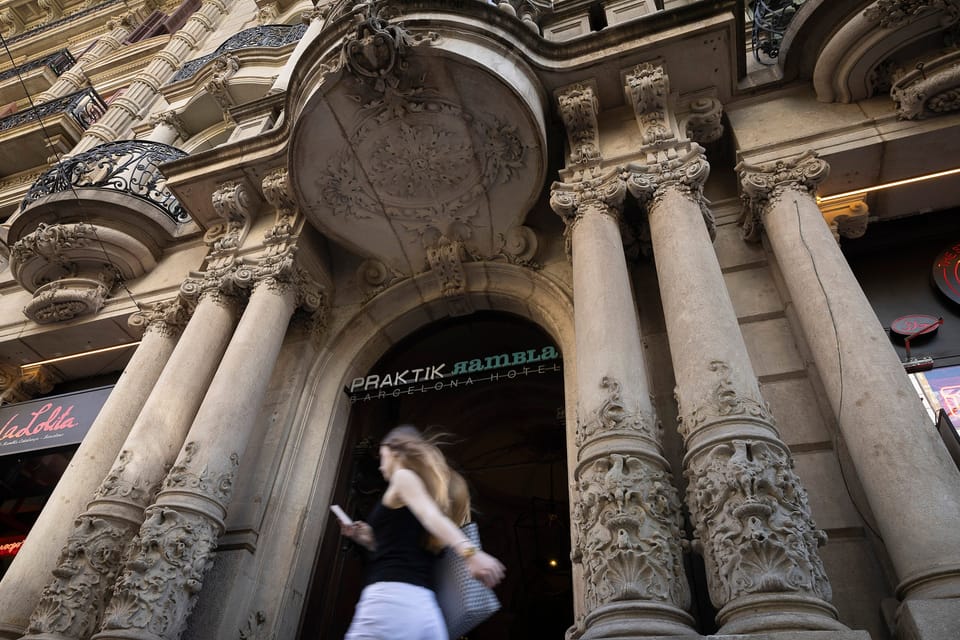
Art historian Beli Artigas has revealed a significant error on a public plaque at Rambla de Catalunya 27, Barcelona. The building, currently operating as Hotel Praktik, has been misidentified as "Casa Climent Arola" for over 30 years; its correct name is "Casa Climent Asols." This discovery emerged during a book presentation on 21 April, drawing attention to a long-standing historical inaccuracy.
The plaque, installed during the Cultural Olympiad preceding the 1992 Olympic Games, attributes the building's authorship to architect Francesc de Paula Villar Carmona. It also states construction occurred between 1900 and 1902. For over three decades, the plaque's official status meant no one questioned its content. Artigas, presenting journalist David Martínez's book Històries de Barcelona (Viena Edicions, 2026), uncovered the blatant naming error. This accidental confusion has prevented the building from displaying its original designation.
"At the very least, here we will demand that the name be corrected," Artigas stated during her initial address to the audience filling the hotel terrace. Her research involved extensive archival and newspaper searches. She successfully recovered the trajectory of the family who gave the building its name. This story is marked by a series of tragedies buried by time.
Uncovering a Family's Tragic Past
To understand the origins of Casa Climent Asols, one must look back to the mid-19th century. Barcelona was then a city confined by medieval walls. The city's ring roads around Ciutat Vella now define the former wall's route. "If we went back 170 years, we would find the train line to Martorell passing through here," Martínez indicated. This railway ran openly from the corner of Rambla de Catalunya and Ronda de la Universitat. It continued up to the current Carrer del Consell de Cent. The line then connected with the future Plaça de Letamendi. It followed Carrer d'Aragó and Avinguda de Roma towards Sants and L'Hospitalet.
When Ildefons Cerdà designed the Eixample district in 1860, he noticed Passeig de Gràcia was slightly misaligned. Applying the plan as initially conceived would result in very small city blocks. Therefore, officials decided to reorient the urban grid. They merged two planned streets to form the current Rambla de Catalunya. This urban transformation, combined with covering the Riera d'en Malla stream, prepared the land. The stream, a sandy riverbed, once flowed through this part of the city. It descended along the route of today's La Rambla.
From Railway Land to Grand Residence
The first building erected in this area was at Rambla de Catalunya 29. It stood at the corner with Carrer de la Diputació. The second was number 25. This property was built on plots owned by the Tarragona to Barcelona and France Railway Company. The company sold these plots to a private individual. The Martorell train line had passed through here until recently. Margarida Blanch i Romaní then became the owner of the land. In early 1900, she sought permission to construct a building. This commission went to architect Antoni Serra Pujals.
Blanch still owned an adjacent plot. She sold it shortly after to Climent Asols Bovets, a silversmith from Manresa who had settled in Barcelona. Artigas's investigation revealed the tragic life of the man who named the house. Before acquiring the land, Asols endured the deaths of his wife, Ignacia Sampere Sala, and four of his five children. Only one child reached their twenties. Asols also survived an attempted assassination in 1888. Someone placed a grenade at the door of his office on Carrer de Vergara 2. The device exploded before his arrival, causing no injuries.
A Legacy of Innovation and Loss
That same year, Climent Asols founded the Compañía Fabril de Carburants with several relatives. This was Spain's first firm dedicated to producing carbon electrodes for electric public lighting. Asols then lived at number 25. He decided to buy the adjacent plot. Francesc de Paula Villar Carmona designed and constructed the building at number 27. The architect was Blanch's son-in-law. Although the two adjacent properties have different style facades, their rear sections are almost identical. Construction finished in 1904. The developer kept the main floor. He could not enjoy it for long, as he died in 1909 at 64 years old.
The house then passed to his only surviving son, Josep Maria Asols Sampere. The heir had sought his fortune in Manila, Philippines, working in commerce. His personal situation was not good. In 1917, he attempted suicide in a Barcelona hotel room but failed. He tried again a year later at the Hotel Inglés in Madrid. There, he ended his life with a gunshot to the head. The property then passed through various family members until the 1920s. Josep Pijuan Ventura bought it then. Pijuan was the son of Catalan immigrants who made a fortune in Camagüey, Cuba. They created a well-known company producing liqueurs, vinegars, and soft drinks.
Modern History and Calls for Correction
Pijuan initiated several reforms to the house. After the Spanish Civil War, it housed the Provincial Headquarters of the Spanish University Syndicate (S.E.U.). The owning family continued to live on the main floor. There, the businessman's wife, Maria Àngels Pijuan Gigier, became the victim of an assault. This assault was orchestrated by the household servant. The events occurred on 26 September 1956. Several men entered the flat and gagged the woman.
The last reference before the hotel business arrived dates to 1985. At that time, the building housed the Casal de l'Eixample. The property then served as Hostal Palacios for several years. After extensive renovation, the current Hotel Praktik opened in June 2009. Artigas detected that the naming error on the plaque likely stems from confusion. It relates to the second surname of the developer of Casa Heribert Pons. This is another architectural gem built in 1907 at Rambla de Catalunya 19-21. Until 2013, it housed the Department of Economy of the Generalitat.
Preserving Barcelona's Heritage
"I am fascinated by what Beli achieved in two days. From one thread, she found all the intertwined stories," Martínez noted after Artigas's explanation. "If anyone hears us, we ask them to correct the house's name." Artigas, in turn, highlighted the "ant-like work" many enthusiasts, like Martínez, do through social media and blogs. They aim to publicise stories and prevent them from being lost without record. Both agreed on the need to preserve local heritage. This remains a significant pending task for various administrations.
The book presentation concluded with a view of the Coliseum Theatre dome. Its rear section is visible from the hotel terrace. "The space was designed to be a grand casino, but the project did not proceed," Martínez recounted. "It ended up housing the Foment de les Arts Decoratives (FAD) from 1936. After the Civil War, it hosted art exhibitions, fashion shows, theatre, and Barcelona's first attempt at a contemporary art museum. For fifty years, the dome has been empty." This call for correction underscores the ongoing effort to accurately document Barcelona's rich architectural and social history. It serves as a reminder of the hidden stories within the city's protected buildings.
Sign up for our new entrepreneurs community Bizcelona, now accepting our second wave of applicants.
Originally published by Tot Barcelona. Read original article.