Owning a car in central Barcelona now costs more in parking alone than two weekends of monthly rentals, and from 2026 the city's Low Emission Zone tightens again to push another tranche of older diesels off the road. If you live inside the Rondes, the Ajuntament's own rules have already made the maths irrational: read the four parking colours, the ZBE thresholds, and the rental alternatives before you sign for anything on four wheels.
The headline numbers, sourced directly from the Ajuntament de Barcelona mobility department and the ZBE Rondes BCN official portal: Zona Blava is priced by environmental badge rather than a flat rate, from €1.25 an hour for a zero-emissions car up to €3.75 an hour for one with no badge in the high-demand Tarifa A zones, Zona Verda resident permits are issued free of charge for the first vehicle under the AREA tariff schedule, and ZBE fines start at €100 and rise to €500 for repeat offences (Ajuntament sanctions schedule). The action this week: if you drive a pre-2006 diesel or pre-2000 petrol and have not checked your distintivo ambiental, you are already non-compliant on weekdays between 07:00 and 20:00.
What changed, and when
The ZBE has been live since 1 January 2020 and fully enforced with automated number-plate cameras since 15 November 2021, per the municipal ordinance published in the BOPB. The next tightening phase targets B-sticker vehicles and is under public consultation at the Ajuntament mobility office through 2026. If you are buying a used car now, treat any B sticker as a depreciating asset.
Best for: people relocating to Sant Cugat, Castelldefels or anywhere outside the Rondes who need a car for daily life.
Avoid if: you live inside the Rondes (Eixample, Gràcia, Sants, Sant Antoni, Poblenou, Sant Martí). The parking maths does not work.
The four parking colours, what they cost
Curbside parking uses four colour-coded bays, administered by B:SM (Barcelona de Serveis Municipals), the council's mobility operator. Walk down any Eixample street and you will see most of them within a single block.
| Colour | Who pays | Hourly rate (2026) | Max stay | Catch |
|---|---|---|---|---|
| Zona Blava (blue) | Anyone | €2.94 central / €1.41 outer (B:SM tariff sheet) | 2 to 4 hours | Different tariffs per district |
| Zona Verda (green) | Residents (free first car); non-residents at penalty rate | €3.25/hr non-resident (B:SM) | 1 to 2 hours non-resident | Permit tied to empadronamiento address |
| Zona DUM (yellow striped) | Commercial loading only | Free for registered vehicles | 30 minutes | Private cars towed; register at AreaDUM |
| Zona Roja (red) | Very short stops | Free | 15 to 30 minutes | Near schools, hospitals, markets |
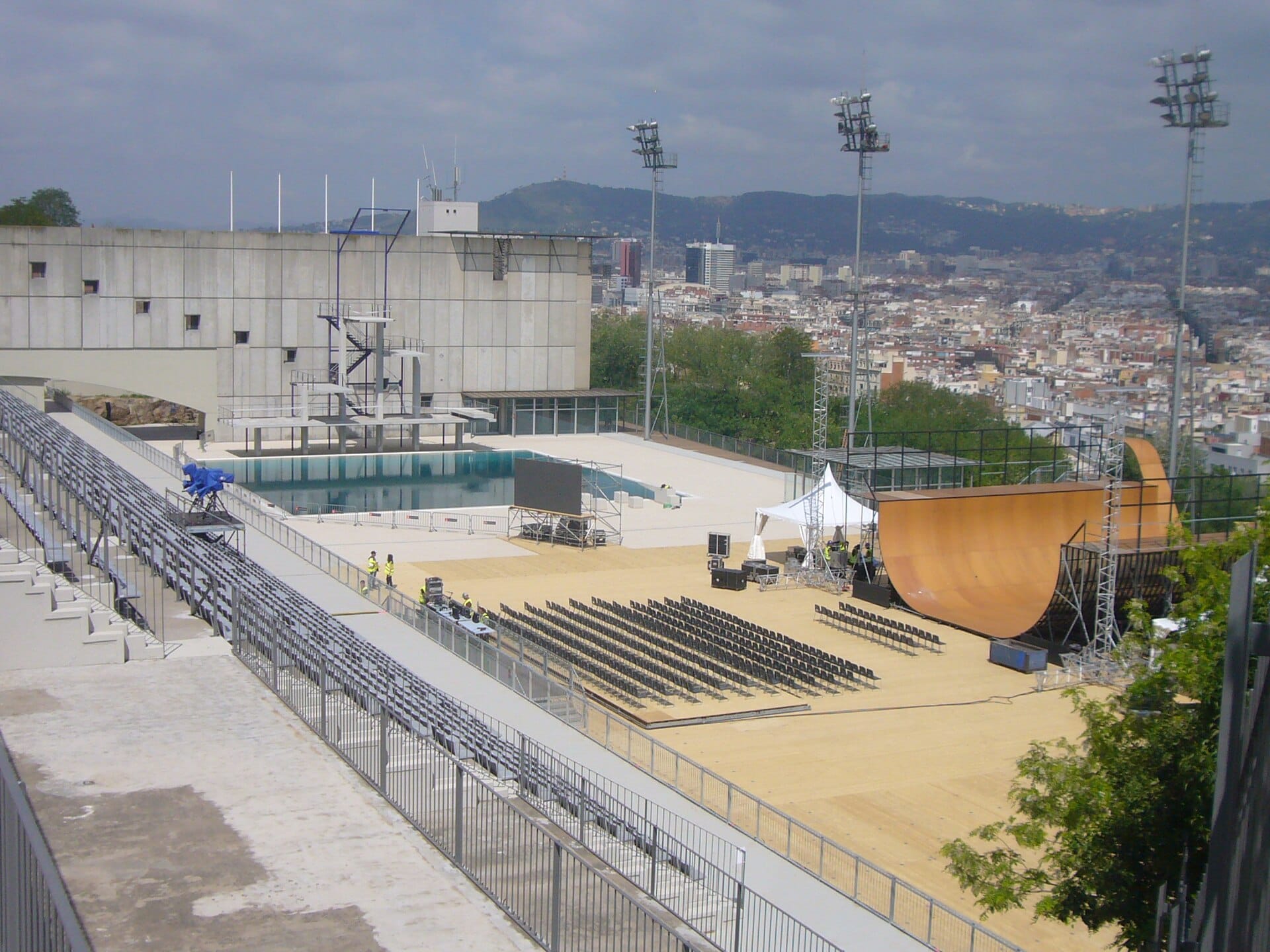
Pay at the machine or via the SMOU app, B:SM's official mobility application. White lines (unrestricted free parking) survive only in pockets: around Montjuïc near the Olympic pool, in Poblenou around Diagonal and Fluvià, and further out in Sants-Badal. Everywhere else, expect to pay.
Street cleaning. Most blocks are cleaned once a week on a posted day, and parking is forbidden during that window. The fine is €80 to €100, per the 2026 fiscal ordinance. Read the signs at the corner of every street: the cleaning day is printed on them.
ZBE Rondes BCN: who it blocks, and when
The Zona de Baixes Emissions Rondes Barcelona (ZBE, the Low Emission Zone) restricts older vehicles inside an area bounded by the Ronda de Dalt and the Ronda Litoral: the entire urban core plus much of L'Hospitalet, Esplugues, Cornellà, Sant Adrià and Badalona.
The confirmed rules (source: ZBE Barcelona operating regulations):
- Restrictions apply Monday to Friday, 07:00 to 20:00, public holidays excluded.
- Excluded vehicles: petrol cars registered before 2000, diesel cars registered before 2006.
- Compliant cars carry a distintivo ambiental (environmental sticker: B, C, ECO or 0), issued by the DGT (Dirección General de Tráfico) for €5 at any post office (Correos).
- Fines: €100 (reduced to €50 if paid within 20 days), rising to €500 for repeat offences within a year (ZBE sanctions page).
Claim, not confirmed: the Ajuntament has indicated B-sticker vehicles will face restrictions from 2028, but the ordinance text is still in consultation. Plenty of older diesel imports become unsellable once that phase lands. Do not be the person buying that car at the start of 2026.
Is a car worth it in central Barcelona?
For most central residents, no. Here is the maths, with each number tied to a source.
| Annual cost (small petrol car) | 2026 figure | Source |
|---|---|---|
| Insurance (third-party plus) | €400 to €800 | UNESPA insurance association annual report (industry estimate) |
| ITV (Inspecció Tècnica de Vehicles, Spanish MOT) | €42.84 every 2 years | Generalitat de Catalunya ITV tariff |
| IVTM (Impost sobre Vehicles de Tracció Mecànica, the Spanish road tax) | €34.30 to €224.74 by engine size | Ajuntament tax office IVTM rates |
| Private garage (central districts) | €120 to €250 per month | Idealista garage rental listings (market data) |
| Zona Verda resident permit | Free, first vehicle | B:SM resident programme |
The verdict. Garage parking alone at €150 a month is €1,800 a year, which buys around 100 days of car rental at typical Spanish rates. If you rent for two weekends a month, every month, you are still spending less than the parking cost alone. Add in narrow streets, scooter chaos, double-parked delivery vans and ZBE friction for older cars, and the vehicle spends most of its life parked, expensively.
When a car does make sense
Some situations flip the maths.
- Outside the central districts. Sant Cugat, Castelldefels, Sant Just, Esplugues: public transport works but a car shortens trips and parking is much easier.
- Equipment-heavy work. Photographers, builders, musicians with heavy gear, anyone moving regularly outside the metro network.
- Small children and weekend travel. Hauling a pushchair plus suitcases on the Rodalies de Catalunya (the Generalitat-operated regional rail network) is technically possible and rarely fun.
- Commute off the rail network. Industrial parks in the Vallès, business sites in the AMB (Àrea Metropolitana de Barcelona) hills, coastal sites south of Castelldefels that Rodalies does not reach efficiently.
If none of those apply and you live in Eixample, Gràcia, Sants, Sant Antoni or anywhere similar, you are better off without one.
Alternatives to ownership
The combined network of TMB (Transports Metropolitans de Barcelona, which runs the metro and most city buses), FGC (Ferrocarrils de la Generalitat de Catalunya, the Generalitat's commuter rail to Sant Cugat and the Vallès) and Rodalies covers almost every regular trip. For the rest:
| Option | Best for | Catch |
|---|---|---|
| Ubeeqo / car-share platforms | Single-afternoon IKEA run, day trip to the coast | Hourly clock keeps ticking; expensive past 6 hours |
| Monthly rental from El Prat (Hertz, Sixt, Europcar) | 30+ day stints; ECO/0-sticker vehicles | Promotional rates only, book direct |
| City-centre weekend hire | Andorra, Pyrenees, Costa Brava weekend | Pre-book; walk-up rates are punitive |
For most central residents, two to four short rentals a year cover the genuine "we need a car" moments without any fixed ownership cost.
How to actually get the paperwork
Operational detail for the three things readers most often ask about:
- Distintivo ambiental sticker: walk into any Correos branch with your permiso de circulación (vehicle registration document). Pay €5. They print and post it. Online order via Correos distintivo portal.
- Zona Verda resident permit: apply at areaverda.cat/residents with your empadronamiento certificate, vehicle permiso de circulación, and proof of insurance. First vehicle is free, second is €91.80 per year. The permit is not free parking, though: for 2026 a resident still pays €0.20 a day to park in their own green zone, capped at €1 a week.
- ITV booking: any Generalitat ITV centre via the cita prèvia (online appointment) system. €42.84 for petrol, €54.45 for diesel. Take the permiso de circulación and the previous ITV card.
The honest verdict
If you are moving to Barcelona, do not bring a car unless you have already worked out where it will live. If you are here and considering buying one, do the parking maths first. TMB, FGC, Rodalies, taxi apps and short-term rentals between them cover almost every legitimate use case, and the ZBE is only getting stricter.
Cars work in suburban Catalonia. They do not fit central Barcelona, and the Ajuntament is not quietly making it easier; if anything, the opposite.
Founder or freelancer in Barcelona?
Still weighing up parking permits, the Low Emission Zone or whether to ditch the car for the metro? These are exactly the questions our members trade answers on every day. The Barcelona English Speakers community brings together more than 4,000 residents across 20-plus free, moderated WhatsApp groups, covering transport, neighbourhoods, flat-hunting and settling in. Come and join us.