The R2 Nord pulls out of Passeig de Gràcia at half past nine on a Saturday morning, and forty-seven minutes later you step off in Cardedeu, a town at the foot of the Montseny natural park where the air is half a degree cooler and the volume drops by about fifteen decibels. I went with my mother (she's in her late seventies) to spend a day with Made My Dia, a small Cardedeu-based outfit that runs guided wildflower walks ending in a hands-on photography session. The whole programme runs about four hours: an hour and a half of easy walking through fields, a picnic of local produce on a striped cloth by a river, and a slow afternoon making a print you take home in a branded envelope. I've done worse with a Saturday.
Produced in partnership with Made My Dia. Editorial direction by Owen.
Getting to Cardedeu
Cardedeu sits on the R2 Nord line of Catalonia's Rodalies regional rail. Trains run roughly every half hour from Sants, Plaça Catalunya, Passeig de Gràcia and El Clot, which makes it one of the more reachable Montseny-region towns from central Barcelona. A return ticket is normally a few euros depending on where you travel from in Barcelona. Made My Dia's how to get to Cardedeu page has the up-to-date guide.
The meeting point was to be Cardedeu station, Made My Dia tells you exactly where to go ahead of time. We arrived a quarter of an hour early, found a café opposite the station, and had a hot drink before we needed to be anywhere, which is the kind of unhurried opening you can't get on most day trips out of Barcelona.
The walk
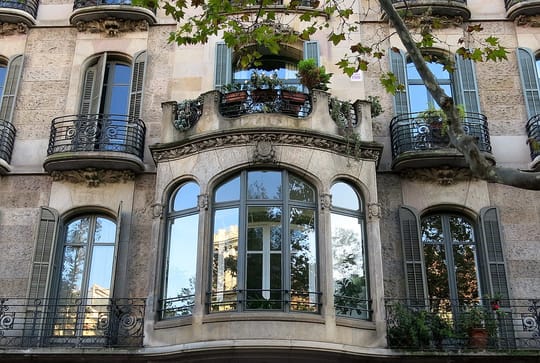
Joanna runs the day. The brief at the meeting point (where you find Joanna and her team waiting alongside the rest of your group) managed to be informative without being earnest. Five minutes of architectural notes on the older parts of Cardedeu, the medieval walls, the modernist house that catches everyone's eye, and then we were out of the town and onto a dirt track between fields.
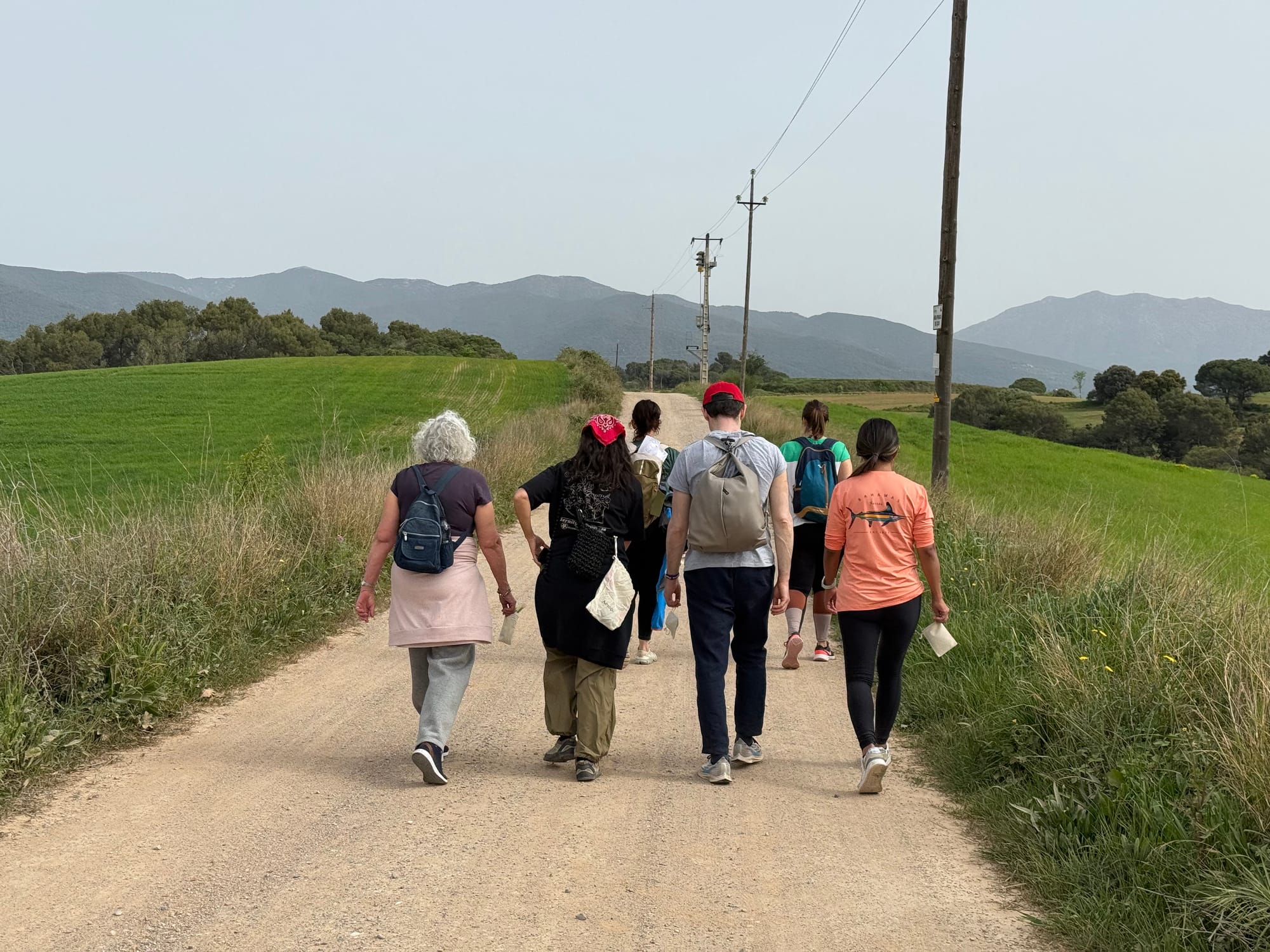
The walk is easy. About 90 minutes, mostly flat, mostly on packed earth and grass, with the Montseny range holding the horizon to the north. There were nine of us in the group, my mother included, and nobody at any point was straining. The pace is built around finding things, not covering distance. On a good day you can see the pyrenees, sadly the visibility was not great on our day - but that did not impact things at all.
What we were finding was wildflowers (for the workshop later), and we were briefed on which species work best for the photographic process (spoiler - poppies). Yarrow with its delicate umbels. Wild fennel for the silhouette. Poppies for colour and bold shape. Ox-eye daisies for the flat, contrasty white. Each of us was given a small cotton drawstring bag and told to gather what we found striking, with a quiet instruction not to over-pick or pull anything by the root. The brief was practical and the activity was meditative in the way only deliberate slow movement in fresh air can be.
The picnic
The walk ends at an outdoor events space beside a river. A flat patch of grass shaded by trees, with a striped blanket already laid out and small steel cups set around it. Joanna and her team had brought lunch, all of it sourced from the Montseny producers Joanna works with.
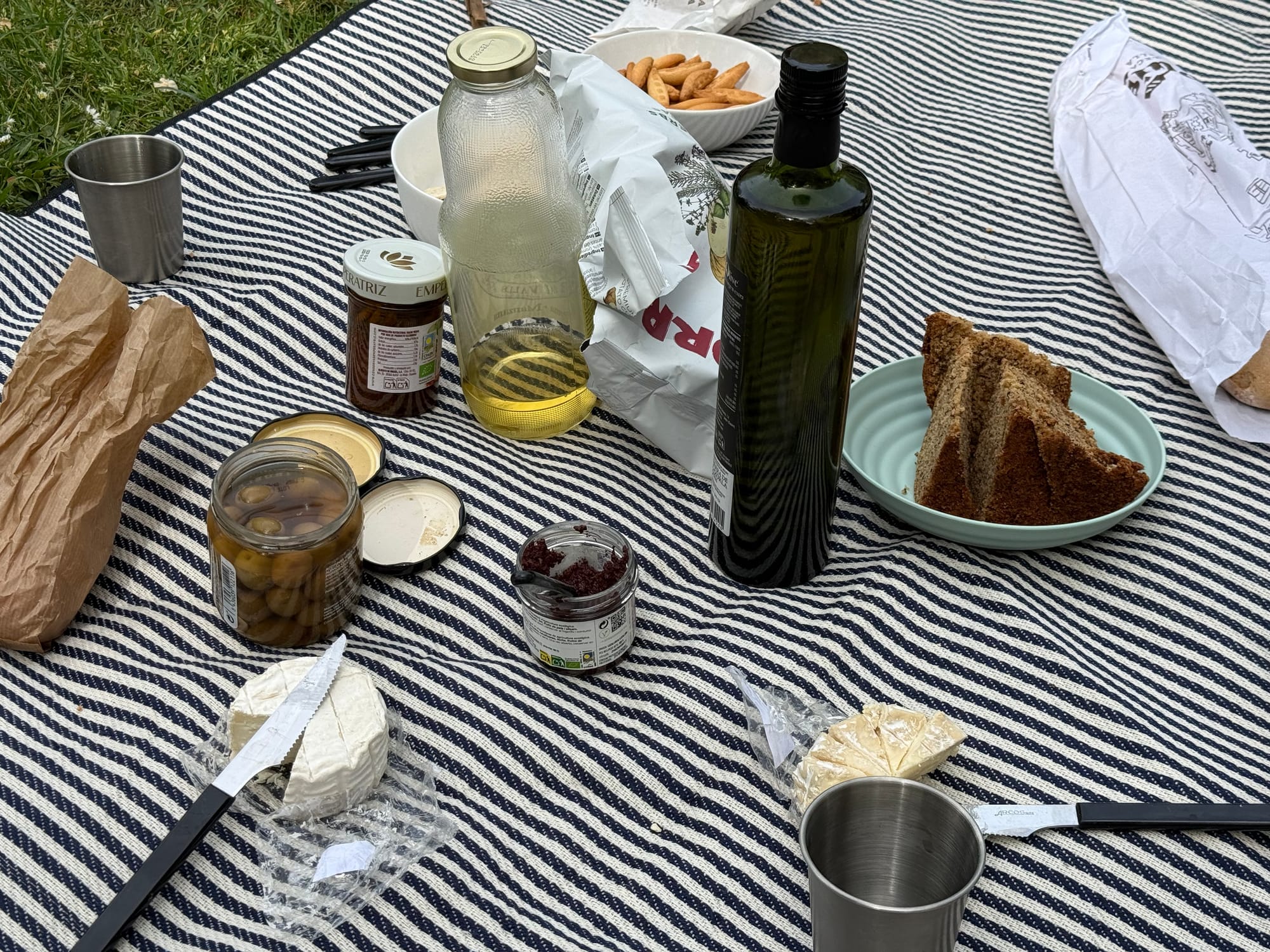
What was on the cloth: bread, two soft cheeses, a glass bottle of olive oil and another of apple juice, olives marinated in herbs, a pot of fig confit, almonds in their skins. None of it was complicated. All of it was good. The apple juice in particular tasted like apples (pressed, not sweetened), and the olive oil had the green, grassy bite that supermarket bottles spend your whole life pretending to have.
The kit is plant-forward without making a thing of it. There was no announcement that the meal was vegetarian. It just happened to be, which is the right way to do it on a day where the focus is the process, not the feeding.
The sunprint workshop
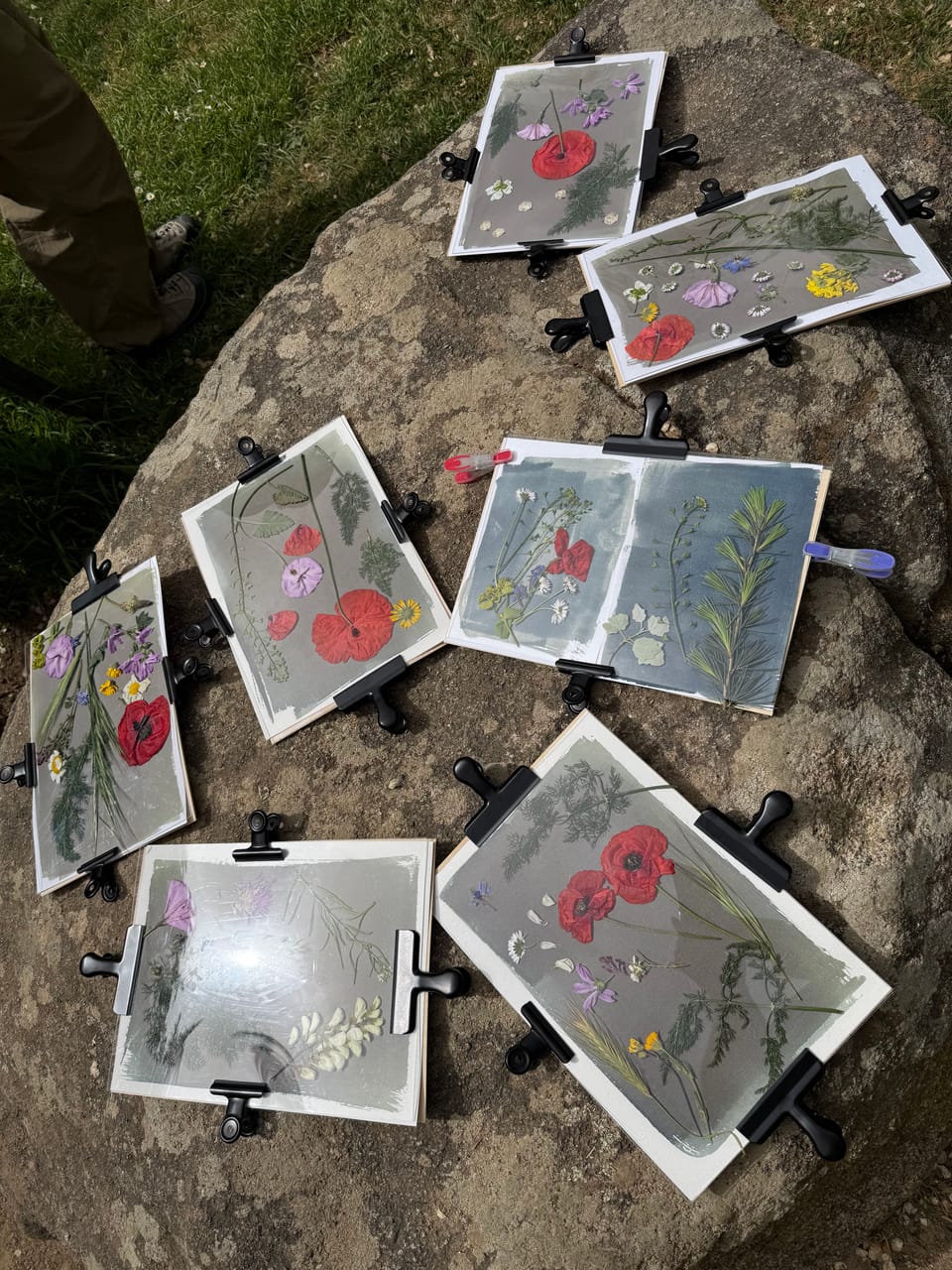
Once everyone had eaten, Joanna walked us through what we were about to do. Sunprint is the everyday word for cyanotype, a photographic process invented in 1842 that uses two iron-based chemicals coated onto paper. The chemicals react to ultraviolet light. Wherever something opaque blocks the UV, the paper stays pale; wherever the sun hits the coated surface, the paper turns a deep Prussian blue. Pressed flowers (flat, opaque, with delicate edges) turn out to be one of the perfect subjects for it.
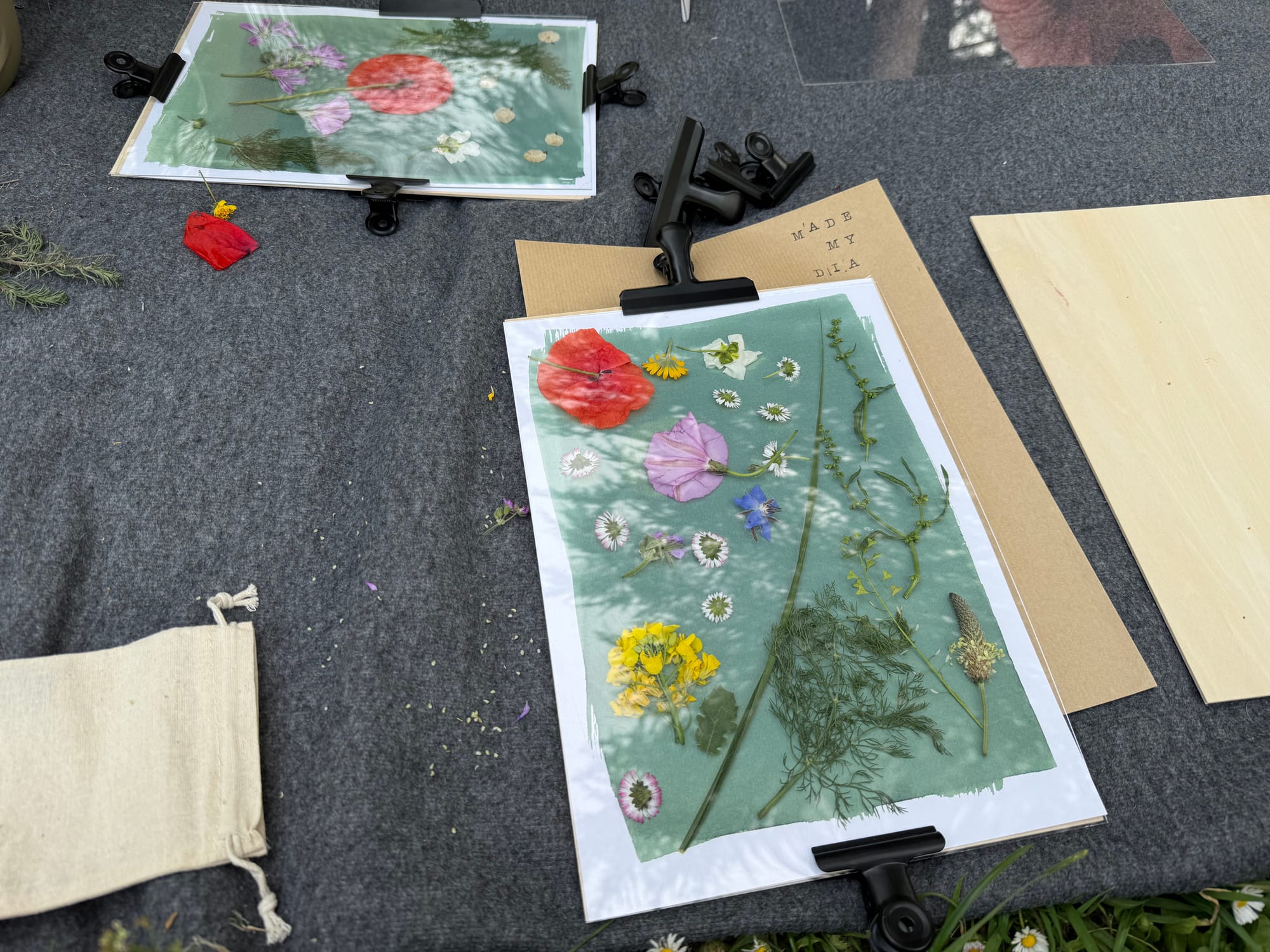
Each of us was handed a pre-coated sheet of paper, a pane of perspex, a clipboard, and clips, plus our small bag of foraged stems. The arrangement is the creative part: you flatten the paper on the clipboard, lay your composition out, then close the glass over the top. Joanna walked between the blankets making small adjustments: fennel arranged like brush strokes, poppies as compositional anchors, ox-eye daisies sprinkled like punctuation. There's no wrong arrangement, but some are clearly better than others, and after two minutes of helpful feedback you start to see why.
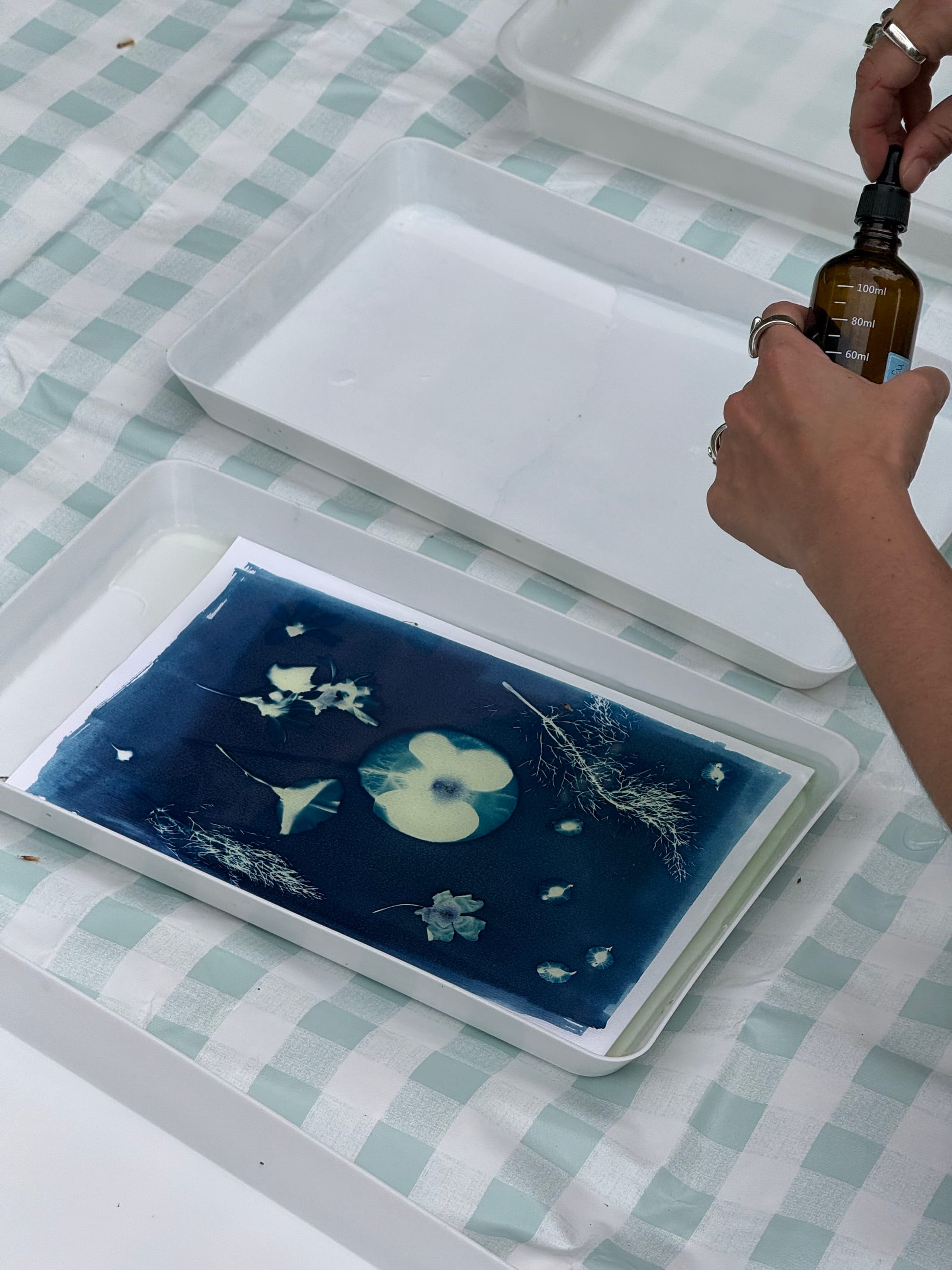
The full process (exposure in the sun, then a water bath, then a hydrogen peroxide bath that deepens the blue) is what makes Joanna's sunprint workshop more than a craft session. You're using a real photographic technique, with real chemistry, on a forgivingly slow timescale. We laid the prints flat in the sun and kept eating while they exposed; about three minutes later, Joanna started the water baths. The white silhouettes of leaves and petals emerged on a deep blue ground. Watching the first print develop is the moment you understand why the process has lasted nearly two centuries.
What you take home
After the chemistry, the prints were clipped to a length of string and hung from a tree to dry, which doubled as one of the better photo opportunities of the day. They take twenty minutes or so to be completely dry, which is conveniently the time it takes to finish off the last of the cheese.
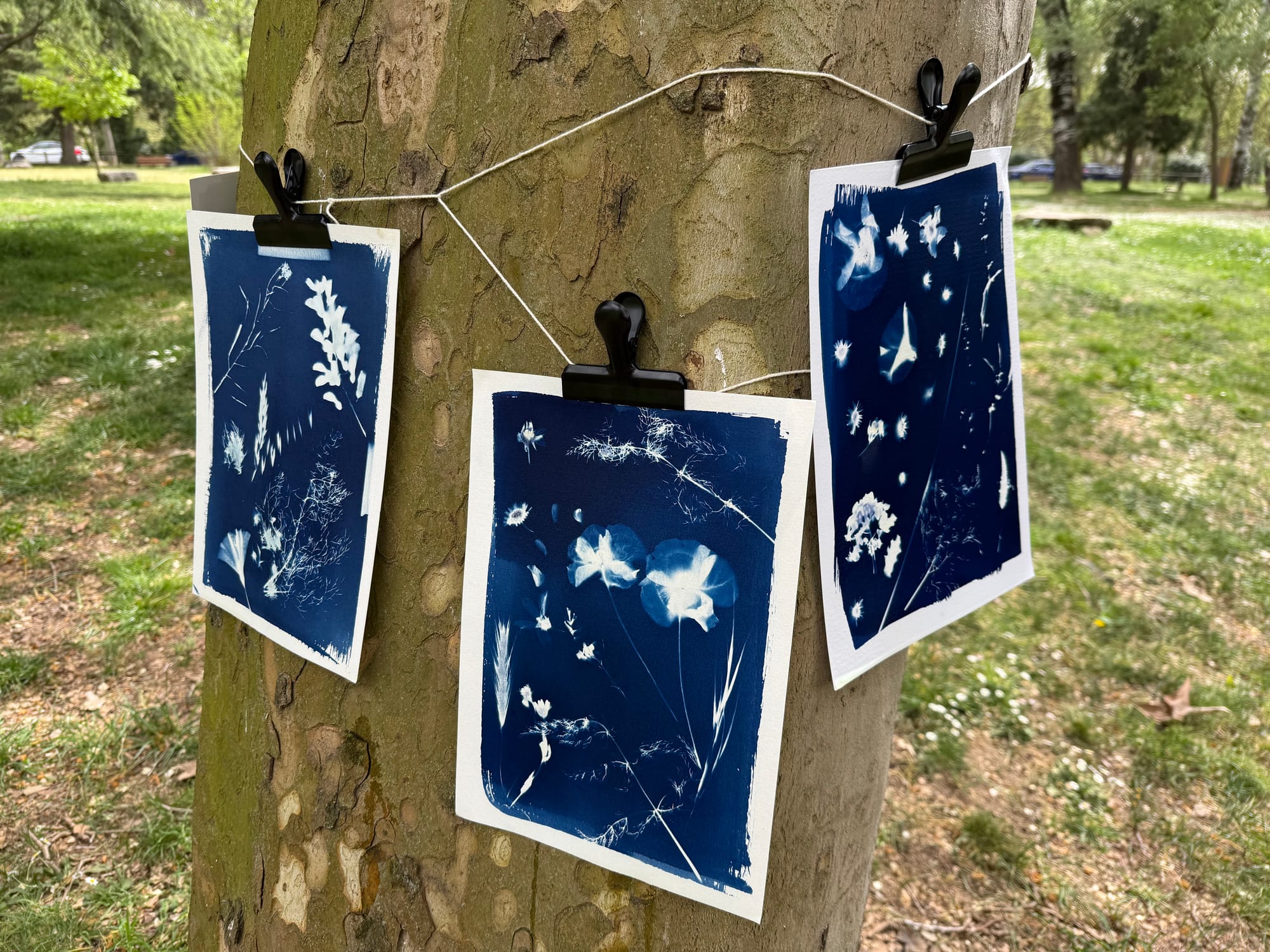
Each finished print was packed flat into a printed envelope branded Made My Dia, and that's what you take home. They're A4-ish in size, the blue is genuinely beautiful, and the compositions (even the ones you weren't sure about while you were arranging them) turn out better than you'd expect. My mother's was framed and on her wall within a fortnight. Mine is in the kitchen.
Who it's for
The honest version: this is a wide-aperture audience. The walk is comfortably manageable for a person in their late seventies. The arts-and-crafts side is engaging enough for older children without being condescending. The slowness of the day means it doesn't suit anyone who wants four bullet-pointed activities and a tight schedule. If you're after stat-bingo Barcelona (Park Güell, Sagrada Família, beach in one day), this is the wrong booking. If you're after a slow, hands-on day with a small group, in nature, less than an hour from the city, with a proper lunch and something to take home that isn't a fridge magnet, it's the right one.
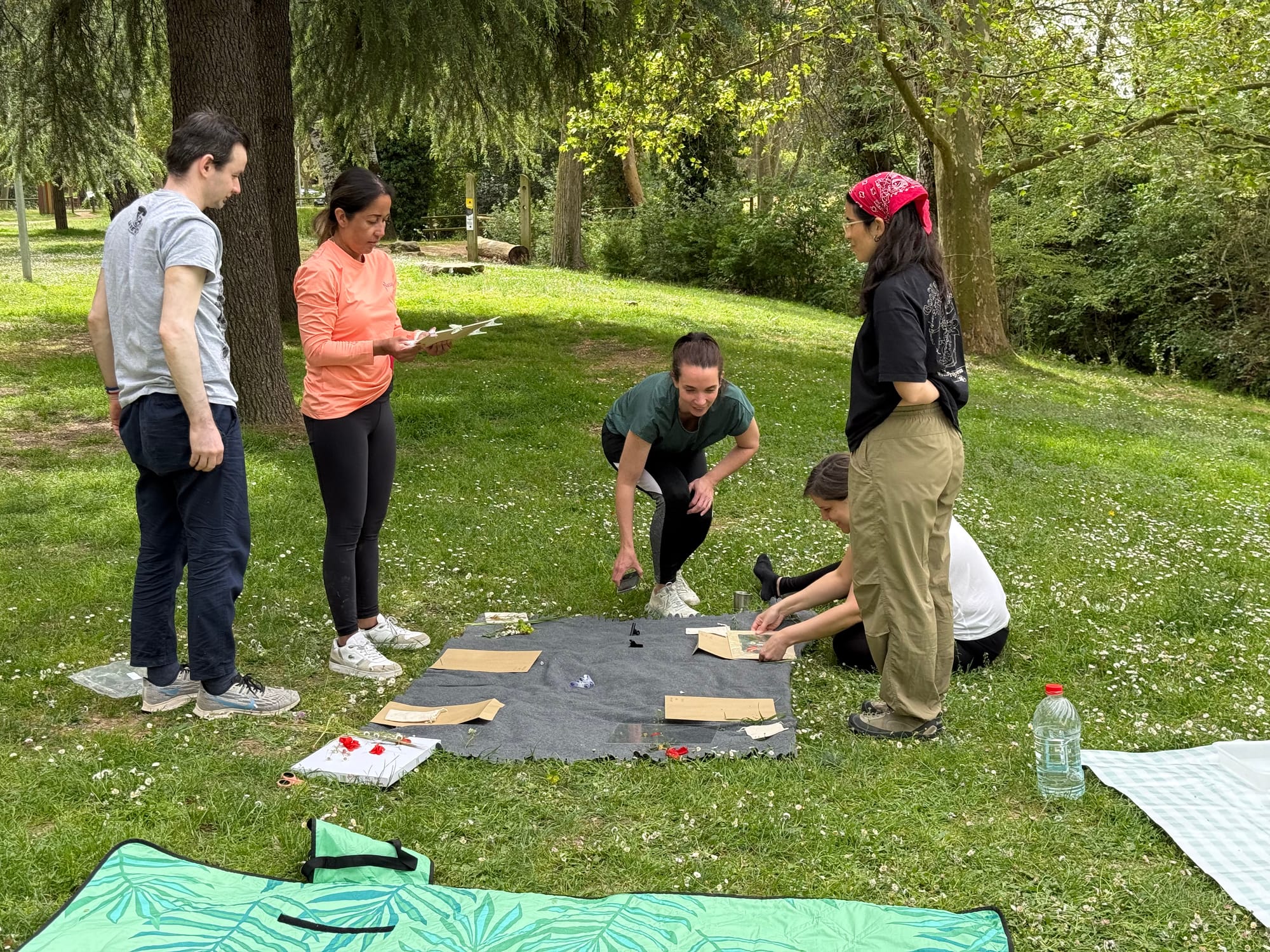
I went with my mother because she'd been visiting for a week and we'd already done the central-Barcelona checklist. We were both glad we'd kept this for the back end of the trip. It was the day she remembered most clearly when she got home.
One small detail worth flagging: on the way back to the station, we wandered through Cardedeu and stopped at a small cooperative store that sources from local producers, including some of the things we'd eaten on the cloth. If you have the time, it's worth the detour. We came back with lots of cheese, a jar of fig confit, and the apple juice we'd been impressed by, all of which made it through the train ride home and onto the kitchen table by Sunday lunch.
Visit Made My Dia in Cardedeu
Cardedeu, Vallès Oriental, Catalonia
The exact meeting point is shared after booking: five to ten minutes' walk from Cardedeu station.
Book: Made My Dia
Transport: getting there from Barcelona
Check current schedule, group sizes and prices on the website.