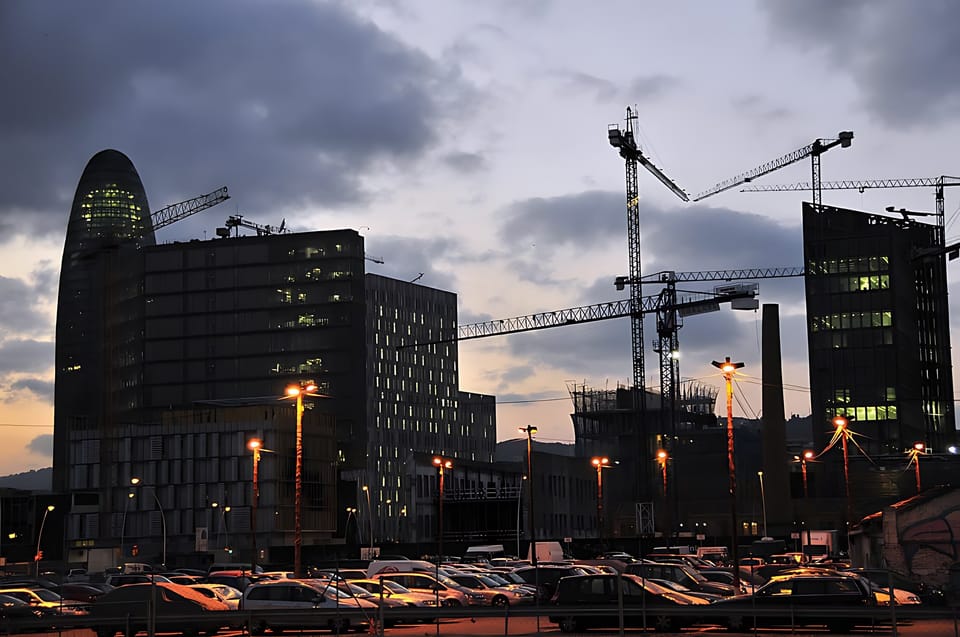
1,800 Homes Built, 15,000 Promised
The 22@ urban development in Poblenou, launched in 2000 to transform industrial land into a tech and business hub, has delivered only about 1,800 protected homes by 2026, a fraction of the 15,000 now envisioned under a revised city plan. When the project began, 10% of the land was reserved for protected housing, initially equating to around 4,000 homes. A later modification to the General Urban Planning Plan (PGM) raised that target, yet construction has lagged. Around twenty public plots in the area have remained vacant for an average of 10 years, with capacity for roughly 2,000 additional apartments. Albert València, an architect and urban planner with the Poblenou Neighborhood Observatory, told Infobarris that only 30% of the 22@ has been built.
If construction continues at the current pace, it will take another 100 years to complete the project,
he said.
Two Paths to Affordable Housing
The 22@ model included two mechanisms to deliver protected housing. First, developers carrying out major urban transformations were required to cede part of their land to the city for affordable homes. One such plot, bounded by Badajoz, Almogàvers, Ciutat de Granada, and Pere IV streets, is now home to the Abril housing cooperative, with residents expected to move in by the end of 2026. Next door, however, a municipal plot transferred to Incasòl, the Catalan public housing agency, remains undeveloped.
When land is given to housing cooperatives, progress is faster than with for-profit developers,
València observed. The second mechanism mandates that major renovations of residential buildings in the 22@ area allocate 70% of units to protected housing, significantly higher than the 30% required elsewhere in Barcelona. However, València noted that tracking compliance in existing buildings is difficult.
New Developments Underway
Despite the delays, new public housing projects are advancing. In June 2026, Barcelona City Council approved the allocation of 32 million euros from a European Investment Bank loan to fund several developments, including 85 publicly owned homes with social rents at the Illa Nubiola site in Poblenou, located between Marroc and Agricultura streets. These are expected to be completed by 2029 or 2030. Additionally, an Urban Improvement Plan (PMU) approved in April 2025 for an area between Pere IV, Selva de Mar, Veneçuela, and Provençals streets will deliver 238 new protected homes, 119 for rent and 119 for sale, along with green spaces and a municipal facility. Construction is set to begin during the current term of office and finish in the next. Eligible applicants must be registered on the Barcelona Register of Applicants for Officially Protected Housing (RSHPOB).
Gentrification Pressures Mount
Since the 22@ plan began, around 3,300 student housing places have been built, most at high rental prices and often occupied by international students. These units, frequently rented as short-term stays in summer, were allowed under previous planning rules until the 2022 PGM update and the Special Urban Plan for Tourist Establishments and Housing (PEUAT) restricted such developments. València welcomed the change, noting that such residences contribute to gentrification. He also pointed out that free-market housing prices in Poblenou have doubled since 2014. On Rambla del Poblenou, commercial activity has shifted: where 80% of premises were shops in 2005, now 80% are restaurants catering to tourists and expats, often with English signage and menus.
A Law Awaits Parliamentary Vote
In July 2026, the Catalan government and Comuns introduced a bill that would allow offices, commercial spaces, hotels, and parking lots to be converted into officially protected housing (HPO) without prior urban planning changes. The Poblenou Neighborhood Observatory estimates this could unlock 17,000 homes in areas like Poblenou. The bill requires majority parliamentary support to pass.
Primary sources: Barcelona City Council. Reported by beteve.cat, betevé.