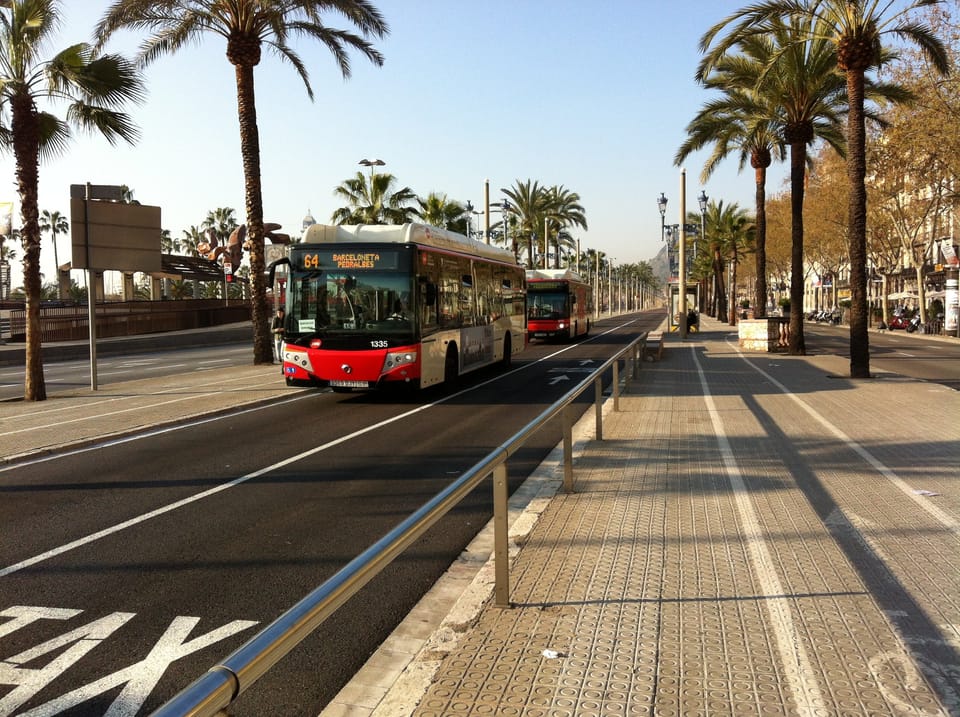
A new bus-only lane on the B-23 into Barcelona began operating this Saturday, designed to reduce travel time for public transport users during peak hours by approximately 15 minutes.
The seven-kilometre lane runs from the A-2 junction in Sant Feliu de Llobregat to the intersection of Avinguda Diagonal and Avinguda d'Albert Bastardas in Barcelona. It occupies the central median strip, positioned to the left of the regular traffic lanes heading towards the city.
David Prat, Director General of Mobility Infrastructure, said:
We’ll see buses moving past stationary vehicles, and that should be a strong incentive for people to take the bus.
The B-23 sees nearly 100,000 vehicles daily and is one of the main road corridors linking Baix Llobregat with the capital. Over 700 buses carrying around four million passengers annually use this route, connecting regions including Baix Llobregat, Bages, Vallès and Anoia with Barcelona.
Public Transport Boost and Economic Gains
According to official estimates, the time savings will amount to 30,000 hours per year for passengers collectively, with an economic value of €450,000 annually. Authorities also expect passenger numbers on these bus routes to rise by between 10% and 15% as reliability improves.
Generalitat President Salvador Illa described the project as “a commitment to public and sustainable mobility” that delivers gains in efficiency and better connects Baix Llobregat with Barcelona. He highlighted it as both a transport upgrade and an example of institutional collaboration.
Long-Term Health and Congestion Concerns
The launch comes amid growing scrutiny over the health impacts of chronic congestion in Baix Llobregat. A separate analysis published today by Viu Molins de Rei highlights that corridors like the B-23, A-2 and B-10 carry 45% of heavy vehicle traffic in the metropolitan region, with 80% of Catalonia’s logistics infrastructure concentrated within ten kilometres of these roads.
Daily traffic volumes reach up to 111,000 vehicles on the B-23 and 133,813 on the B-10. Prolonged exposure to exhaust emissions from idling vehicles has been linked to increased risks of respiratory and cardiovascular diseases, particularly affecting children, the elderly and those with pre-existing conditions.
The article calls for redefining the region’s role not just as a transit corridor but as a zone requiring urgent action on environmental and public health equity.
Reported by beteve.cat, Viu Molins de Rei.