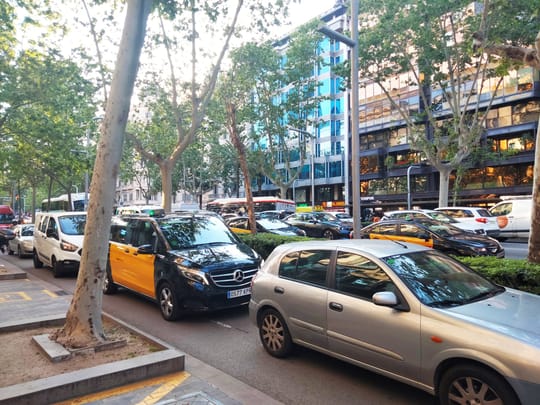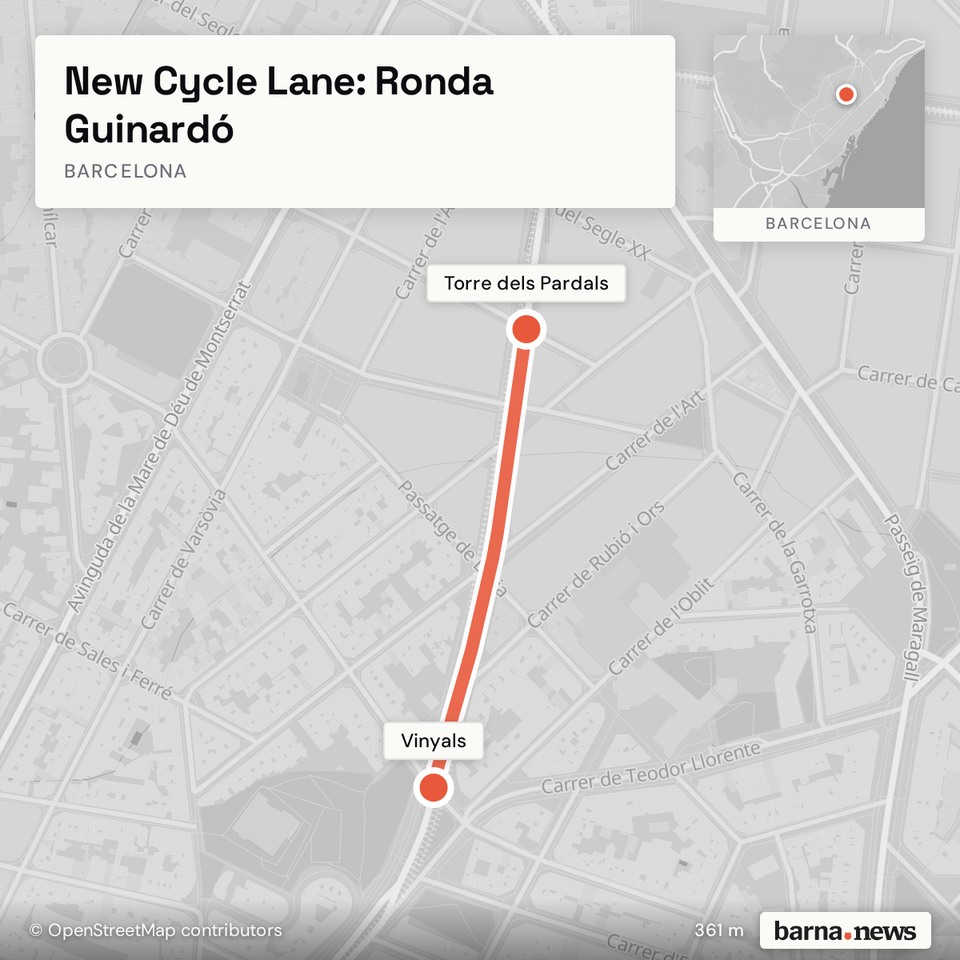
Barcelona is set to reclaim road space from cars on Ronda Guinardó to extend its cycling network. Between Vinyals and Torre dels Pardals streets, one of two traffic lanes in the Llobregat direction will be converted into a protected bike lane, linking the existing route from Segle XX to Vinyals. The Barcelona City Council has approved the executive project with a budget of €451,697.33, including VAT.
The new 380-metre segment forms part of a wider strategy to improve connectivity on the city’s western axis. Currently, the stretch has two lanes per direction, one for buses and one for general traffic. Under the new layout, both buses and private vehicles will share a single lane in the Llobregat direction. The existing sidewalk-level cycle path will be removed as part of a phased, four-month operation.
Extensive Urban Upgrades Beyond Paint
The project goes beyond standard lane marking. According to the technical specifications, it includes full sidewalk renovations, installation of bike racks, replacement of benches with sustainably certified wood, tree maintenance, and 5,100 square metres of high-drainage, noise-reducing asphalt designed for heavy-traffic areas.
€59,119.47–13% of the total budget, will fund upgrades to traffic signals. Ten existing lights will be replaced, with new LED units installed, including those specifically for cyclists. Wiring and support structures will be updated, and five remote-controlled audible signals for visually impaired pedestrians will be added.
Phased Work to Minimise Disruption
Construction will proceed in phases, maintaining traffic flow as much as possible. Temporary central lanes will be set up on the Ronda, and access from transversal streets, Llívia passage, Montaña rambla, and Art and Anna M. Martínez Sagi streets, will be closed to allow uninterrupted work by asphalt machinery.
An accessible pedestrian route of at least 1.80 metres will be maintained throughout, with temporary walkways used when necessary. Pedestrian crossings will remain functional except during brief intervention periods.
Part of Broader Cycling Expansion
This project aligns with the city’s Agenda de la bicicleta 2026–2030, which aims to add 43 kilometres of new bike lanes by 2030. Barcelona’s current network spans nearly 270 kilometres, with cycling use up 17% in 2025.
Other planned upgrades include changes on Via Laietana and Diagonal, where the lane between Glòries and Verdaguer has moved from the pavement to the road. Work is also advancing on completing the network up to Cinc d’Oros and between Glòries and El Fòrum.
The renovation of Meridiana between Felipe II and Fabra i Puig, featuring a wide, segregated bike lane, is expected to finish by autumn 2026. No start date has been set for the Ronda Guinardó works.
The project has received a favourable technical report with conditions, adopted by the Urban Planning Manager on 31 July and published in the Official Gazette of the Province of Barcelona on 13 August.
Before final approval, the project will be on public display for 30 working days. Citizens and stakeholders may consult documents and submit formal allegations. If no objections are received, and no further reports require modifications, the project will be approved without additional resolution.
Ronda del Guinardó, part of the Ronda del Mig, traces its origins to Léon Jaussely’s 1905 Plan de Enlaces. It links Travessera de Dalt to Passeig Maragall, passing Plaça Alfons X and the new Hospital de Sant Pau. Its name, Carrer de l'Agregació, reflects its historical role in connecting annexed municipalities to central Barcelona.
Primary sources: barcelona.cat. Reported by elperiodico.com, David Guerrero, El Periódico Barcelona.