Passenger Growth Outpaces Infrastructure
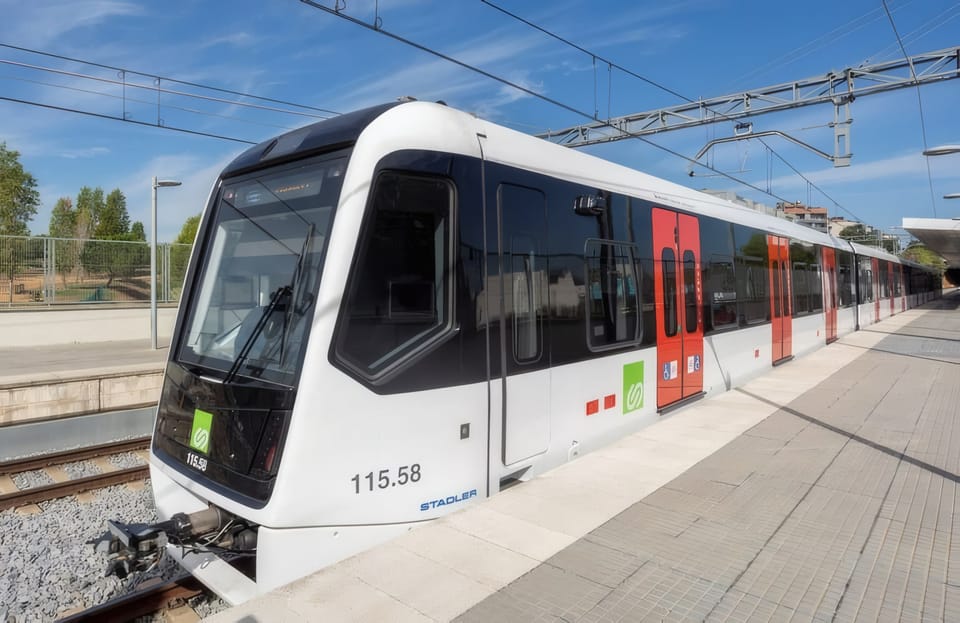
The Barcelona-Vallès line operated by Ferrocarrils de la Generalitat de Catalunya (FGC) is on track for service saturation by 2029, according to the Catalan Audit Office (Sindicatura de Comptes de Catalunya). The agency's analysis of operations between 2022 and 2024 projects an 80% occupancy rate by 2029–2030, potentially rising to full capacity between 2034 and 2037. Passenger numbers have surged in recent years. In 2024, the S1 and S2 lines recorded 68.86 million journeys, exceeding pre-pandemic levels. That figure rose to 71.21 million in 2025, a 25% increase from 57 million in 2022, as confirmed in FGC’s 2025 Integrated Management Report.
Infrastructure Bottlenecks Limit Expansion
Despite increased demand, expanding service capacity is constrained by physical limitations. The current double-track layout between Barcelona and Vallès cannot support more trains, and plans for a new tunnel through Vallvidrera remain in early development stages. According to the audit report, this delays the duplication of the corridor and prevents timely relief before saturation begins. The bottleneck is most acute on the central section between Gràcia and Plaça Catalunya, where a single track per direction limits frequency. Although the BV07 service introduced in 2022 achieved peak frequencies of one train every 2.5 minutes between Sant Cugat and central Barcelona, this has reached the technical maximum of the existing infrastructure.
Recommendations to Prevent Collapse
To mitigate the risk of collapse, the Audit Office recommends targeted measures. These include increasing train frequency on the busiest branches, to Terrassa (S1) and Sabadell (S2), and reorganising underused lines such as the Tibidabo (L7) and Sarrià (L6) services. The audit report also highlights that 84% of passengers use the service on weekdays, with high density not only during morning peaks but also in the afternoons. This sustained pressure further strains capacity.
The evolution of supply, in relation to the predicted growing evolution of demand, leads us to foresee that the Barcelona-Vallès line will begin to experience service saturation problems around 2029–2030.
Capacity Upgrades Already Implemented
Since 2017, FGC has expanded access with new stations in Sabadell, La Creu Alta, Sabadell Nord, and Sabadell Parc del Nord, and in Terrassa. In December 2022, the BV07 timetable change introduced all-stations stopping patterns, slightly extending journey times but enabling higher overall frequency. At the time, FGC stated this would raise annual operational capacity from 80 million to 110 million passengers. However, the Audit Office warns that projected demand, estimated at 84.6 to 89.7 million journeys by 2030 and up to 122 million by 2037, may exceed even these enhanced limits.
Reported by isabadell.cat, [email protected];[email protected];[email protected], FGC Ferrocarrils de la Generalitat de Catalunya, metropoliabierta.cat, eleconomista.es, transparencia.fgc.cat, [email protected], elmon.cat, KONICA MINOLTA bizhub PRESS C1070, metropoliabierta.elespanol.com, fgc.cat.