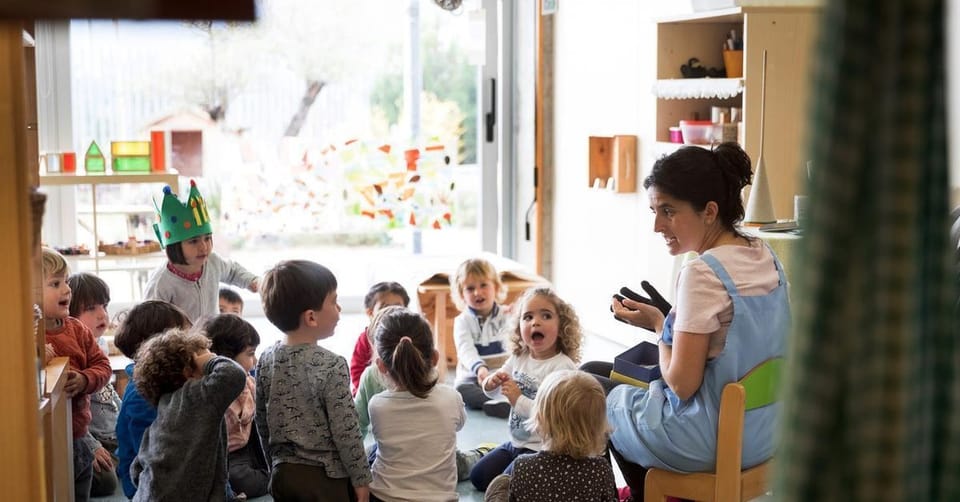
Barcelona faces a significant surplus of I3 school places for the upcoming academic year, with 1,540 vacancies reported, marking the highest number since the pandemic. This oversupply stems from a combination of declining birth rates and families leaving the city due to high housing costs.
The city registered 9,767 applications for I3 (3-year-old) places for the 2026-27 academic year. However, Barcelona offers 11,307 places, leaving nearly 15% of the total available. This 1,540-place surplus is the largest recorded during a pre-registration period since the 2020-21 academic year, when 2,007 vacancies occurred.
Xavier Bonal, a Professor of Sociology at the Autonomous University of Barcelona (UAB) specialising in educational policy, confirmed this trend, according to Consortium of Education. He stated, "It confirms that the level of demographic winter is a reality, and increasingly so."
Declining Birth Rates and Housing Costs
The demand for starting school in Barcelona has fallen by 4% compared to last year. This continues a long-term trend; I3 pre-registration applications in the city have dropped by 21% over the last decade. Officials expect the next academic year to be the first with fewer than 10,000 children starting I3 in Barcelona.
A significant factor behind this decline is the falling birth rate. The number of births in Barcelona plummeted by 18% between 2013 and 2023. These are the children who would be starting I3 next academic year.
María Segurola, Head of Projects at Equitat.org, highlighted another reason for the drop in school applications. She explained, "There is a part of this variation that is due to people leaving Barcelona. There is an economic expulsion due to housing prices." Data from the Barcelona municipal register supports this, showing 7,000 children aged 0 to 14 emigrated from Barcelona in 2024 alone.
Nadia, a Barcelona resident, exemplifies this statistic. She shared her family's struggle, stating, "We have two children and a third will arrive soon. We live in a two-bedroom flat, and it's unfeasible. When we considered buying a flat in Barcelona, we saw it was impossible." Nadia and her partner, both public sector workers, found housing prices "expelled them" from the city despite good salaries. They bought a house in Terrassa and will move soon. Consequently, their two-year-old will not start I3 in Barcelona.
District-Specific Trends Emerge
While Barcelona's I3 pre-registrations fell by 4% city-wide, this trend varies significantly by district. Sarrià-Sant Gervasi experienced the sharpest decline, with nearly 10% fewer applications than last year. Sant Martí followed with a 9.9% decrease, Horta-Guinardó saw a 7% drop, and Ciutat Vella recorded a 6.9% reduction.
Conversely, some areas noted an increase in applications. Nou Barris saw an 8.4% rise, making it almost the only district to experience growth. Les Corts also registered a modest 1% increase in requests for school places.
Experts attribute these district variations to different factors. Professor Bonal noted Sarrià-Sant Gervasi "always" had a "brutal oversupply" of places. This could amplify the impact of demographic decline. The district also has many private schools, which have seen increased interest. Pre-registration applies only to public and subsidised centres.
Segurola suggested a reduction in "school tourism" might also play a role. This refers to families from other neighbourhoods or municipalities enrolling their children in the district. Professor Bonal also pointed to internal mobility within the city, driven by work or housing costs. This could explain increases in areas like Nou Barris.
Managing the Oversupply of Places
Both experts stress the need for a clear strategy to manage the oversupply of school places. Segurola warned, "The reduction in students will have a significant impact on small subsidised schools and also on the more complex public schools." She added that the system will not need as many places as it did in 2008.
Professor Bonal acknowledged that "the policy of reducing ratios has a limit." He also admitted that closing a school can sometimes be "counterproductive," potentially leaving a neighbourhood without a school. However, he reiterated that facing the current "demographic winter," "unpopular decisions must inevitably be taken."
Segurola and Bonal both described managing this oversupply as "a very complicated political decision." They cautioned about the potential impact on public schools, where the administration has more control over closing groups. Professor Bonal concluded that this situation highlights the long-standing call for a new decree on subsidised schools. This decree should ensure planning logic applies equally to both public and subsidised sectors.
Come and join our Barcelona English Speakers community on WhatsApp.
Originally published by Ara Cat. Read original article.