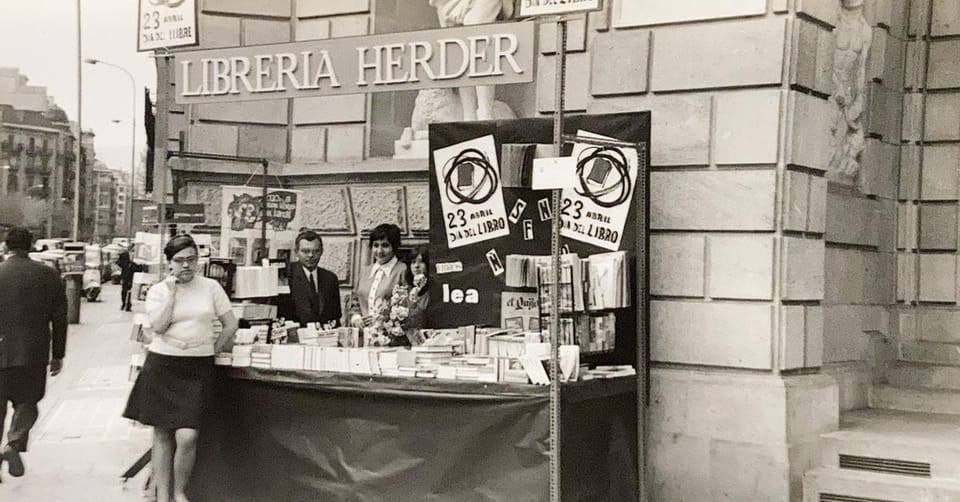
Barcelona's Alibri bookshop, formerly Herder, marks nearly a century of continuous operation on Carrer Balmes. The historic establishment, founded in November 1925, has navigated dictatorships, civil war, and economic crises. It always found a way to endure, even through recent financial struggles.
A Century of German Roots
Anton Schaedel, a German bookseller trained at the Herder Institute in Freiburg, opened the Herder bookshop at Carrer Balmes 22. Hermann Herder initiated this project. He aimed to establish two bookshops in Southern Europe, one in Barcelona and another in Rome. Initially located on the first floor, the shop focused on importing and selling books in Castilian and Latin from Herder Editorial. Residents still call it the "German bookshop." This is due to its origins and extensive German-language collection.
Martí Romaní, a former commercial agent and book distributor, recalled the disciplined environment there. He stated that the bookshop gained a reputation for meticulous organisation and strict management. "Just as the clock struck 11:00, Mr Nahm, the bookshop manager, would shoot out of his office and throw us all out, even if we hadn't finished our work," Romaní explained. He added that he was exempt from this rule. Romaní managed the special Penguin Bookshop, an English-language section within Herder.
Navigating Dictatorship and War
The bookshop opened during Primo de Rivera's dictatorship. It faced immediate challenges to freedom. The bookshop also grew during the adverse international economic climate of the 1929 crisis. In 1929, workers buried the Sarrià railway. It had run openly along Carrer Balmes. This street was known as the "street of death" due to frequent accidents.
Barcelona experienced a cultural boom in the 1930s. Herder became a hub for university and scientific publications. It even sold tickets for cultural events, including boxing matches. In 1931, the Second Republic arrived. That year, 23 April became Book Day. Writer Vicent Clavel created this event in 1926. However, street tensions escalated. This led to violence. Assassins killed Francesc Layret, a lawyer and politician, outside the bookshop's current location.
The Spanish Civil War brought significant upheaval to the bookshop. The FAI (Federación Anarquista Ibérica) collectivised the bookshop. They renamed it "La Internacional." Herder booksellers hid valuable books in a city flat. However, authorities later discovered and destroyed them. On 17 March 1938, a bomb exploded near the bookshop, at the intersection of Gran Via de les Corts Catalanes and Carrer Balmes. The blast killed 23 soldiers and many pedestrians. It also destroyed the bookshop's display windows. Herder of Freiburg decided to close the Barcelona branch due to debts. They tasked Leo Fetscher with liquidating the business.
Post-War Revival and Modernisation
Despite these setbacks, the bookshop was reborn. In 1940, Antonio Valt and Leo Fetscher bought and reopened the bookshop. Its owners then re-purchased it at auction in 1949. The bookshop established a strong link with the University of Barcelona. It received the title of "university bookshop" in 1941. However, this period also saw a German book exhibition at the University of Barcelona's Paranymph. It featured omnipresent Nazi symbolism.
In the 1970s, the bookshop underwent a major reorganisation. It moved from a "pharmacy-style" counter service to an open "supermarket-style" layout. Architect Josep Ribas González directed this renovation. He was known for the Torre Colom in El Raval. The bookshop successfully navigated the COVID-19 pandemic in 2020. However, in 2022, financial difficulties threatened its closure. This happened just before its centenary.
A New Chapter for a Cultural Landmark
At the end of 2022, the book subscription company Bookish acquired the bookshop. This ensured its continuity. Bookish had planned to open a large bookshop in Barcelona. However, they chose to preserve Alibri when they learned of its impending closure. Bookish has since revitalised the bookshop. It strengthened its cultural programme and attracted new audiences.
Early sales heavily featured Catholic publications. However, the bookshop later embraced ecumenism and diverse religious trends. It also became a key source for modern thought. It sold Erich Fromm's "The Art of Loving" during the psychoanalysis boom. Sebastià Serrano, emeritus professor of linguistics at the University of Barcelona, noted its importance. "I started teaching at the University of Barcelona in 1968, a time of political, social, sexual revolution," Serrano explained. "Students of the famous May '68 in Paris read three authors: Marx, Freud, and Saussure. We found all of them at Herder." Alibri also remains a primary sales point for Barcelona-based Herder Editorial.
Come and join our Barcelona English Speakers community on WhatsApp.
Originally published by Ara Cat. Read original article.