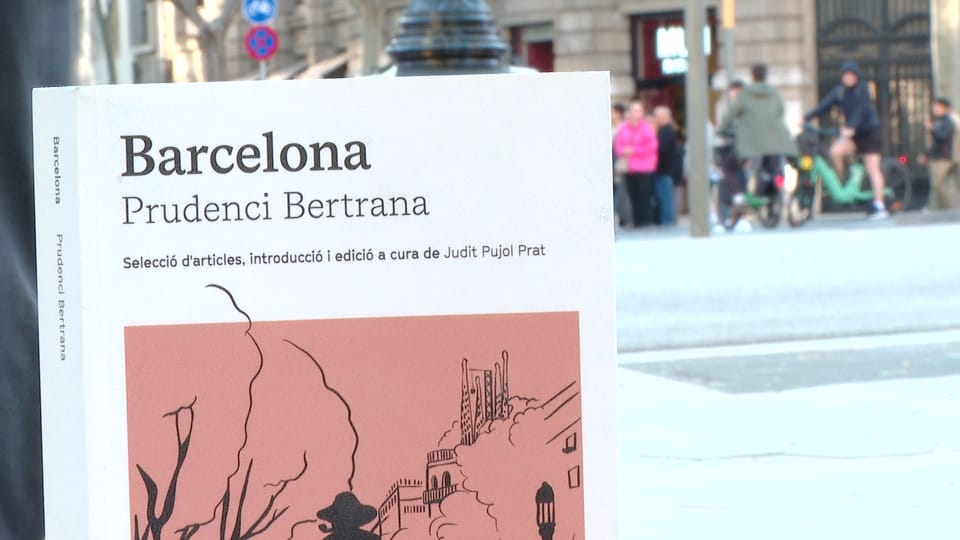
A new collection of newspaper articles by Catalan writer Prudenci Bertrana reveals his critical perspective on Barcelona life from the early 20th century. The book, titled "Barcelona" and edited by Cap de Brot, compiles pieces written between 1912 and 1936. This collection highlights Bertrana's lesser-known journalistic work.
Curator Judit Pujol Prat, a scholar of Bertrana's work, selected the articles. She explained the project's goal: "We wanted, in addition to highlighting Bertrana's figure, to make known his journalistic facet, which is quite unknown." Bertrana (1867-1941) lived in Barcelona for nearly 30 years. He wrote for major city newspapers, including L'Esquella de la Torratxa and La Campana de Gràcia, a publication based in the Gràcia district. This was despite many considering him a "provincial writer."
Bertrana's literary portrayals of Barcelona were not always positive. They often contained acid humour and showed the disillusionment of a biting rural philosopher. Pujol noted his feeling of being "a hunted hunter" in the city, missing the nature he had in Girona, according to Catalan Modernisme and Noucentisme literature. Articles like "La pols" (The Dust) demonstrate his difficulty adapting to urban life.
Bertrana's Urban Discontent
Prudenci Bertrana frequently criticised Barcelona, stating officials designed it for foreigners. He also expressed concern about the poor living conditions of those who "really built the city." Judit Pujol observed that this sentiment "could resonate with many today." Bertrana's work faced opposition from many intellectuals of his time. The conflict, according to Pujol's prologue in "Barcelona", was not simply between country and city. Instead, it represented a clash between an "industrial and capitalist mentality versus pre-industrial and artisanal mentality."
A Prolific Catalan Figure
Bertrana was a painter, writer, and journalist. His first novel, "Violeta", appeared in 1899. This was followed by the popular "Josafat" in 1906 and "Proses bàrbares" in 1911. He also wrote "Jo, memòries d’un metge filòsof" and the trilogy "Entre la terra i els núvols" (1931-1933-1948). In 1935, he co-authored "L'illa perduda" with his daughter, Aurora Bertrana. Although he received recognition, such as the Premi Creixells, he felt marginalised by the Noucentisme movement. He did not recognise that modernists had lost their position, Pujol stated.
This new collection offers residents and visitors a unique historical lens on Barcelona's urban development and social dynamics. It provides insight into how residents perceived the city's growth and its impact on local life over a century ago.
Sign up for our new entrepreneurs community Bizcelona, now accepting our second wave of applicants.
Originally published by betevé. Read original article.