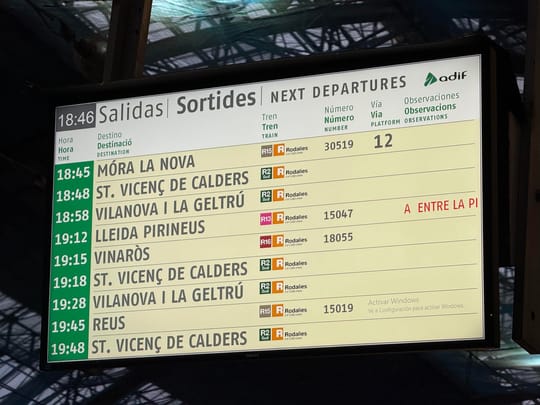
Adif, the public company that manages Spain's railway infrastructure, has mobilised 29 work crews, comprising 110 operators and 71 units of machinery and vehicles, to normalise Rodalies service after torrential rains. The deployment aims to address the impact of the severe weather on the railway network.
This mobilisation comes as Rodalies faces an autumn of intense rainfall. Despite forecasts, neither Renfe nor Adif plan to activate extraordinary measures beyond their established protocols, which they deem sufficient. However, train drivers' unions note that a new specific protocol for adverse weather, agreed upon after the Gelida accident in January, has not yet been drafted or discussed in any subsequent meeting.
Following the Gelida accident, which occurred in January, the SEMAF train drivers' union called for a general strike in February to demand safety changes. The strike was later cancelled after agreements were reached with the Ministry of Transport, Adif, Renfe, and the State Railway Safety Agency. These agreements included a commitment to joint inspections of any rail network section by infrastructure technicians and train drivers before resuming services after an incident. These inspections are intended to identify risks and determine necessary immediate actions.
Adif reports that it has nearly restored 95% of the infrastructure. However, the SEMAF union has raised concerns about safety and alleged non-compliance with agreed-upon revisions, complicating the full restoration of services. The union previously pressured for the suspension of Rodalies services on Saturday when the severe weather was forecast, leaving thousands of passengers unable to return home.
The Generalitat of Catalonia's Ministry of Territory, Housing, and Ecological Transition's February 2026 Rodalies bulletin outlined an updated Rodalies Plan for 2020-2030, which includes an investment of 8.037 million euros, an increase of 1.691 million euros (26%). The plan aims for greater infrastructure reliability, improved service quality, and increased system capacity. The Ministry of Transport and Sustainable Mobility has also created a Preventive Maintenance Division with specialised technical staff dedicated to lines R1, R2, R4, and the Barcelona tunnels.
Primary sources: territori.gencat.cat. Reported by europapress.es, Europa Press, elperiodico.com, elpais.com, Metrópoli Abierta - Urban Life, Conselleria de Territori, adif.es, elperiodico.cat, Europa Press Barcelona.