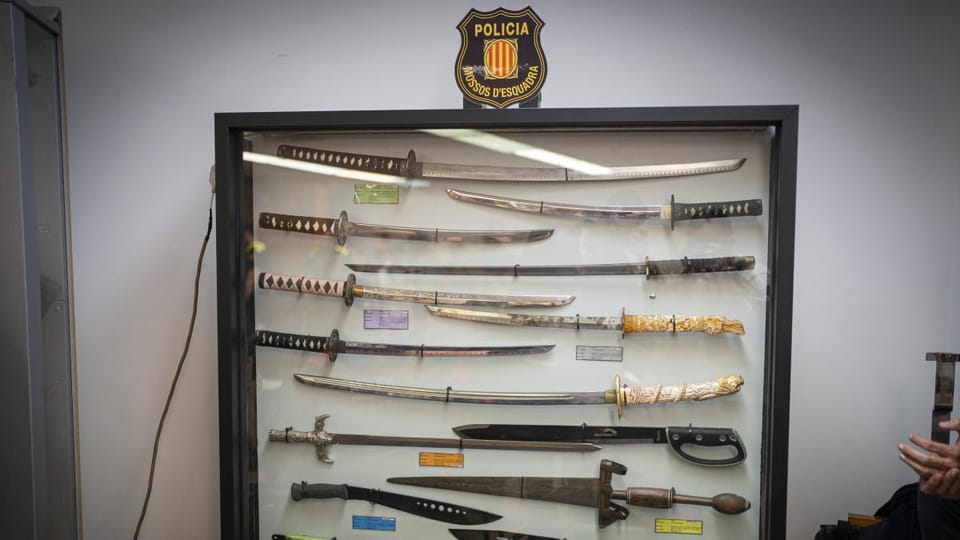
The Mossos d'Esquadra yesterday defended their anti-knife crime strategy, reporting a significant reduction in reoffending rates for individuals caught carrying bladed weapons across Catalonia. Intendent Toni Rodríguez, a leader within the Catalan police force, presented figures to La Vanguardia showing the impact of Plan Daga, an initiative focused on removing knives from circulation. This defence followed a weekend marked by two fatal stabbings and other knife-related injuries, prompting public debate on security in the region.
Intendent Rodríguez stated that the reoffending rate for individuals caught with a bladed weapon has decreased by almost 10 percentage points. This figure stood at 35% approximately 18 months ago. Rodríguez explained, "Because we are constantly on top of them, they know we will not stop until it stops being worrying. For all that, some no longer carry the knife."
Intensified Police Operations
Plan Daga began in 2023, with the Guardia Urbana de Barcelona initially using metal detectors for searches in known problematic squares. Consellera d'Interior Núria Parlon announced the intensification of this plan about 18 months ago. The strategy adapts to specific urban contexts in Barcelona, targeting areas frequented by violent youth gangs, including those of Latin origin.
These focused operations result in police seizing approximately 700 bladed weapons each month, according to Intendent Rodríguez. This consistent effort provides the police with a clear understanding of street-level dynamics. The Mossos d'Esquadra recorded 285 knife incidents this March, a decrease from 346 incidents in March of the previous year.
Broader Context and Challenges
Despite these reductions, knife incidents remain a significant concern for the police. Intendent Rodríguez noted that this phenomenon mirrors trends seen in other European nations. "It is a phenomenon very similar to what happens in France, Germany and the United Kingdom, or Madrid, without going so far," he observed. January 2025 recorded 441 incidents involving knives or machetes, a period when Plan Daga intensified with the support of municipal police forces and the Guardia Urbana.
The issue of violent youth gangs extends beyond Barcelona and its metropolitan area. Madrid has faced similar challenges for some time. Additionally, yesterday, the Guardia Civil announced the dismantling of a Latin Kings branch in Galapagar, a municipality in Madrid. This group was involved in intimidating, threatening, and coercing minors, among other crimes. A judge yesterday ordered the imprisonment of a suspect accused of a random murder in Esplugues, a municipality near Barcelona.
Future Strategy and Community Involvement
Intendent Rodríguez acknowledged that the problem is not fully resolved. He stressed the need for continued persistence and pressure. "We have not solved the problem, but we are facing slow social dynamics of change that require us to continue persisting and pressing," he stated. However, he also warned that police action alone is insufficient.
Rodríguez emphasised the importance of broader societal interventions. He called for "educational and pedagogical measures at the grassroots" to complement law enforcement efforts. This transversal approach is critical for addressing the emerging phenomenon of violent youth gangs and fostering long-term public safety across Catalonia.
Sign up for our new entrepreneurs community Bizcelona, now accepting our second wave of applicants.
Originally published by La Vanguardia Catalonia. Read original article.