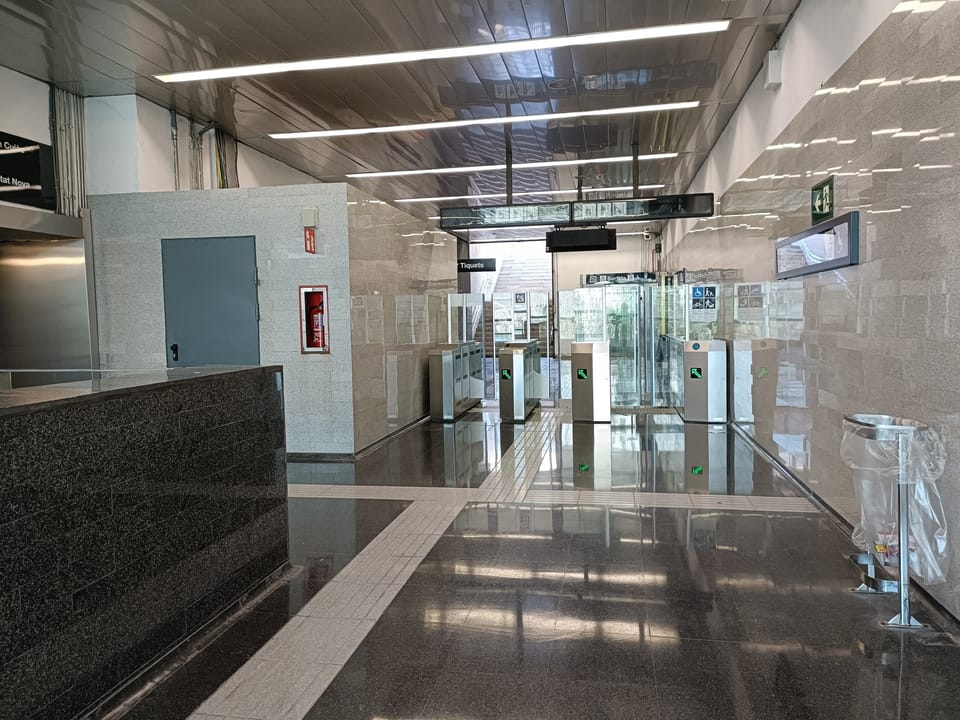
Barcelona’s public transport users will soon be able to pay for single journeys directly with contactless bank cards across the metro, train, and bus network, with the Metropolitan Transport Authority (ATM) launching a tender to implement the system by 2027. The move will allow passengers to tap in and out using their credit or debit cards or mobile devices at existing T-Mobilitat readers, eliminating the need for cash or pre-purchased tickets.
The ATM has initiated the procurement process for banking services to integrate direct card payments into the current T-Mobilitat validation infrastructure. According to the tender, the successful provider must complete integration within three months of contract award, expected by the end of 2026, paving the way for system-wide rollout in 2027. The project, valued at approximately €3.46 million, will require the contractor to ensure transaction authorisation occurs in under 500 milliseconds to prevent boarding delays.
How the System Will Work
Under the new system, users will tap their contactless card or mobile device upon boarding and again when alighting from metro, train, or bus services. The fare will be calculated based on zones travelled through, with initial implementation focused on Zone 1 before expanding across the network’s seven fare zones. Unlike current systems, which require fixed-price tickets, this approach allows dynamic pricing based on journey length.
Currently, Transports Metropolitans de Barcelona (TMB) buses accept contactless card payments for single tickets via dedicated EMV readers next to drivers, a system introduced in January 2022. Once the new ATM-wide system is live, these standalone readers will be removed, and payments will instead be processed through the upgraded T-Mobilitat validators already in place at station turnstiles and vehicle entrances.
Operator Approval Still Required
Although the ATM is leading the rollout, full implementation depends on approval from individual transport operators, including Renfe, FGC, TMB, and TRAM, as well as nearly 70 urban and interurban bus companies such as Avanza, Hife, Moventis, and Julià. The ATM has been in discussions with all operators, but final adoption rests with each company.
The ATM speaks of a 'long process' and that, although this contracting is 'necessary' for the new system to arrive, 'it is not sufficient.'
The ATM manages integrated tickets like the T-Usual and T-Jove, but single-journey tickets fall under operator control. This creates a paradox in the tender: while the ATM is procuring the financial infrastructure, operators must agree to accept direct card payments for their individual fares.
Benefits for Tourists and Occasional Users
The change is expected to benefit tourists and infrequent users who currently face barriers to entry, such as needing to purchase reloadable T-Mobilitat cards or use ticket machines. It will also help regular users who occasionally travel outside their usual fare zones, enabling seamless cross-zone trips without buying additional tickets.
According to ATM documents, the system is designed to eventually support storing multi-journey tickets on bank cards, though this functionality will come after the initial launch. The contractor will also be responsible for verifying sufficient funds before journey validation and absorbing the cost of initial unpaid trips when cards are declined post-travel.
Learning from Past Delays
Plans for open-loop payment in Catalonia have faced delays. Renfe’s CRONOS programme, announced in 2020, aimed to introduce contactless payments on Rodalies trains but was paused pending integration with T-Mobilitat. Unlike earlier proposals that required separate hardware, the current project upgrades existing T-Mobilitat readers by integrating secure-access modules (SAMs), allowing them to process bank card transactions without installing new turnstiles.
Officials aim to move beyond the current zone-based pricing in the future, potentially shifting to distance-based fares to make short trips more fairly priced. The T-Mobilitat system, led by the Department of Territory of the Generalitat and promoted by the ATM, AMB, TMB, and FGC, is already available across six zones in the Barcelona area and supports tickets such as the T-casual, T-usual, and T-jove.
Primary sources: noticies.tmb.cat, tmb.cat, miriam. Reported by elperiodico.com, Descarga nuestra APP, Dan Balaban, atm.cat, Trainee Reporter, El Periódico Barcelona.