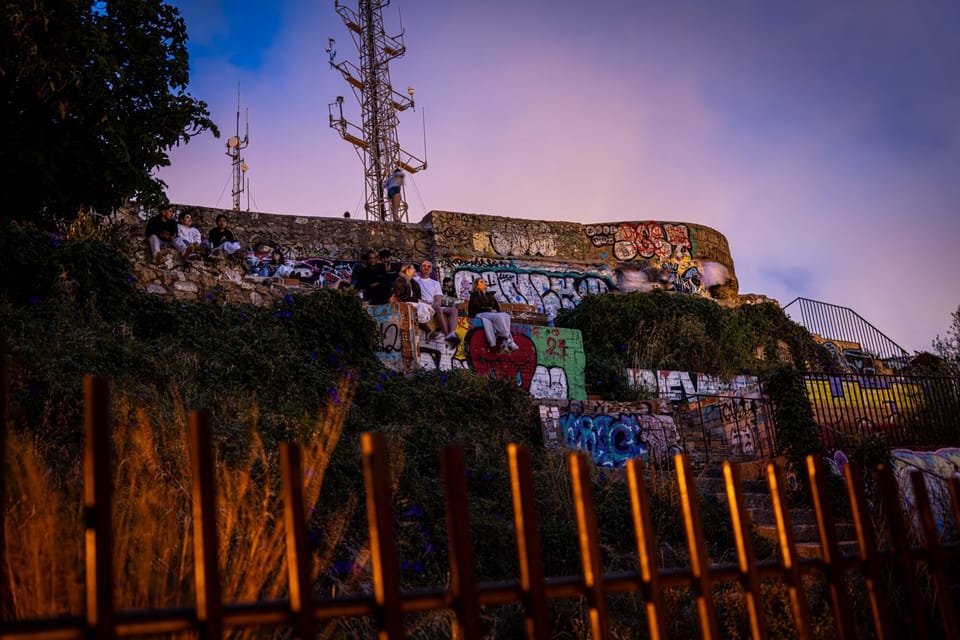
Every evening, shortly after 19:30, dozens of people scale the fence at Barcelona's Turó de la Rovira. This popular viewpoint is known as the Bunkers del Carmel. Residents in the Horta-Guinardó district are demanding urgent action. They want to stop these daily intrusions and illegal outdoor drinking sessions.
David Mar, a member of the Turó de la Rovira Neighbourhood Council, stated, "The area should be 'de-botellón-ised' and their alcohol confiscated." He added, "But there is no way." The council will reiterate its demands on Monday. They meet with officials from the Horta-Guinardó district. They want the municipal police to confiscate drinks and increase fines for fence-jumpers. Additionally, the council advocates for reforesting the hill. This would make it harder for people to settle on the slopes to drink.
The city council maintains a dedicated operation with municipal police, civic agents, and traffic controllers since 2023. This aims to manage the massive arrival of tourists at the former anti-aircraft batteries. However, the council admits "there are still groups of tourists who violate closing times." They also consume alcohol in public. This problem worsens with the arrival of spring and during the summer months.
Escalating Incidents and Resident Distress
Two recent altercations have intensified these community demands. A few weeks ago, young people broke into Alexander's home staircase. His house sits next to the bunkers' fence. They destroyed plants on his steps and then confronted him when he asked them to leave. Alexander and his partner had to take refuge inside their home to avoid assault. He stated, "They have entered other times to throw pots, at night and in the early hours." He added, "But they had never been so cocky."
Alexander explained that police did not allow him to install barbed wire to reinforce his wall. He has since planted cacti near the barrier and put up signs warning of dogs. However, these measures barely deter intruders. He added, "Many go up with their beer or wine. They then come down tipsy, with noise and small joints. They pass by our house with their things and their laughter; it is annoying."
Last Sunday, a drunk driver ran over an employee. This employee controls vehicle access to the Turó de la Rovira summit. His colleagues reported that the driver then got out of the car and assaulted the victim. The employee remained in hospital for a day and a half. A security guard commented, "Every month we have an incident." He added, "They have thrown stones at us, pulled knives on us. We endure insults from foreign tourists."
Fence Fails to Deter Intruders
Another guard testified that a driver once crashed him into a fence. He explained, "They want to go up no matter what; it is constant." Queues form, and they start honking, whether it is at 05:00 or 21:00. Joan, who has lived opposite the fence for 78 years, declared himself fed up with tourists. He protested, "Every day they bother us. Every day they sneak in. Every day they wait for the municipal police to leave to jump the fence."
Three years ago, some young men severely beat Joan. He had photographed them scaling the fence, which he constantly reminds people cost €1.6 million. He disapproves, stating, "It has solved almost nothing." Joan has also encountered people urinating on his door. Others were perched on his home's wall, gazing at the horizon.
He recounted, "They ask for pizzas and give my house number so the delivery drivers come." They ring my doorbell even though I haven't ordered anything. Then they come out through the bunkers and say it was them. Joan added, "I had to replace the door; it was rusted from the urination." They ring the bell. When I go out, I already see them in the distance. I tell them everything. Once they painted a penis on my car with a permanent marker. It was hard to remove.
Historical Site, Modern Challenges
Joan also mentioned bizarre requests. "They have even called me to ask for a corkscrew or to sell them water to make mate. I send them away." Joan and other neighbours openly criticise the police. Officers advise visitors to use the path around the fence when the main access is sealed. David Mar observed that the barrier has shifted part of the problem. It now brings it closer to homes adjacent to the fence. This includes properties on Mühlberg Street, opposite the hillside.
María's home also borders the bunkers. Years ago, her car, parked near her door, suffered an attempted arson attack, which neighbours extinguished. Recently, unknown individuals have again infiltrated the walls surrounding her house. They ring her doorbell in the early hours. Her son has advised her always to lock the bolt.
María, who has lived at the top of El Carmel for 70 years, lamented the change. She recalled coming from Calasparra with her family when it was the Cannons neighbourhood. "My father bought a rock, and we were in a shack," she said. "There were seven of us in one room." "There were many shacks, and it was said to have a bad reputation," she continued. "But we will never be better than before. We were all equals, and everyone respected each other." "Perhaps then there was a drunkard," she mused. "But now, even by closing, they do not leave us alone."
The ongoing issues at Turó de la Rovira highlight complex challenges. They show the difficulty of managing popular tourist sites within residential areas. Residents hope their renewed calls will bring peace to their neighbourhood. They want stricter enforcement and more effective deterrents.
Come and join our Barcelona English Speakers community on WhatsApp.
Originally published by El Periódico Barcelona. Read original article.