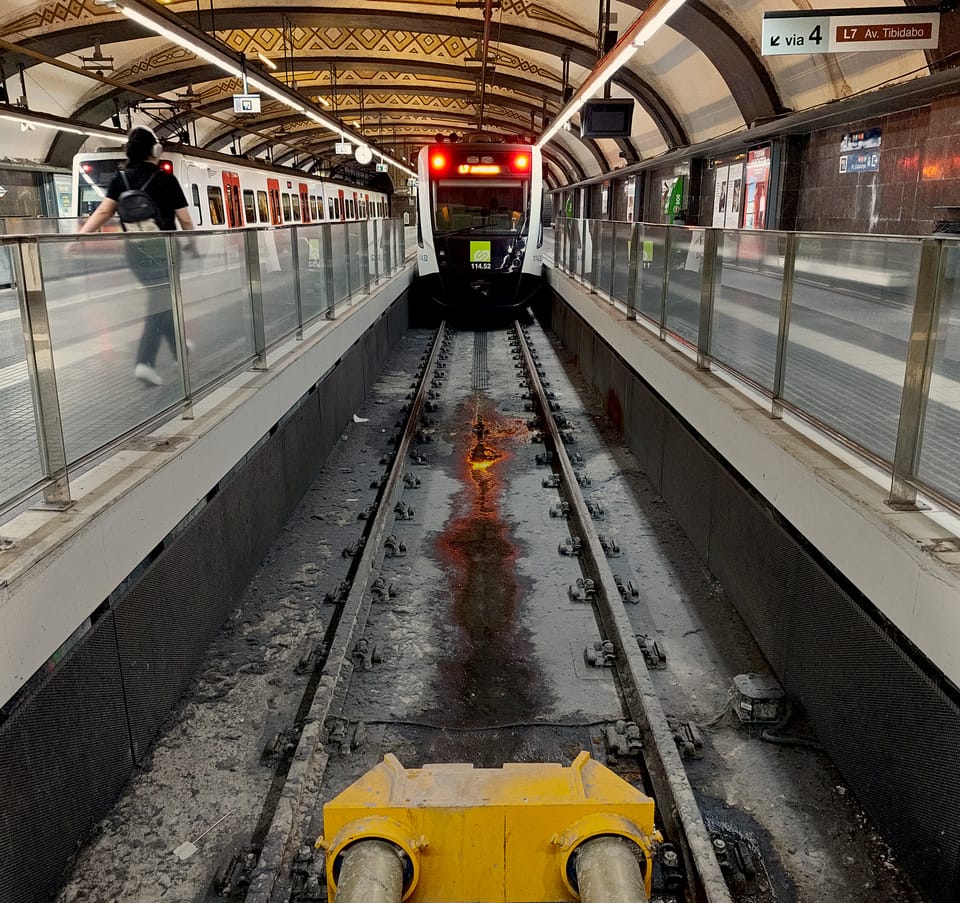
Shops along key stretches of Barcelona’s Travessera de Gràcia, Muntaner, and Comte d’Urgell streets are warning of permanent closures as construction for the FGC L8 line enters a new phase. Long-term works to connect the Vallès and Baix Llobregat-Anoia rail lines have left businesses struggling with dwindling footfall, obstructed access, and rising operational strain.
A jewellery shop at the corner of Travessera de Gràcia and Sant Gabriel closed on 31 July after more than a year of disrupted trade. In a farewell letter, owners cited the L8 works as making their premises “practically inaccessible” and forcing a relocation to Sant Gervasi. Three weeks later, a red “For Rent” sign marks the empty unit. A few metres away, underwear shop Curvaciones has not ruled out a similar move. Owner Isabel said trade has already declined, and she expects the next phase to be worse: “If it continues like this, we’ll have to leave.”
On Muntaner street, Casas shoe shop has operated for years but now faces a construction fence just over a metre from its entrance. Worker Laia Bueno said the barrier has intensified noise and heat inside the shop and deterred customers, especially those who used to arrive by car. “Many people avoid this street if they can,” she said. Another shoe shop, Gola, has already shut down, with a sign reading: “Liquidation due to works.”
The Department of Territory, Housing and Ecological Transition began new surface-level works at Plaça Espanya and Gràcia in January, including perimeter screen installations and preparatory work for a future emergency exit on Muntaner street. These activities require ongoing traffic and pedestrian disruptions, with lane reductions on the Plaça Espanya roundabout and relocations of bus stops on Gran Via de les Corts Catalanes, according to a January 2026 government notice.
Further down the L8 route, on Comte d’Urgell, businesses have endured construction fencing for over 20 months. The Urgell 1929 bar, approaching its centenary in three years, has managed to restore one terrace table after prolonged restrictions. Co-owner Rosa Parramon acknowledged improved communication with the city through a new mediation role for affected traders, but said the challenges remain substantial.
Similar pressures have hit Poble-sec, where Vila i Vilà street businesses have coped with two and a half years of works on a new stormwater collector. Some shops have closed, while others have cut staff. Traders in the area continue to demand compensation for lost income.
Council Approves Aid Plan
The lack of financial support is a common grievance. Many shopkeepers say the city has done little beyond installing signage to identify businesses hidden behind construction fences. In a recent plenary session, Barcelona City Council unanimously approved a proposal by Junts per Barcelona calling for aid to businesses affected by long-term infrastructure projects.
The plan includes direct financial compensation, municipal discount vouchers for residents to spend at impacted shops, and negotiations with suppliers to allow payment delays for temporarily closed establishments, similar to support offered after the L9 sinkhole incident in Sant Gervasi.
The works cause inconvenience, but the discomfort is temporary and the benefits are lasting.
Deputy Mayor for Economic Promotion Raquel Gil acknowledged the hardship during the debate but stressed the long-term gains. She added that the council has been advancing measures to promote visibility and support for affected businesses.
The L8 extension, part of a €412 million project, will create a 4-kilometre underground link between Plaça Espanya and Gràcia, with three new stations, Hospital Clínic, Francesc Macià, and Gràcia, and upgrades to existing interchanges. A €300 million loan from the European Investment Bank supports the initiative, according to an official announcement.
Primary sources: govern.cat, eb.gencat.cat. Reported by ara.cat, Gerard Pruna, Joan Manel Oller, barna.news, beteve.cat, eib.org, larazon.es, Ara Cat.