Renovate, expand, avoid displacement
The Government of Catalonia is advocating for the transformation of existing buildings into new homes as a key strategy to tackle housing shortages and climate challenges. This approach was the focus of a conference held on Wednesday 4th November 2026 at the Catalan delegation to the European Union in Brussels, organised by the Department of Territory, Housing, and Ecological Transition and the Department of European Union and External Action. Architects and EU officials examined methods including property rehabilitation, change of use, building extensions, and construction material recovery. The goal is to identify the technical, economic, social, and regulatory conditions needed to scale such interventions across more neighbourhoods. One highlighted project was the renovation of the Bois-le-Prêtre tower in Paris and the Grand Parc complex in Bordeaux, where architect Frédéric Druot explained that residents were not displaced during works that cut energy consumption by 60%. This contrasts with the renovation of the Brunfaut tower in Molenbeek-Saint-Jean, presented by Jaime Eizaguirre of Atelier 229, where severe deterioration required temporary resident relocation. The project preserved the original structure, added new floors, and created shared community spaces.
Improving living conditions and community life
The conference also focused on enhancing indoor living conditions through features like balconies, winter gardens, and structural extensions to increase usable space and improve connections to the outdoors. Shared spaces and alternative housing models were discussed, including cooperative housing promoted by Xavier Bustos Serrat of the Cities Connection Project. Josep Casas i Miralles, Deputy Director General of Architecture and Housing at the Generalitat, stressed the importance of regenerating vulnerable neighbourhoods through integrated social, educational, and environmental measures alongside physical upgrades. MEP Marcos Ros emphasised resident protection during urban renewal, while Elena Montani of the New European Bauhaus Unit called for sustainability, inclusion, and community participation in all interventions.
Financing and scaling the model
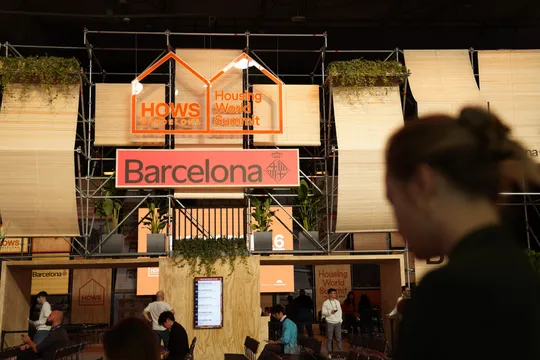
A major challenge identified was the reuse of construction materials. José Toral, co-curator of the event, advocated for certification systems, storage facilities, and infrastructure to support material recovery and reuse. Tatiana Márquez Uriarte from the European Commission’s Housing Task Force outlined ongoing efforts to simplify administrative procedures to accelerate housing projects. The Brussels event forms part of the Contemporary Catalan Architecture Conference series on Social Housing, linked to Barcelona’s designation as 2026 World Capital of Architecture. A follow-up meeting is planned in the first quarter of 2027 to present conclusions and continue dialogue between institutions and professionals. The series aims to explore how existing building stock can be leveraged to increase housing supply, cut construction emissions, and preserve community cohesion.
Sources: CatalunyaPress, Govern de Catalunya, Ajuntament de Barcelona, catalunyapress.cat, El Nacional.