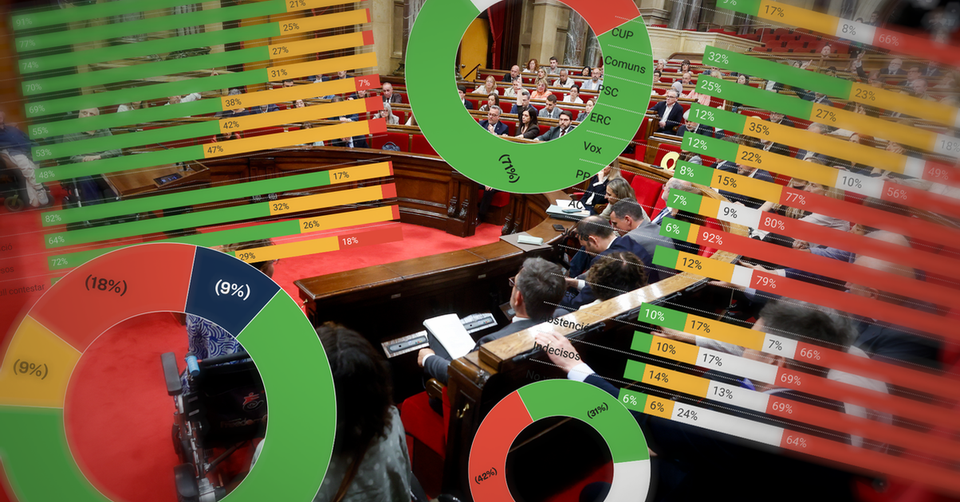
A new YouGov poll for Ara newspaper reveals a significant shift in Catalonia's political landscape. The far-right Aliança Catalana party surged past Junts per Catalunya in this projection. This indicates a potential shake-up in the Catalan Parliament, even as left-wing parties appear set to retain their majority.
The survey, conducted by YouGov for Ara, places the Socialist Party of Catalonia (PSC) firmly in the lead. It secures between 36 and 42 seats. Esquerra Republicana de Catalunya (ERC) would become the second-largest party, projected to win 27 to 30 seats. Junts previously held the second position, but this marks a notable decline for the party.
Aliança Catalana, an independentist far-right party, is predicted to multiply its current representation tenfold. It would achieve 20 to 22 seats. Meanwhile, Junts per Catalunya faces a substantial setback, dropping from 35 seats to a range of 11 to 14. This would relegate Junts to fifth place in the Catalan Parliament.
Far-Right Gains and Junts' Decline
The poll highlights a significant voter migration. Approximately 23% of those who backed Junts in 2024 now favour Aliança Catalana. This shift could make Aliança Catalana the leading force in Lleida, closely competing with the PSC. The party also projects to be third in both Girona and Tarragona. In Barcelona, Aliança Catalana would contend for a podium finish with Vox, another far-right party. Vox, led by Ignacio Garriga, also strengthens its position, expected to secure 14 to 17 seats across Catalonia.
Junts faces challenges from both the right and the left. The poll indicates that 12% of its 2024 voters would now support ERC. Junts shows the lowest voter retention among major parties, keeping only 36% of its previous electorate. This internal struggle comes as the party awaits the potential return of its leader, Carles Puigdemont, from exile. This is not expected before summer.
Shifting Political Dynamics
The current Catalan government, led by President Salvador Illa of the PSC, operates in a minority. The Ara poll by YouGov reflects some electoral wear for the PSC. However, the Socialists would still consolidate their first-place position if an early election were held today. Budget negotiations with ERC remain open, adding an element of unpredictability to the political calendar.
The survey also shows a low approval rating for the current executive, which scores 4.1 out of 10. Approximately 37% of respondents rate the government's management as poor or deficient. Only 22% consider its performance good or excellent. These figures show public dissatisfaction with Catalonia's current political climate.
Left-Wing Majority Holds
Despite the rise of far-right parties, the left-wing bloc appears poised to maintain its majority. The combined forces of the PSC, ERC, and Comuns could secure between 67 and 79 seats. This comfortably exceeds the 68 seats required for an absolute majority in the Catalan Parliament. This potential outcome mirrors the current legislative majority of 68 seats.
ERC, in particular, shows significant growth, projected to gain 7 to 10 seats from its current 20. This recovery would restore much of the party's strength lost in 2024. Gabriel Rufián, an ERC politician from Santa Coloma de Gramenet, emerged as the best-rated leader in the poll. He also received the most 'likes' to become President of the Generalitat. Rufián's style and proposals resonated with the Catalan electorate. This made him more popular than Oriol Junqueras among ERC voters.
Independentist Bloc Weakens
The independentist parties, ERC, Junts, and the Popular Unity Candidacy (CUP), would see a significant reduction in their combined strength. Their projected total would fall to about 45 seats. This marks a sharp decline from the 74 seats they collectively held in 2021. Even with Aliança Catalana, an independentist party, the bloc would likely not achieve a majority. ERC, Junts, and the CUP have established a “sanitary cordon” against Aliança Catalana in the Parliament.
The poll suggests opposition to immigration unites voters more than the call for Catalan independence. Among voters of the four independentist parties, Aliança Catalana supporters identify least as Catalan. Only 51% identify as “only Catalan” or “more Catalan than Spanish.” This compares to 56% for ERC, 67% for the CUP, and 80% for Junts. This finding highlights a complex dynamic within the independentist movement.
Future Political Landscape
The PSC positions itself as a bulwark against the far-right. This mirrors Pedro Sánchez's approach in Spain. Initially focusing on Vox, the Socialists now increasingly confront Sílvia Orriols' Aliança Catalana. They believe the threat of Aliança Catalana's growth could make the PSC the 'useful vote' for many.
The current minority government will likely continue without a coalition agreement during this legislature. The ongoing budget negotiations with ERC will be a key factor in the coming months. Junts' political future depends heavily on Carles Puigdemont's anticipated return. His subsequent role in the party will be critical.
Sign up for our new entrepreneurs community Bizcelona, now accepting our second wave of applicants.
Originally published by Ara Cat. Read original article.