Contract awarded after appeal and withdrawal
The construction company Calaf, owned by the Pujol family, will build the new outpatient building at Vall d’Hebron University Hospital in Barcelona in a temporary joint venture (UTE) with Serom, after being awarded the contract for 33.24 million euros. The project, which still requires formalisation on the public contracting platform and may be subject to appeal, follows the withdrawal of the original winning consortium. The initial award in late 2025 was granted to a UTE comprising Dragados, ACSA Obras e Infra, and Dominion I&I Applied Engineering. However, Calaf filed an appeal with the Catalan Court of Public Sector Contracts (Tribunal Català de Contractes del Sector Públic) in November 2025. The appeal was dismissed on 22 April 2026, but the resulting delay contributed to the original winners declaring the project economically unviable by July 2025. On 6 August 2025, Infraestructures.cat, the public contracting authority, confirmed there were no public interest grounds to cancel the contract, leading the Dragados-led consortium to formally withdraw. Under clause 13.1 of the contracting rules, the award was then transferred to the next-ranked bidder, Calaf and Serom.
Core of Vall d’Hebron transformation plan
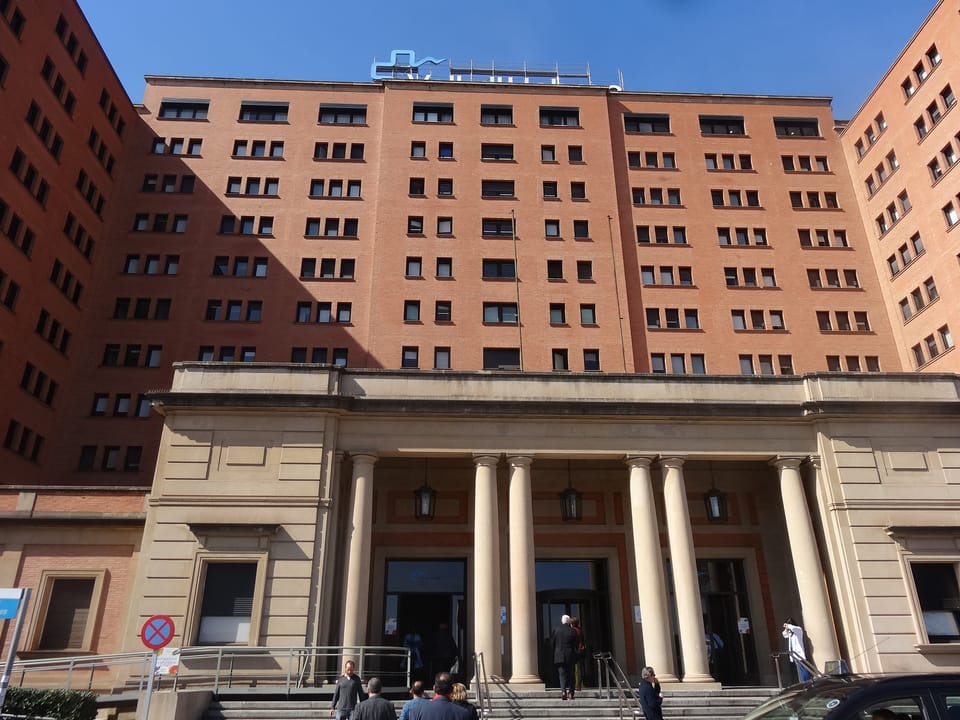
This 29-month construction project marks the first major hospital build to begin in Catalonia, preceding the planned new Clínic and Girona Hospital developments. It is the central piece of the Vall d’Hebron transformation plan announced in 2017, aimed at modernising facilities and reorganising services. The new outpatient building, designed by architects Diego Nakamatsu and Lluís Morán, will be constructed on the municipal slab covering the L3 metro depots in La Teixonera, across the Ronda de Dalt from the main hospital complex. Spanning ten floors and 36,640 square metres, it will house 250 consultation rooms, 100 examination rooms, 100 day hospital beds, outpatient pharmacy units, and administrative areas. It will centralise nearly all adult outpatient services currently dispersed across the campus, excluding only paediatric care. Vall d’Hebron handles around one million outpatient visits annually.
The transfer of all non-paediatric outpatient activity to the other side of the Ronda is key to creating a more patient-friendly hospital and a campus more open to the city.
The Vall d’Hebron Barcelona Hospital Campus spans approximately 220,000 square metres and hosts the hospital, Vall d’Hebron Research Institute (VHIR), Vall d’Hebron Institute of Oncology (VHIO), Cemcat, and the Universitat Autònoma de Barcelona (UAB), employing about 9,000 people. Calaf previously worked on the VHIR building between 2021 and 2024 as part of a UTE with Serom and Agefred. The broader Nou Vall d’Hebron plan requires at least 276 million euros in investment by 2028, though costs have risen and timelines have slipped. The new Clínic hospital, by comparison, is not expected to begin construction until 2030, with an opening projected for late 2035 or early 2036 and a budget of 1.7 billion euros.
Primary sources: eb.gencat.cat, Tribunal Català de Contractes del Sector Públic, cido.diba.cat. Reported by cronicaglobal.elespanol.com, hospital.vallhebron.com, vallhebron.com, Alimarket Sanidad y Dependencia, Crónica Global.