If you have been hunting for a separate rubbish bill in Barcelona, stop looking. There isn't one. The household waste fee, the taxa de recollida de residus municipals, arrives as an extra line on your Aigues de Barcelona water bill. It has been on the bill since 2020 and it stepped up sharply from 2025, it confuses almost everyone who spots it, and most of what gets passed around in flat-share chats about it is wrong. It is one of the small admin shocks that catch out anyone settling into life in Barcelona, so here is the version that is actually correct.
TL;DR: Barcelona has charged a dedicated household waste fee since 2020, and a rewritten version has been phasing in bigger amounts since 1 January 2025. It is billed on your water bill, calculated from your water use (not how many people live with you), and the person who pays is whoever holds the water contract.
Why this fee suddenly appeared
This is not the Ajuntament inventing a new way to take your money. It was forced from above.
Spanish national law, Ley 7/2022 of 8 April (the waste and contaminated-soils law for a circular economy), made every local authority in the country bring in a specific, cost-covering waste fee within three years, by 10 April 2025. That law transposes an EU rule, Directive 2018/851. The principle behind it is "pay for what you generate": the more waste you produce, the more you should pay.
So Barcelona rewrote its local tax rule, Fiscal Ordinance 3.18, and the new version came into force on 1 January 2025. The city had already charged a waste fee since 2020, when the first ordinance was approved; before that, waste collection was funded out of general municipal coffers. Now it has its own dedicated, ring-fenced charge that is legally required to cover the cost of the service.
That is the whole reason it exists. Brussels asked, Madrid legislated, the Ajuntament implemented.
Who actually pays it
The taxpayer, in the language of the ordinance the subjecte passiu, is the person whose name is on the water-supply contract. Not the landlord by default. Not the property owner as a separate party. Whoever the water account is registered to.
That single fact clears up a lot of the panic. If your name is on the Aigues de Barcelona contract, you are the one the city bills.
Renting? This is where it gets sharp, and where the long-standing flat-share folklore is now flat wrong.
For years the community wisdom was that a clause forcing the tenant to pay IBI (the property tax) or the waste tax was "abusiva" and could be struck down in court. Plenty of people still run their lease through a chatbot to flag such clauses as illegal, then ask the landlord to strike them. That tactic is now built on outdated law.
The Spanish Supreme Court (Tribunal Supremo), in ruling STS 1637/2025 of 17 November 2025 (court reference ECLI:ES:TS:2025:5076), held that passing both the IBI and the waste fee to the tenant is perfectly valid as long as there is a clear, express written agreement. The Court went further: because these are individualised, per-property taxes (and so sit outside the general-costs rule in Article 20.1 of the tenancy act), the contract does not even need to state the annual amount. In that same case it upheld an eviction for non-payment of exactly these charges.
So if your Barcelona lease says you cover the waste fee and IBI, and you signed it, assume it sticks. The older "it's abusive, ignore it" advice can now get you evicted. It is one more clause to read carefully before signing, alongside the deposit, the Incasol rules and the rent cap covered in our renting guide.
One nuance worth holding onto: even when a contract pushes the cost onto you, it does not change who the law sees as the taxpayer. The owner stays the legally obligated party to the tax authority. They just recover the money from you through the contract. The framework here is the Ley de Arrendamientos Urbanos (Ley 29/1994), the urban-tenancy act, at Article 20.
How much it costs, and why it is not headcount
Here is the myth that needs killing. The amount is not set by how many people are empadronados (registered) at your address. You will hear this constantly, usually backed by a story about someone whose rubbish charge doubled when they moved flat and got told to update the padro and phone the water company to lower it. It is wrong as a description of how the fee is set.
The fee is calculated from your water consumption, used as a rough proxy for how much rubbish you produce. More water through the meter, more waste assumed, higher band. There are four domestic bands keyed to your monthly cubic metres of water:
- D11: up to 6 m3 a month
- D12: over 6 up to 12 m3
- D13: over 12 up to 18 m3
- D14: over 18 m3 a month
The headline annual figures set out in Article 9 of Ordinance 3.18 (published in the Butlleti Oficial de la Provincia de Barcelona on 23 December 2024) are €40.79 for D11, €75.80 for D12, €129.16 for D13 and €193.94 for D14. But, and this matters, those are the full quotas, and the ordinance's transitional provision says they only apply from 1 January 2028. Until then the increase is phased in year by year (extended from an initial three years at ERC's request, per the budget agreement behind the ordinance), so what lands on your 2026 bill is well short of the headline figure.
In practice it is the ordinance's transitional table, not the Article 9 headline, that sets what you pay. For 2026 the domestic bands are €35.53 for D11, €66.03 for D12, €112.52 for D13 and €168.95 for D14. They rise again to €38.16, €70.92, €120.84 and €181.44 in 2027, and the full quotas land in 2028. About 73% of Barcelona households sit in D11 or D12, on the household counts in the ordinance's economic report, so the realistic 2026 range is roughly €35 to €66 a year, about €3 to €5.50 a month. The €27 to €51 range still repeated in a lot of places is the pre-2025 level, close to what the fee launched at in 2020, not what you pay now.
So when someone in your building swears their rubbish charge "doubled" because of who is registered, they have almost certainly moved water bands or moved into a phased-in year. It is the consumption, not the census.
The second waste charge hiding on the same bill
Now the part nobody warns you about. There are two waste charges on your water bill, not one.
The city fee above covers collection. A separate charge, the Taxa Metropolitana de Tractament de Residus (TMTR), covers treatment and disposal across the 36-municipality metropolitan area run by the Area Metropolitana de Barcelona (AMB). It too is billed on your water bill, also via your consumption.
The TMTR went up about 10% on average for 2025, and a further 3% across the metropolitan area for 2026 under the fiscal ordinances the AMB approved in October 2025. For roughly 71% of domestic users the 2025 rise was small, at most around €6 (the range ran from about €2.72 to €6.02 a year), according to the figures the AMB published when it approved that rate, as reported by El Punt Avui on the day the increase was set. The AMB's justification, in that same report, is blunt: the charge was not covering the cost of the service, which it puts at around €200 million a year, leaving a deficit of roughly €15 million. What the TMTR is and how it is billed is set out on the AMB's own metropolitan-waste-treatment-fee page; the specific 2025 increase, the €200 million service cost and the €15 million deficit are the figures carried in that El Punt Avui report.
Two charges, one bill, both tied to your water meter. Worth knowing before you ring up to dispute a number. It also means the single best lever on your waste bill is using less water, which is the same lever that keeps the rest of your electricity, gas and water costs down.
The discounts almost nobody claims
There are real reductions available, and they do not come from phoning the water company to "add a person", which is the other piece of bad advice doing the rounds.
Keep two things separate here, because they attach to the two different charges. The first set are city collection-fee discounts, applied to the Ajuntament's taxa de residus under Ordinance 3.18. The second is a metropolitan TMTR discount, applied by the AMB to the treatment charge. They are claimed in different places and stack rather than overlap.
City collection-fee discounts (Ordinance 3.18)
The per-person discount is real but conditional. You get 5% off the waste fee for each additional registered resident, but only if you qualify for the ACA (Agencia Catalana de l'Aigua) water-tariff tier extension, the ampliacio de trams, which is for households of four or more people registered at the same address. This is where your padro (the municipal residency register) genuinely matters: getting everyone correctly empadronat is what unlocks the tier extension that in turn unlocks the discount. If you have not registered everyone on the padro yet, that is the first step, and it is a formal application to the Catalan water agency after that, not a quick call.
Other reductions on the city fee, set out in Ordinance 3.18:
- 5% per resident with a recognised disability of 75% or more.
- 50% off for taxpayers aged 60 or over on minimum Social Security pensions (retirement, permanent disability or widowhood), or for households where every member is unemployed.
- Up to 14% for using the green points (deixalleries).
Metropolitan TMTR discount (AMB)
That city green-point reduction stacks with a parallel green-point discount on the metropolitan TMTR: from your second visit each year, every green-point visit earns 1% off the following year's TMTR, capped at 14% (fifteen or more visits). So the deixalleria habit pays you back twice, once against the city fee and once against the metropolitan charge.
This is also the lever that moves the whole fee, not just your personal discount. Just down the river, El Prat de Llobregat is going the other way to Barcelona: it cut its 2026 waste fee by an average 15% because better town-wide recycling pulled the cost of the service down. Barcelona's fee is still climbing through its phase-in, but the same logic applies. The more a city actually separates its waste, the cheaper the collection bill it has to cover.
While you have the bins on your mind: bulky waste and recycling
Two practical things newcomers always ask.
Old furniture and junk: Barcelona runs a free door-side collection by street. You leave items out between 20:00 and 22:00 on your assigned day. Find your day through the Cuidem Barcelona waste locator, or call 010 (or 900 226 226). There is also a faster paid home collection, roughly within 36 hours, which is free for accredited residents with a disability or limited mobility. Leaving a mattress beside the container on a random Tuesday is not the system; the assigned-evening collection is, and the street-dumped IKEA flat-pack that locals grumble about is exactly what the assigned slot is meant to replace.
Anything that does not fit a street bin, electronics, appliances, glass, rubble, textiles, can go to a Green Point (Punt Verd / deixalleria), free for residents. Use the official Cercador de residus to find your nearest one and to check the rules for your exact address.
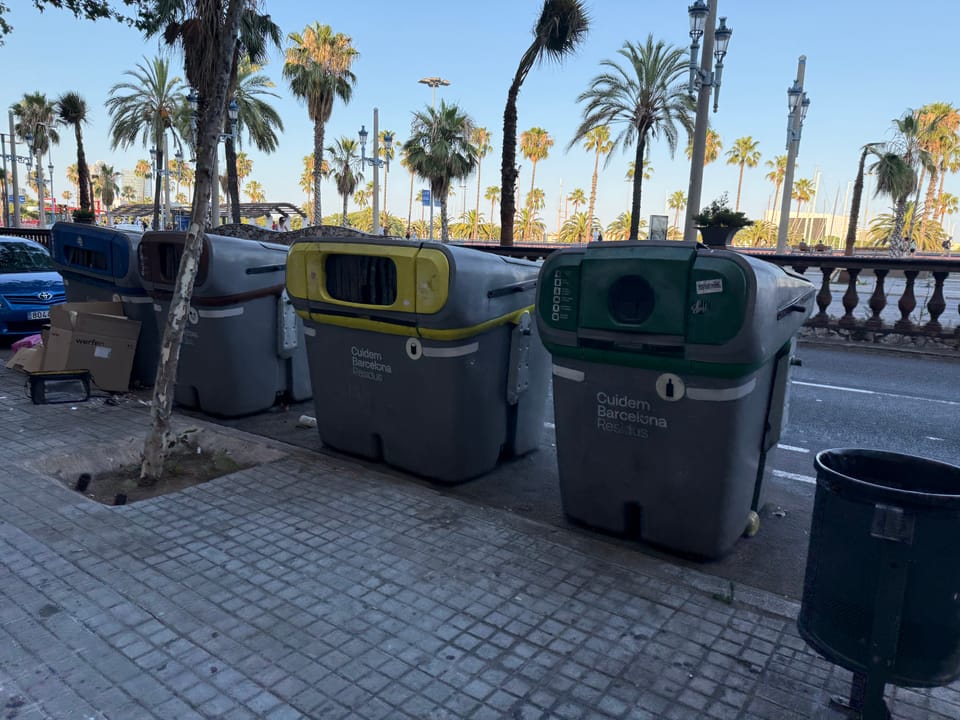
For day-to-day sorting, Barcelona runs five fractions: organic (brown), packaging and light plastic (yellow), paper and cardboard (blue), glass (green), and general rest (grey). The Cercador de residus has the address-specific detail.
Two things often muddled in chat are worth a quick correction. Spain does have a deposit-return scheme coming: a national system for drink containers up to three litres becomes mandatory from November 2026 (Real Decreto 1055/2022), with a minimum 10-cent deposit per bottle, can or carton. And the "5 cents on plastic" people half-remember is the plastic packaging tax, the impuesto especial sobre los envases de plastico no reutilizables created by the same waste law as the rest of this story, Ley 7/2022 of 8 April (Title VII), and in force since 1 January 2023. It is levied at EUR 0.45 per kilo of non-recycled plastic in the packaging, not a flat per-item charge.
The practical wrap-up
Three things to actually do. First, find the waste lines on your next Aigues de Barcelona bill and check which consumption band you are in, because that, not your flatmates, sets the price. Second, if you rent, read your contract: after the November 2025 Supreme Court ruling a clause making you pay the waste fee and IBI is enforceable, so factor it in rather than assume you can wave it away. Third, if your household is four-plus, or someone is 60-plus on a minimum pension, or disabled, chase the discount through the padro and the Catalan water agency, because it does not apply itself.
And keep your green-point receipts. Fifteen visits a year is real money off two separate charges.
Sources
- Ajuntament de Barcelona, Institut Municipal d'Hisenda / Neteja i Residus, municipal waste-collection fee: https://ajuntament.barcelona.cat/neteja-i-residus/en/household-waste-collection/municipal-waste-collection-fee
- Ajuntament de Barcelona, Fiscal Ordinance 3.18 (published in the Butlleti Oficial de la Provincia de Barcelona, 23 December 2024), full text including the Article 9 quotas, the transitional phase-in and the discounts: https://ajuntament.barcelona.cat/hisenda/sites/default/files/normativa/2021-01/3.18-taxa-pel-servei-de-recollida-de-residus-municipals-generats-en-els-domicilis-particulars.pdf?profile=1
- Ajuntament de Barcelona, Ordinance 3.18 economic report (memoria economica) for 2025, source of the four consumption bands and the 2025 worked example: https://ajuntament.barcelona.cat/transparencia/sites/default/files/of_3.18_taxa_residus_2025_3_memoria_economica.pdf
- Tribunal Supremo (Spain), STS 1637/2025 of 17 November 2025, ECLI:ES:TS:2025:5076 (tenant-pays IBI and waste fee valid with an express clause; annual amount need not be stated; eviction for non-payment upheld), via the Poder Judicial / CENDOJ case-law search: https://www.poderjudicial.es/search/indexAN.jsp
- BOE, Ley 7/2022, de 8 de abril, de residuos y suelos contaminados para una economia circular (the national waste law that forced the local fee and, in its Title VII, created the impuesto especial sobre los envases de plastico no reutilizables at EUR 0.45/kg from 1 January 2023): https://www.boe.es/buscar/act.php?id=BOE-A-2022-5809
- Agencia de Residus de Catalunya (Generalitat), waste fees and Ley 7/2022: https://residus.gencat.cat/ca/ambits_dactuacio/recollida_selectiva/taxes_residus/
- Area Metropolitana de Barcelona (AMB), Taxa Metropolitana de Tractament de Residus (the metropolitan tariff and the service-cost figure behind the increase): https://www.amb.cat/web/medi-ambient/gestio-i-organitzacio/taxa-metropolitana-de-tractament-de-residus
- El Punt Avui, report on the AMB setting the 2025 TMTR increase (the about-10% average and the per-household increase range): https://www.elpuntavui.cat/societat/article/13-serveis/2473349-la-taxa-metropolitana-de-tractament-de-residus-s-apuja-un-10-de-mitjana.html
- Ajuntament del Prat de Llobregat, 2026 waste-collection fee cut of about 15% on the back of better recycling (the nearby-municipality comparison): https://www.elprat.cat/actualitat/noticies/el-prat-reduira-un-15-de-mitjana-la-taxa-de-recollida-de-residus-del-2026
- Agencia Catalana de l'Aigua (ACA), water-canon bonifications (the tier extension behind the per-person waste-fee discount): https://aca.gencat.cat/ca/laca/canon-i-altres-tributs/canon-de-laigua/domestic/bonificacions-del-canon-de-laigua/index.html
- BOE, Ley 29/1994 de Arrendamientos Urbanos, Article 20: https://www.boe.es/buscar/act.php?id=BOE-A-1994-26003
- Ajuntament de Barcelona, Neteja i Residus, old furniture and junk collection (assigned-evening street collection, 20:00 to 22:00): https://ajuntament.barcelona.cat/neteja-i-residus/en/household-waste-collection/other-types-waste-collection-system/old-furniture-and-junk-collection
- Ajuntament de Barcelona, Cercador de residus (the five household fractions and address-specific rules): https://ajuntament.barcelona.cat/cercador-de-residus/ca
- BOE, Real Decreto 1055/2022, de 27 de diciembre, de envases y residuos de envases (the deposit-return scheme for single-use drink containers up to three litres, minimum 10-cent deposit, mandatory from November 2026): https://www.boe.es/buscar/act.php?id=BOE-A-2022-22690
- Agencia Tributaria (AEAT), impuesto especial sobre los envases de plastico no reutilizables (base imponible, tipo impositivo of EUR 0.45/kg of non-recycled plastic): https://sede.agenciatributaria.gob.es/Sede/impuestos-especiales-medioambientales/impuesto-especial-sobre-envases-plastico-reutilizables/base-imponible-tipo-impositivo-cuota-tributaria.html
Working out which waste band you fall into, or whether a lease clause really sticks, is exactly the kind of thing other Barcelona residents have already puzzled through. Compare notes in the Barcelona English Speakers community, the largest WhatsApp network for English-speaking locals, with 4,000+ members across more than 20 free, moderated groups covering flat-hunting, bills, neighbourhoods and everyday life here.