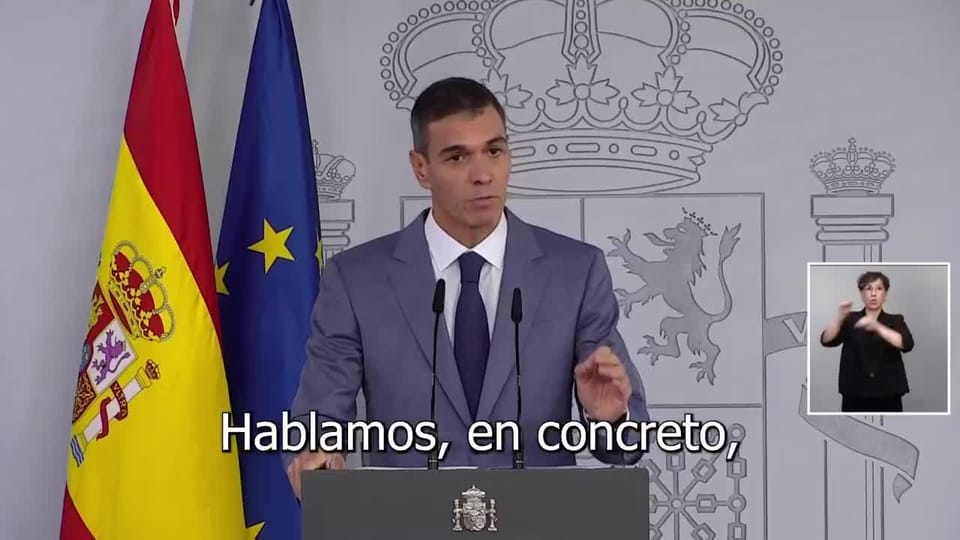
Video: @sanchezcastejon / X
Government Re-Approves Housing Decrees with New Loan Scheme
The Council of Ministers has re-approved two housing decrees on Tuesday 6 October 2026, introducing a new €10 billion fund for interest-free loans of up to €50,000 to help first-time buyers purchase a home. The measure, named Tu Casa, is designed for individuals with stable incomes who lack sufficient savings for a down payment. Under the plan, the public loan will cover up to 20% of a property’s value and be managed by the Official Credit Institute (ICO). It carries zero interest, no fees, and allows repayment over up to ten years, with a grace period that may last until the end of the associated mortgage, up to 30 years in total. This time, the government has specified the funding amount, unlike the initial version approved on 29 September 2026, which did not set a figure. The change aims to accelerate implementation before the November 29 general elections dissolve the current legislature.
Measures Target Rentals, Supply and Speculation
Prime Minister Pedro Sánchez outlined a package of measures intended to stabilise Spain’s housing market, including tax incentives for landlords who offer affordable rents and deductions for tenants on their income tax returns. To boost supply, €280 million will support industrialised construction guarantees and €400 million will go to social housing providers. The state-owned housing entity Casa 47 will acquire thousands of properties from Social Security holdings to expand the stock of social housing. Seasonal and room rentals are also being regulated more tightly, particularly in areas declared under housing stress, where rent increases will be controlled. Vulture funds remain restricted from purchasing homes until 2030, extended from the previous 2028 deadline, and tourist apartments must now be taxed as commercial premises. For tenants at risk of eviction due to non-payment, the administration will cover outstanding debts and legal costs if no alternative housing exists. Protections against evictions for vulnerable individuals remain in place until 31 December 2030.
We are not talking about an ideological issue but about humanity and common sense.
Path Through Parliament Remains Uncertain
With Congress dissolved ahead of elections, both decrees must now be ratified by the Permanent Deputation, a reduced parliamentary body comprising 68 deputies. The larger, broader housing decree is expected to pass, as PSOE, Sumar, ERC, Bildu, PNB, and the Mixed Group together hold 35 votes versus 34 from PP, Vox, and Junts. However, the second decree, which mandates automatic renewal of rental contracts, faces likely rejection. Although it passed the Council of Ministers, it lacks support from the PNB, which opposed it in the full chamber, making ratification improbable. Sánchez acknowledged this limitation: the automatic renewal provision will only take effect if formally endorsed by the Permanent Deputation.
This government does not throw in the towel or abandon its people; we will not allow any more evictions.
Despite the proposed reforms, Sánchez admitted the measures alone “will not solve the housing problem” and stressed the need for greater market intervention and thousands of additional homes to meet demand.
Primary sources: lamoncloa.gob.es, Activity of the Council of Ministers. Reported by 3cat.cat, Redacción La 7, democrata.es, 3CatInfo Barcelona.