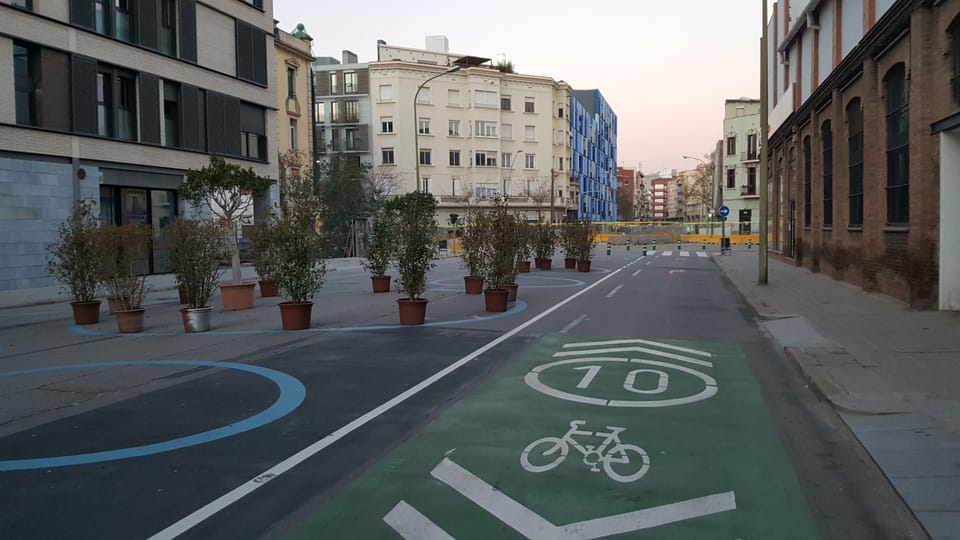
The Poblenou superblock has reached 10 years since traffic rules changed on 5 September 2016 within the streets bounded by Badajoz, Pallars, Llacuna and Tànger, in Barcelona’s Sant Martí district.
For residents, drivers and people travelling through the area, the scheme removed through traffic from its interior streets: vehicles entering the superblock had to turn at each internal junction. The measure was designed to free road space for public use and made Poblenou the first experimental superblock in Ildefons Cerdà’s Barcelona grid.
The anniversary marks a decade since the pilot became a reference point for Barcelona’s wider debate over how streets should balance vehicle access, walking, cycling and neighbourhood activity.
Four-street pilot aimed to reduce through traffic
According to TMB, Barcelona’s public transport operator, a superblock is an urban area larger than a city block but smaller than a neighbourhood, where streets are calmed and through traffic is excluded from the interior.
TMB said the intended result was less noise, more greenery and streets that are easier to use on foot or by bicycle, as well as space for play, sport and outdoor activities.
- Location: the rectangle formed by Badajoz, Pallars, Llacuna and Tànger streets in Poblenou.
- Start date: traffic changes began on 5 September 2016.
- Traffic rule: vehicles inside the perimeter were required to turn at every internal crossroads, preventing journeys straight across the area.
The Poblenou intervention was described at the time as the first phase of deploying superblocks in the Cerdà grid. A superblock had previously been defined in the former town of Gràcia, TMB said.
Residents seeking a description of how the model was designed to work can consult TMB’s official superblock explainer.
Primary sources: noticies.tmb.cat. Reported by lavanguardia.com, S. R, ara.cat, elpais.com, La Vanguardia Barcelona.