From Sunday 25th October, traffic in Barcelona’s Eixample district will be altered due to the next phase of rehabilitation work on the Marina Bridge. The Barcelona City Council confirmed on Saturday 24th October that the changes will affect movement between Via Ali Bei and Avinguda Meridiana until April 2027.
During this stage, the sidewalk on the Llobregat (south) side, two traffic lanes, and part of the bike lane will be occupied. However, the bike lane will remain open in both directions with a width of 1.9 metres, protected by barriers and specific signage to separate cyclists from vehicles.
Traffic in the “mountain” direction (northbound) will be maintained in one lane and the bus lane. However, the “sea” direction (southbound) on Via Marina will be closed from Ali Bei. Drivers will be diverted via Ali Bei, Sardenya, and Meridiana. The left turn from Marina to Ali Bei in the “mountain” direction is also restricted. Alternative access will be via Marina, Casp, and Lepant.
Pedestrians will be redirected to the sidewalk on the Besòs side. The city council advises walkers to follow on-site signage for safe passage.
Bus Route Changes
- Bus line V21 will be diverted via Lepant and Meridiana, with stops 3231 and 38 cancelled.
- Line 6 will run off its usual route along the “sea” side of Diagonal, Lepant, and Meridiana, with stops 38 and 3401 cancelled.
- Provisional stops will be established for both lines, shared between the V21 and line 6.
Line N0 is also affected; passengers are advised to check updates via TMB’s website or at bus stops.
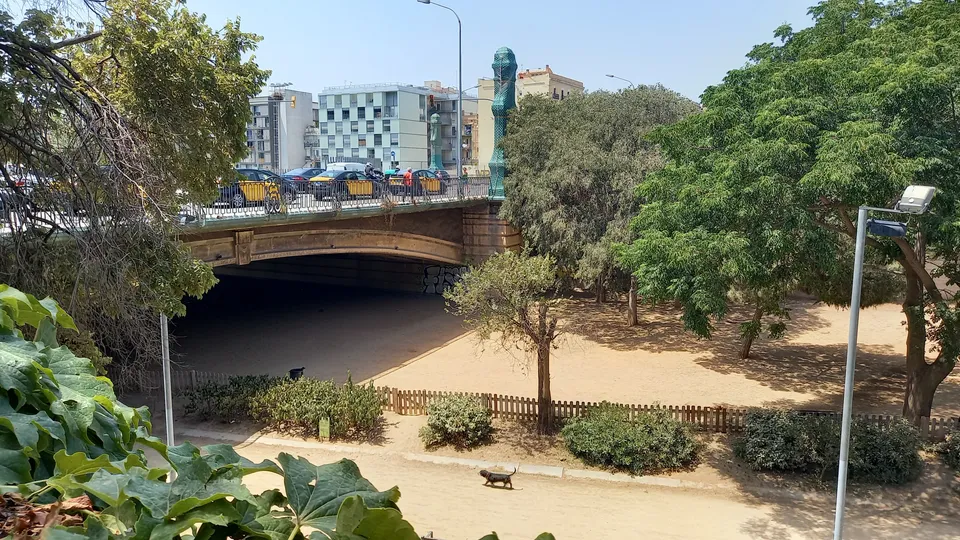
The comprehensive refurbishment of the Marina Bridge aims to strengthen the structure, improve waterproofing, and restore historic ornamental features.
Project Scope and Timeline
The €6 million project began in August 2026 and is expected to last 14 months, finishing in autumn 2027. Work is being carried out in phases to minimise disruption. Earlier stages included repairs to the bridge’s underside and work beneath it in the park area. Between November and December, coordination with Adif will allow railway track-related work.
The bridge, constructed between 1926 and 1928, requires intervention due to ageing materials, moisture infiltration, concrete deterioration, metal corrosion, and damage to ornamental artificial stonework. The refurbishment includes:
- Strengthening the bridge deck with a new reinforced concrete slab
- Complete waterproofing and improved drainage
- Localised repairs to concrete elements
- Restoration of ornamental stonework and metal railings
- Upgrades to road surfaces, lighting, traffic signals, and signage
- Improved accessibility
The project is part of the Endreça Plan for public space maintenance.
Sources: El Periódico, Ajuntament de Barcelona, Europa Press.