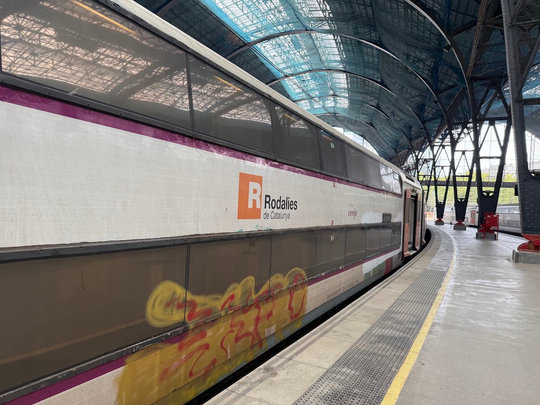
The Generalitat de Catalunya has selected TÜV SÜD to lead development of the Catalonia Railway Services Plan 2040, a long-term plan intended to define how rail services should meet projected travel demand by 2040.
For Rodalies, regional and local rail passengers, the work may eventually shape proposals on interchange connections and network bottlenecks. The announcement does not set out any immediate changes to routes, frequencies, fares or timetables.
According to Railway-News, the plan is intended to provide an integrated, long-range framework for public transport, rather than announce a single construction project or a new railway line.
Plan will examine connections and capacity constraints
The work is intended to establish an optimal rail system capable of anticipating mobility needs projected for 2040. TÜV SÜD’s brief includes identifying constraints in the network and setting out proposals to address them, together with an implementation strategy.
- Integrating rail services with other transport modes.
- Identifying bottlenecks affecting the railway network.
- Formulating solutions and a strategy for putting them into effect.
The Generalitat is Catalonia’s autonomous government. The source material does not specify a publication date for the final plan, individual schemes to be proposed, or which lines and stations could be affected.
“The major challenge is not only to plan services using more efficient infrastructure, but to do so from a sustainable and people-centred perspective,” said Lydia Alonso, Rail business unit manager at TÜV SÜD Spain.
Weekly noise checks planned for FGC Line 8 extension
Separately, TÜV SÜD has been named an Entity for Control in Noise Pollution Prevention for work extending Line 8 of Ferrocarrils de la Generalitat de Catalunya (FGC), the Generalitat-owned railway operator, in Barcelona.
The company’s environmental acoustics specialists will install continuous measurement sensors to monitor construction noise in real time. The collected data will be analysed weekly against levels stated in the project’s acoustic impact studies.
Residents near the Line 8 extension works will therefore be covered by a continuous noise-monitoring programme during construction, although the source material does not identify the monitoring locations or provide a schedule for the works.
Reported by content, elespanol.com, Por Economía Digital, servimedia.es, Agencia Europa Press, barna.news, Railway-News.