Target Set to Reduce Rainfall Dependence
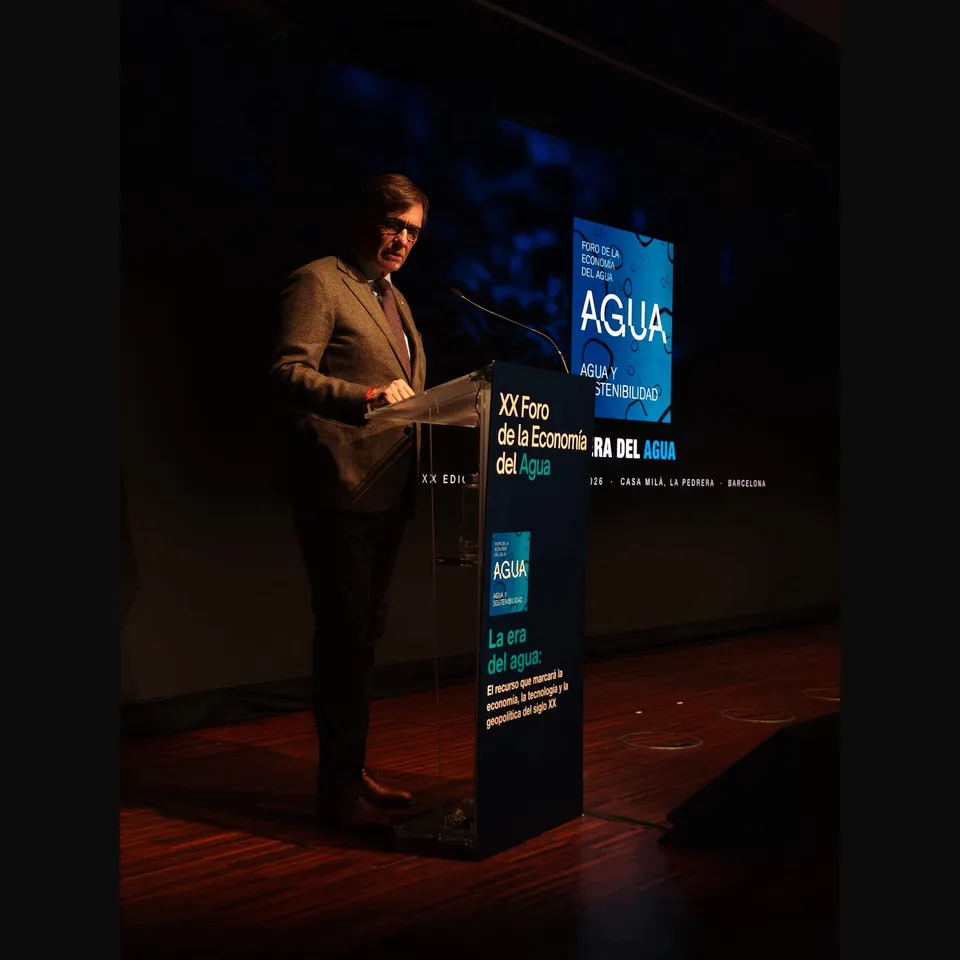
Catalonia aims to increase its water autonomy from 33% to 70% by 2030, regional president Salvador Illa announced on Wednesday 18th November 2026 at the 20th Water Economy Forum held at Casa Milà-La Pedrera, a modernist landmark in Barcelona. The goal is to ensure the region's water supply no longer depends on rainfall patterns, which have become increasingly unpredictable due to climate change. Illa stated that current water reserves equal about one year of consumption, but expanding them via new reservoirs is no longer viable due to environmental and social constraints. Instead, the Generalitat (regional government) will focus on three key strategies: desalination, water reuse, and network efficiency.
Expanding Desalination and Reuse
The first strategy involves scaling up desalination capacity. Work is already underway to expand the Tordera desalination plant in the Maresme region and build a new facility in El Foix, Cubelles (Garraf). Additionally, the capacity of the Llobregat desalination plant, currently operating at full capacity, will be doubled. Illa acknowledged the high cost but insisted, "It is expensive, but having no water is even more expensive." The second pillar is water reuse. In 2025, around 60 cubic hectometres of water were reused, nearly 90% of the Llobregat plant’s annual output. This model will now be extended to the Besòs basin using a closed-circuit system: treated wastewater receives additional purification and is pumped back upstream for reuse. "Without this, we would not have overcome the drought the way we did," Illa said.
Investing in Efficiency and Infrastructure
The third focus is improving efficiency. Illa highlighted that Catalonia already has one of Europe’s most efficient water networks and lowest per capita consumption rates. Nevertheless, the Generalitat will invest €190 million to duplicate a section of the Ter-Trinitat pipeline, which carries water from the Cardedeu treatment plant to the metropolitan area and suffers significant losses. Modernisation of agricultural irrigation is also underway, beginning with the Urgell canal. "This is resolved when there is no drought, when it rains, that is when sustained investments must be made over time," Illa stressed.
Business Leaders Back Water Policy
Josep Sánchez Llibre, president of Foment del Treball (the region’s leading employers’ association), praised Illa’s water strategy, stating, "No industry will leave Catalonia due to a lack of water." He contrasted this with tensions over housing and regional financing, noting that water policy has earned cross-sector consensus. Sánchez Llibre cited the petrochemical industry in Tarragona, which reuses six million cubic metres of water annually, as proof of industrial resilience. However, he criticised the government’s stance on nuclear energy, urging extension of the operational lifespan of the Ascó and Vandellós plants, which supply 59% of industrial energy in Catalonia.
Urgent Calls for Greater Investment
Daniel Tugues, general manager of Veolia in Spain, warned of a major investment shortfall. He said the water sector requires €8.1 billion annually but receives only €3.6 billion, less than half. Spain renews just 0.5% of its drinking water network and 0.1% of its sewage system each year, implying pipe lifespans of 200 and 1,000 years respectively. "We are facing the risk of a slow death," he said. Tugues called for stronger public-private collaboration and reform of public procurement, arguing that short-term, lowest-bid contracts hinder long-term infrastructure development. He also noted that Spanish households pay less than half the European average for water, despite recent investments in Barcelona amounting to just 10 cents per family per day. Francisco Lombardo, president of the Water Economy Forum, placed Spain’s annual water investment deficit at over €4.5 billion. Complying with the new European urban wastewater directive will require more than €24.5 billion, according to the Directorate-General for Water. "Without water, there is no industry. Without water, there is no competitiveness. And without water, there is no economic future," he stated. The forum concluded with the presentation of the Barcelona Water Declaration, a ten-point manifesto calling for water policies to be treated as matters of state, beyond political cycles.
Sources: La Razón Cataluña, El Periódico.