The Barcelona Metropolitan Area (AMB) has awarded a €3.63 million contract to convert the former Ca n'Aimeric quarry in Castelldefels into a metropolitan park. The project, granted to Eurocatalana Obres i Serveis SLU, marks a major step in repurposing the long-derelict site, which most recently served as a truck parking lot. Works could begin as early as September 2026, with completion expected within six and a half months.
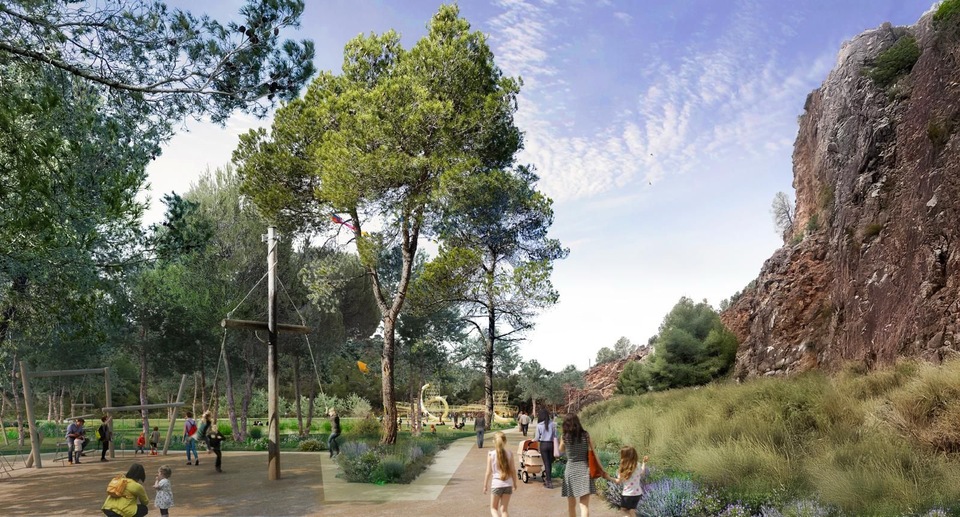
The redevelopment will focus on the lower section of the site, adjacent to Camí del Fondo de Ca n'Aimeric and Dolores Ibárruri street, preserving the upper platform near the Rinoceronet cave and Eurasian Eagle-Owl nesting area. The project, designed by architecture firms Batlle i Roig (BIR) and Simon i Blanco (SBS), aims to balance environmental restoration with recreational use for residents.
Green Space and Community Facilities
The future park, built on municipally owned land, will feature native woodland, children’s play areas, dog zones, walking and sports paths, basketball and pickleball courts, and an open-air amphitheatre for gatherings and relaxation. An interpretation area will highlight the site’s geological and paleontological significance, including the ‘rhino cave’ where a University of Barcelona study confirmed prehistoric rhino activity around 130,000 years ago. Fossils of turtles, elephants, deer and bovids were also found there.
The future area will have a night closing system to guarantee the safety and good maintenance of the space, according to the Castelldefels City Council.
- Wooded green zones with native vegetation
- Interpretation space for the ‘rhino cave’
- Children’s play areas and dog zone
- Basketball and pickleball courts
- Open-air amphitheatre and walking paths
Historical Site with Shifting Uses
The area, named after a farmhouse documented since 1391 and once owned by the Aimeric family, operated as a quarry from 1945 under Cubiertas y Tejados, S.A. In 1955, it hosted a military camp during Franco’s regime. After years of disuse, a 2001 proposal for a water park sparked local opposition, including protests in Barcelona’s Sant Jaume Square.
A 2006 agreement allowed truckers to use the site as a parking area. In 2020, plans for a funeral home near the entrance were met with community resistance. The current park project became possible only after the local government rescinded the truckers’ agreement in 2024, freeing the land for public use.
Reported by elperiodico.com, Àlex Rebollo, castelldefels.org, Exa, N.C, El Periódico Barcelona.