The Catalan Traffic Service (SCT) is studying bus lanes and variable speed limits on Barcelona’s ring roads, its director Ramon Lamiel said on Monday. The options are intended to ease queues on routes used daily by drivers and bus passengers, but they have not been announced as confirmed changes.
Lamiel told public broadcaster Catalunya Ràdio that the agency is working with Barcelona City Council and the Metropolitan Area of Barcelona, the body that coordinates services across the wider city region. The roads under examination are the Ronda de Dalt (B-20) and the Ronda Litoral (B-10).
Speed controls and space for buses
One option is to vary speed limits according to traffic conditions. The current limit is 80 km/h, and similar variable systems are already used on other Catalan roads, according to Lamiel.
He said a more consistent speed, even if slower, “helps reduce sudden braking, collisions, and high-risk situations”. The aim is to improve traffic flow rather than simply increase the speed at which individual vehicles travel.
A lane reserved for buses is another possibility. For passengers using the ring roads, that would set aside road space for their vehicles, although Lamiel cautioned that the limited width of the roads makes the option difficult.
The agency is also considering whether lanes could be taken from the opposite direction to provide extra capacity in the direction carrying the heaviest traffic. Lamiel said that arrangement is already used at weekends on roads including the AP-7, but would be very complicated to introduce during the week.
Four junctions under examination
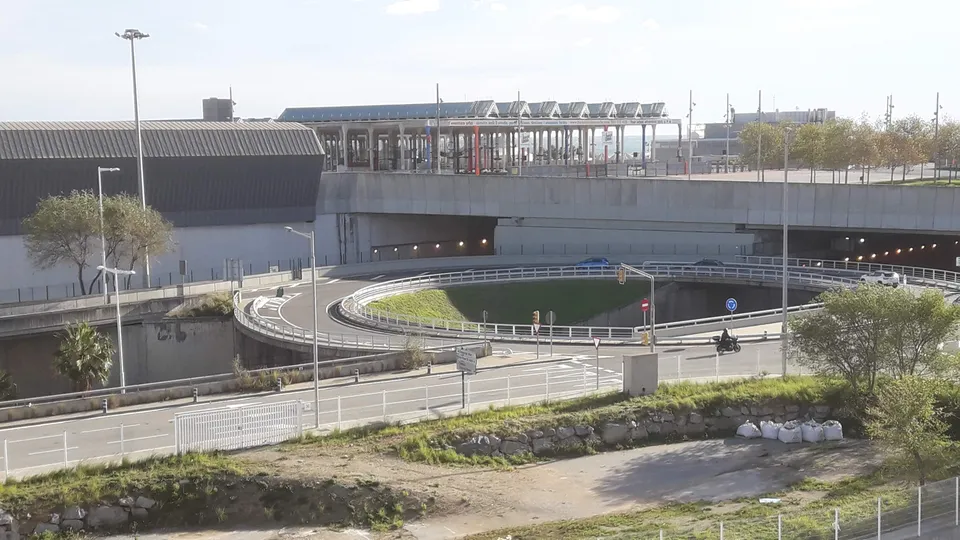
The SCT also wants to reduce conflicts where entering vehicles meet others that are leaving or changing lanes. Lamiel identified four locations for examination:
- The Ronda Litoral interchange with the C-31 at Sant Adrià de Besòs.
- The connection with the C-31 near El Prat de Llobregat.
- The Trinitat junction, between Santa Coloma de Gramenet and the Ronda de Dalt.
- The Ronda de Dalt interchange with the C-32 at Cornellà de Llobregat.
At these points, changes would address the places where drivers entering, leaving and crossing lanes can encounter one another. The measures remain under study; Lamiel did not announce a decision to introduce any of them.
Congestion rose on both roads
SCT data obtained by El Periódico and published on 15th November 2026 show that accumulated hours of congestion rose by 79.1% on the Ronda de Dalt and 54.1% on the Ronda Litoral between 2019 and 2025.
On the Ronda de Dalt, the Monday-to-Thursday daily total rose from 11 hours to 19.7 hours. On the Ronda Litoral, it increased from 13.3 to 20.5 hours.
Those totals add together congestion recorded at different points along each road. They do not mean a single driver was delayed for 20 hours, or that a continuous queue lasted that long.
The SCT figures also show that average daily vehicle numbers on the Ronda de Dalt from Monday to Thursday rose from 125,631 in 2019 to 131,582 in 2025, an increase of 4.7%. Traffic service sources told El Periódico that the roads have long carried more traffic than they can absorb, making them vulnerable to saturation after even a small incident.
Serious crashes near Sant Adrià
A separate SCT analysis obtained by El Periódico identified the Ronda Litoral at Sant Adrià de Besòs as the section with the most crashes involving deaths or serious injuries across the two ring roads.
The stretch, between kilometre markers 2 and 5.1 near the C-31 connection, recorded 49 such crashes over the past decade. Another Ronda Litoral section, between kilometre markers 18.3 and 20 near the C-31 and C-32 connections between l’Hospitalet and Cornellà de Llobregat, recorded 18.
Barcelona City Council figures reported by El Periódico show that the two ring roads recorded 683 crashes involving casualties in 2025, including both minor and serious cases. Those crashes left 937 people injured.
Sources: Generalitat de Catalunya, El Periódico, periodico.top.