Community Action After Months of Delays
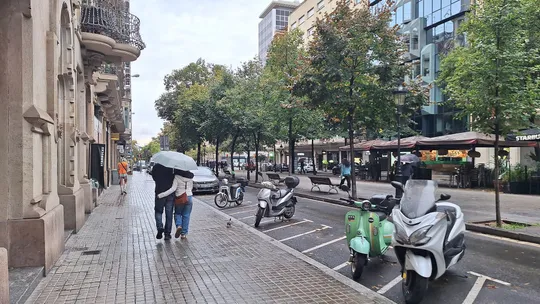
At least a dozen temporary signs have been taped to the pavement along Gran Via de les Corts Catalanes, between Rambla Prim and carrer de Fluvià, warning pedestrians to watch out for broken, raised, and loose paving stones. The hand-printed notices, placed by local resident José María Herrero two weeks ago, read: "Watch out! Don't trip and fall. The city council does not repair. Reported since April and, again, in July, October, and November." Herrero says he filed multiple complaints with the Ajuntament de Barcelona, the city council, after noticing the deteriorating condition of the sidewalk. He was told repairs would be completed by May 2026 but remains frustrated by the lack of action. "Someone could fall there and, when that is known, you cannot wait for months like this," he said.
Council Cites Shortage of Specific Paving Stones
The city council confirmed it is aware of the damage on this section of Gran Via in the Sant Martí district. It stated that routine repairs typically involve replacing damaged paving stones with identical ones. However, it claims a specific model used on this stretch is currently out of stock. "This is a specific paving stone model for this section of Gran Via, of which there was no stock," the municipal government said. An order for replacements was placed in June 2026, but as of mid-November, the delivery had not arrived. The manufacturer now expects to deliver the materials "in the next few days," with repairs to follow immediately upon receipt.
Neighbourhood Concerns Over Safety and Ageing Population
Jacoba Castillo, president of the Sant Martí de Provençals Neighbourhood Association, said members recently surveyed the area from Bac de Roda to Cantàbria and found most sidewalks in poor condition. The council had previously told both the association and Herrero that materials were expected by 23rd November, but that deadline passed without delivery. "I asked when the repair would be done and they no longer knew that," Castillo said. Herrero has considered taking matters into his own hands. "It was very simple to take them out whole, put a little cement to fill the gap and avoid the problem of someone falling. And when the new ones arrive, they can be put in," he said. He continues to monitor the site daily, replacing worn signs and checking for repairs.
"The most important thing is not who put them up, but that the council makes repairs. What I want is for them to fix the damage, because you have to be careful with these things; the population is increasingly elderly and I worry about the people with disabilities we have in the neighbourhood." José María Herrero, local resident
Sources: El Periódico, Ajuntament de Barcelona.