Landlords with multiple properties charge premium
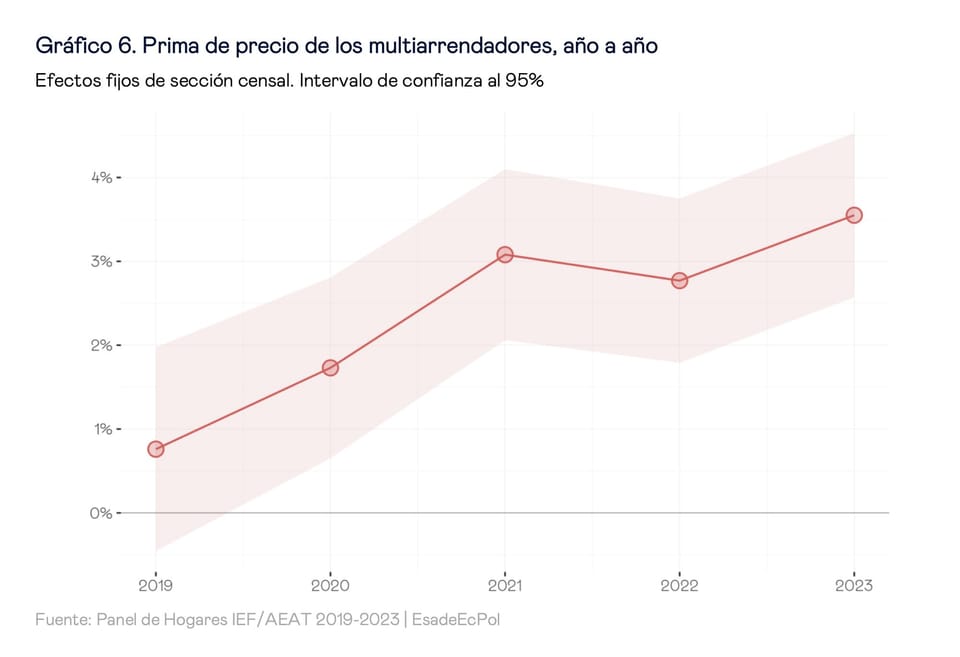
Owners of two or more rental apartments in Spain charge 3.5% more than those with just one property, according to a study by the Centre for Economic Policy at Esade (EsadeEcPol). The research, published on Thursday 22nd October 2026, shows this 'multi-landlord premium' has grown from 0.8% in 2019 to 3.5% in 2023 for equivalent homes in the same census section. The premium increases with portfolio size: landlords with five or more properties charge rents 4.5% above those with only one, compared to a 1.3% increase for owners of two homes. The study attributes this trend to both higher initial pricing and steeper increases at renewal, where multi-landlords raise rents by 5.2% on average, versus 3.8% for single-property owners.
Premium spreads across municipalities
The rent gap is more pronounced when properties are spread across different municipalities, where the premium reaches +2.8%, compared to +1.5% when concentrated in one area. Surprisingly, the premium turns negative (–3.8%) when all properties are in the same census section, a finding the report says contradicts expectations of local market dominance. The study analysed data from the Household Panel and the Tax Agency, focusing exclusively on individual landlords and excluding companies and investment funds. It finds that multi-landlords account for "a little less than a fifth" of the overall rent increase between 2019 and 2023, with their rising premium, not increased market share, driving the effect.
Policy recommendations
EsadeEcPol suggests public policy should focus on portfolio size rather than geographic concentration, as the pricing difference grows with the number of properties owned. The report highlights contract renewal as a key moment for intervention, proposing measures such as extending IRPF (Personal Income Tax) reductions to incentivise rent moderation during renewals. Another proposal is to reduce perceived landlord risk through an automatically activated payment guarantee. However, experts caution that such measures would have "limited" impact, as eliminating the multi-landlord premium would reduce rent growth but not return prices to 2019 levels. They conclude it is "reasonable" to assess policies based on their ability to contain increases without discouraging rental supply.
The majority of the rise in housing costs responds to the general revaluation of the market, which is consistent with the tension between the scarcity of supply and the increase in demand.
Primary sources: esade.edu. Reported by viaempresa.cat, democrata.es, en.ara.cat, Newsroom Infobae, abc.es.