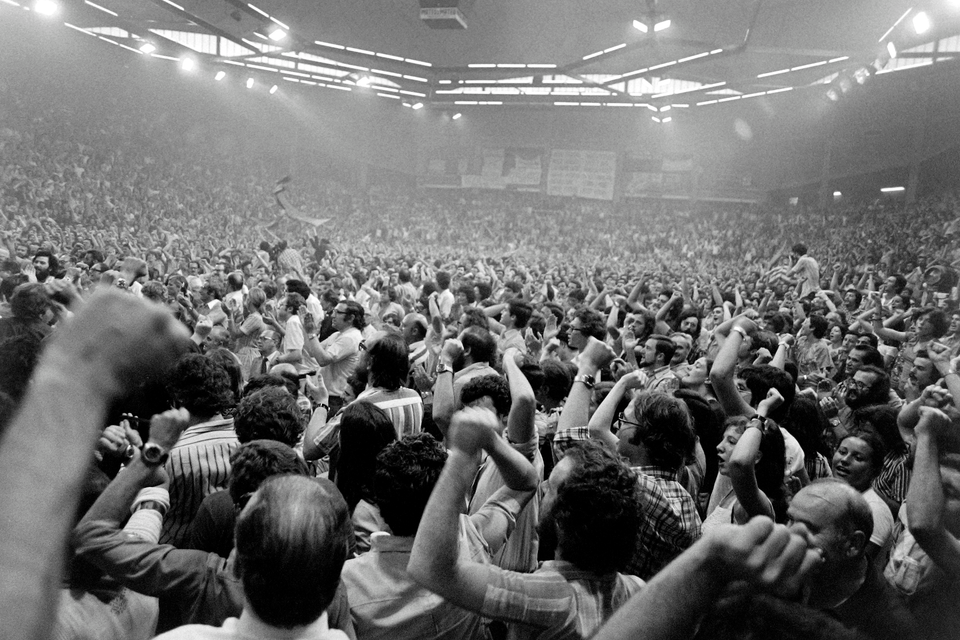
Barcelona's Míting de la Llibertat marks its 50th anniversary on Monday, 22 June 2026. It recalls the historic 1976 rally at the Palau Blaugrana. This event became a foundational moment for the Socialist Party of Catalonia (PSC). It also shaped the democratic transition after Francisco Franco's death.
The rally was the first tolerated mass democratic meeting in Catalonia since the end of the Civil War. It was a clandestine and formally illegal convocation. However, it started the unification of various Catalan socialist groups. Contemporary reports estimated attendance between 8,000 and 20,000 people. Many citizens remained outside the venue. Police did not officially intervene.
Attendees filled the Palau Blaugrana, home to FC Barcelona's basketball team, with 'senyeres' (Catalan flags) and red flags. They sang freedom chants and resistance songs by Raimon and Lluís Llach, including 'L'Estaca'. The event concluded with 'The Internationale' and 'Els Segadors', Catalonia's national anthem.
Prominent figures from Catalan socialism attended. These included members of the Unified Socialist Party of Catalonia (PSUC). Jordi Pujol, who later became President of the Generalitat, was also present. Singers Lluís Llach and Guillermina Motta performed.
Voices for Freedom and Unity
The rally began with a text from Josep Tarradellas, then President of the Generalitat in exile. His message started with the famous phrase "Citizens of Catalonia...". He wished success to those gathered in their fight for Catalan liberties and rights. Tarradellas called for unity during the "confused and dangerous" Transition period. He stated, "Catalonia needs all its children, because, as I have said before, it is too small to lose any and it is big enough for all of us to fit."
Joan Colomines delivered one of the most celebrated speeches. He famously declared, "We are sweating socialism," referring to the high temperatures inside the pavilion. Writer Maria Aurèlia Capmany defended the link between culture and language. She said, "Those of us who have fought so that they would not snatch away our freedom and our language must be present here. Because culture is politics, and whoever says otherwise, whoever says that culture must be apolitical or outside politics, not only lies, but also makes an immobilist and reactionary policy."
Journalist Anna Balletbò demanded that democratic recovery include women's rights. She stressed that "freedom cannot be granted, masked, or reformed." Instead, people must always conquer it. Joan Reventós of Convergència Socialista de Catalunya closed the event. He explicitly urged unity. Reventós stated, "We will place above any party interest, above any incidental question, the cause of the unity of the working class and the cause of the unity of the people of Catalonia." He also chanted, "Down with oppression! Party without exclusion!" Reventós became the first secretary of the PSC. He noted the full capacity of the Blaugrana as proof of ongoing oppression.
Laying the Foundations for the PSC
The Míting de la Llibertat produced a manifesto. This document established the principles for the future PSC. It advocated for a class-based, national, mass, and democratic party. The manifesto welcomed diverse viewpoints. It also adopted "Marxism as a method of analysis and transformation of reality."
The text called for an organisation with "broad autonomy and decision-making capacity." It also proposed direct democracy mechanisms. Additionally, it suggested elected and revocable officials with presence in workplaces and municipalities. On a national level, the manifesto promoted a party "rooted in the Catalan national reality." It also sought to be "unquestionably linked to the rest of the Catalan Countries."
The party would be "fraternally open to collaboration among all socialists in the Spanish State." It would also be "decidedly committed to internationalism." The document left the constituent congress open. This congress would define the party's political structure and alliances. It would do so through self-organisation and mobilisation.
The Path to Socialist Unity
The Míting per la Llibertat marked the formal start of socialist convergence. Before this, the socialist movement was fragmented and clandestine. It then moved towards forming a unified party by summer 1978. Three main currents existed until then. Convergència Socialista de Catalunya (CSC) was led by Reventós. This group was the origin of the later PSC-Congrés.
The PSC-Reagrupament was led by Josep Pallach. The Catalan Federation of the Spanish Socialist Workers' Party (PSOE) was headed by Josep Maria Triginer. This federation had ties to the national leadership of Felipe González. For the 1977 general elections, PSC-Congrés and the PSOE federation formed the 'Pact of April'. They agreed to run in a coalition.
PSC-Congrés approved this alliance by a narrow margin: 33 votes for, 31 against, and 33 abstentions. This coalition won the elections in Catalonia. They secured 15 seats. This placed them ahead of Democratic Convergence of Catalonia (CDC) with 11 seats. The Union of the Democratic Centre (UCD) had 9 seats. The PSUC obtained 8 seats.
A Lasting Legacy
This victory accelerated discussions. These talks ended in July 1978 with the Congress of Socialist Unity. There, the three currents ratified their dissolution. They then founded the current Socialist Party of Catalonia (PSC) under Joan Reventós's leadership. The Míting de la Llibertat remains a crucial event in Catalonia's modern political history. It shaped the region's democratic future.
Come and join our Barcelona English Speakers community on WhatsApp.
Originally published by Europa Press Barcelona. Read original article.