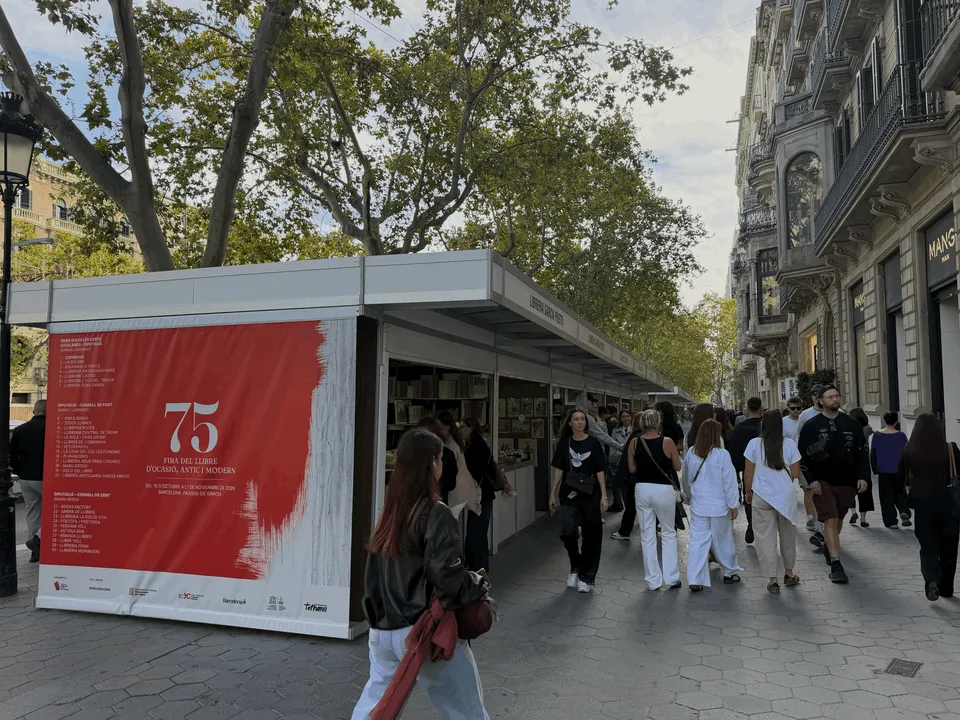
Free to enter until 1 November, the fair brings together 29 bookstalls and an exhibition of book illustrations.
What I found on Passeig de Gràcia
On Thursday 22 October, Passeig de Gràcia offered two very different experiences at once: the familiar rush of one of Barcelona’s busiest shopping streets and the slower rhythm of people browsing through old books.
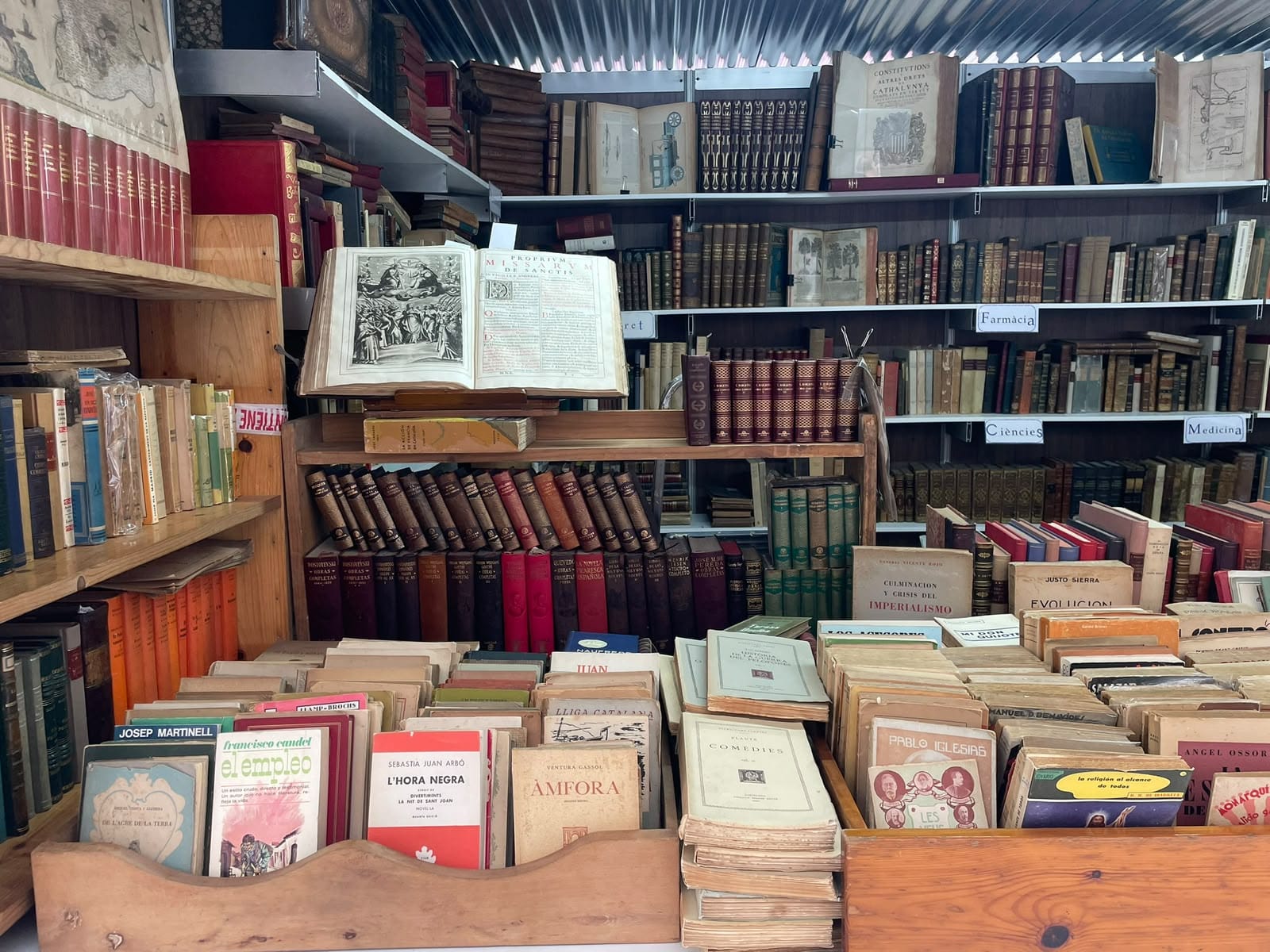
At the 75th Fira del Llibre d’Ocasió Antic i Modern, I found philosophy paperbacks, Stephen King novels, Disney comics, vintage maps and illustrated publications. Some visitors moved quickly between stalls, while others stopped to inspect a particular edition or turn through a pile of books, seemingly in no hurry to leave.
The fair is free to enter and runs until 1 November. Whether you are looking for a specific title, a second-hand book to read on the metro or simply an excuse to explore Passeig de Gràcia at a different pace, it is worth taking a look.
What is the fair?
The Fira del Llibre d’Ocasió Antic i Modern is organised by the Gremi de Llibreters de Vell de Catalunya, the guild of Catalan second-hand booksellers. According to Barcelona City Council, the 75th edition runs until 1 November 2026. Entry is free, and the stalls line Passeig de Gràcia between Carrer del Consell de Cent and Gran Via.
For the first time, the fair has moved to autumn. In previous years, it coincided with La Mercè, Barcelona’s annual city festival. The change gives the event a different seasonal setting, although it also means some regular visitors may need time to adjust to the new dates.
This year’s edition brings together 29 stalls, from established second-hand bookshops to newer projects. Visitors can browse books from private collections, discontinued publications and specialist collections, with prices varying according to the age, condition and rarity of each item.
There is also an exhibition at stall 1, curated by historian Albert Domènech. It explores the history of printing and book illustration, from traditional printing techniques to 19th-century photography. The fair’s poster was designed by printmaker Rosa Vives.
The booksellers: what keeps the fair going?
Speaking with the booksellers offered a closer look at what keeps second-hand book culture alive, from the work involved in pricing older editions to the importance of seeing familiar visitors return each year.
At La Bohème, a bookshop in El Clot run by sisters Íngrid and Clàudia, the fair is an opportunity to bring a large selection of their stock to a wider audience. This is their second year taking part. Their stall is located at Passeig de Gràcia 13, the second stall just after the exhibition.
Íngrid said that the fair attracts a mix of visitors. Some are looking for particular books, while others, including tourists, buy them as decorative objects. She explained that what matters most is that people keep coming back each year. Regular visitors help keep the fair alive and support the booksellers who make it possible. “The regulars who say, ‘I come every year’, those are the people who keep us booksellers going,” she said. “People are very kind.”
The books available at the fair also differ from those in La Bohème’s permanent shop. At the shop in El Clot, every book costs €3. At the fair, prices vary because the booksellers have to account for the cost of renting a stall and the different prices they pay when buying books from private libraries. The audience can also be more specialised, with some visitors searching for a particular edition or trying to complete a collection.
La Bohème’s selection ranges from novels and children’s books to 19th-century volumes and older editions of French literature. Íngrid mentioned first editions of works by Balzac and books from French humorous and manners literature, alongside more recent fiction.
Pricing older books requires research. Booksellers consult reference books and online sources, examine the paper and binding, and sometimes ask other members of the guild for advice. A book may have been rebound, for example, which can affect how it is valued.
“You learn as you go,” Íngrid said.
What you will find
The selection varies from stall to stall, so browsing is part of the experience. During my visit, I found philosophy books for €5 and Stephen King novels for €7, alongside art books, Disney publications and vintage collectible comics.
At stall 16, Plana Books had maps and travel-related publications, as well as postcards priced between €3 and €7 and decorative posters. Other stalls offered chronicles, illustrated publications and books from private collections.
Most of the books I saw were in Catalan or Spanish. However, almost every stall had at least a small selection of books in English, alongside books in other languages. The range varied considerably between stalls, so if you are looking for a particular language or subject, it is worth asking the booksellers what they have available
Most stalls accept card payments or Bizum, so you won’t necessarily need cash.
The fair can also be a starting point for discovering Barcelona’s permanent second-hand bookshops. Llibreria Rodés, at Carrer de la Diputació 8, is another bookshop worth visiting.
Is it worth visiting?
I would recommend the fair to anyone who enjoys browsing through books, even without a particular title in mind. You might leave with an inexpensive paperback, a vintage postcard or a book about Barcelona that you would not have found elsewhere.
Collectors will have plenty to look through, particularly if they are interested in older editions or specific publications. For English-speaking visitors, there is something to browse at almost every stall, although the overall selection is still predominantly in Catalan and Spanish.
You do not need to be an expert or a dedicated collector to enjoy it. The stalls offer a glimpse into Barcelona’s second-hand book culture, and a conversation with a bookseller can be as interesting as finding something to take home.
The fair is free and runs until Sunday 1 November, making it an easy stop if you are already in the area.
Good to know
- Dates: Until Sunday 1 November 2026
- Opening hours: Monday to Saturday, 10:00–20:30; Sundays and public holidays, 11:00–20:30.
- Location: Passeig de Gràcia, between Carrer del Consell de Cent and Gran Via.
- Entry: Free
- Getting there: Passeig de Gràcia metro station, served by lines L2, L3 and L4. Nearby bus routes include 7, H12, 22, 24, 52, 54, 67 and V15. Bicing stations are also available in the area.
- Payment: Some stalls accept cards, but bring cash as a backup.
- For English speakers: Almost every stall has at least a few books in English, but the selection varies. Ask booksellers if you are looking for a particular title or subject.
A few useful Catalan phrases
- Quant val aquest llibre? (How much is this book?)
- Teniu res en anglès? (Do you have anything in English?)
- Em recomanes algun llibre? (Can you recommend a book?)