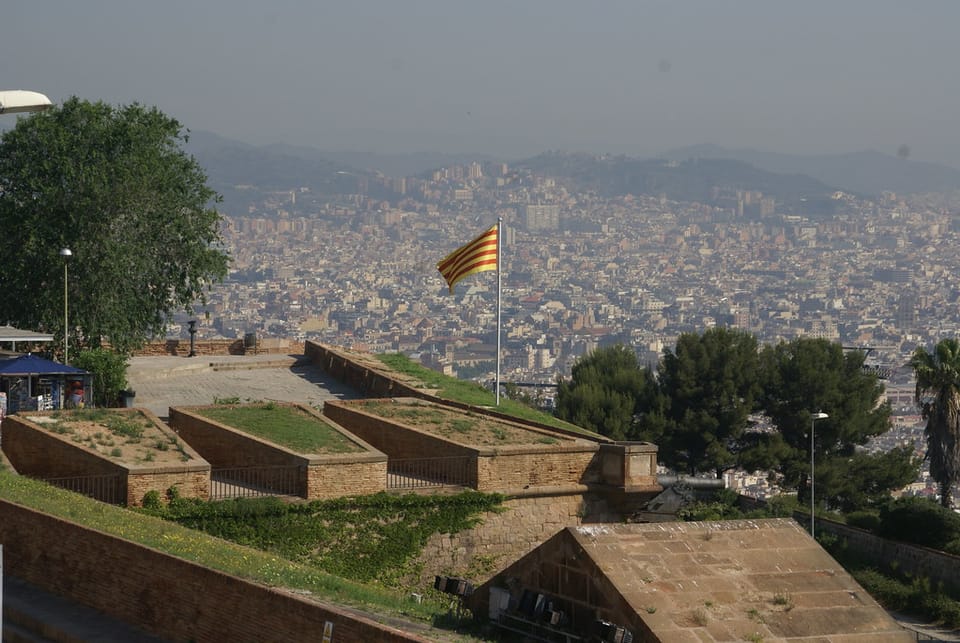
Montjuïc Castle, a prominent Barcelona landmark, has opened a significantly renovated permanent exhibition at its interpretation centre. The new display, which started welcoming visitors at the end of April, offers a deep exploration of the castle's 10-century history, focusing on its social and political impact on the city.
The Institut de Cultura de Barcelona (ICUB) commissioned the project. Archaeologist and historian Josep Maria Vila and historian Ricard Conesa curated the exhibition. They worked together to expand and improve the previous display. The new exhibition features seven distinct spaces.
"We wanted a new narrative about the castle," Conesa stated. "A deep vision of the social and popular aspects was missing, and of the relationship between the city and the mountain in the 19th and 20th centuries. Like the bombardments, which were previously covered with very small pieces in the previous centre. We have used drawings, plans, popular music."
The exhibition moves beyond a focus on military conflicts. "We agreed that we did not want to explain the wars, the little battles, beyond what was essential," Vila explained. "Although you cannot explain the castle without talking about the Reapers' War, you do not have to focus only on that." Vila concentrated on the castle's ancient and constructive history, including archaeological findings. "I have led all the archaeological excavations carried out in the castle since 2009. I found this," he said, pointing to a bulwark section. Conesa focused on the contemporary social and political memory.
From Signal Tower to Fortress
The castle's history begins with a signal tower, first documented in 1073. This tower used sails by day and fire by night to warn Barcelona of approaching ships. It communicated details like the presence of corsairs or burning vessels. The tower became a key part of Barcelona's skyline. Military activity on Montjuïc started in 1640, before the Reapers' War, when the city built a fort. This fort played a role in the 1641 Battle of Montjuïc, where Catalan and French forces defeated King Philip IV of Castile's troops.
A Symbol of Repression
Under Bourbon rule, the castle transformed into a symbol of repression. Its current form dates from 1753, following architect Juan Martín Cermeño's redesign. From this vantage point, the Spanish government bombarded Barcelona three times, in 1842, 1843, and 1856. These attacks aimed to punish and intimidate the population, particularly the working class, to prevent rebellion.
The castle also served as a prison and torture site for revolutionaries, anarchists, and workers during the 19th and early 20th centuries. Many faced arbitrary punishment without specific charges. International protests arose from cases like the 1909 execution of Francesc Ferrer i Guàrdia, a scapegoat during the Tragic Week. Filipino independence activists were also held here. During the Spanish Civil War, the castle imprisoned Nationalists, right-wing individuals, and religious figures.
Lluís Companys and Memory
Lluís Companys, the President of Catalonia, represents the castle's most prominent victim of repression. German Nazi forces arrested him in France and returned him to Spain. He was executed at Montjuïc Castle after refusing to abandon his mentally ill son, Lluïset, to flee to America. The exhibition uses photographs, historical timelines, and sounds, including 19th-century revolutionary songs, to tell these stories. It also covers the anarchist attacks of the late 19th century, such as the 1893 Liceu bomb, which killed 22 people.
The seven exhibition spaces cover Montjuïc's ancient past, including human presence from 5500 to 2200 BC, and the Jewish cemetery. It also highlights the Montjuïc stone, used extensively in the construction of the Eixample district, home to around 260,000 residents. The exhibition aims to explain the castle's context and the events that occurred within its walls.
The new permanent exhibition at Montjuïc Castle provides a compelling reason for both tourists and Barcelona residents to visit. It offers a deeper understanding of the city's complex history and the mountain's enduring significance. This renewed focus on social and political narratives ensures the castle's past remains relevant for future generations.
Come and join our Barcelona English Speakers community on WhatsApp.
Originally published by El Periódico Barcelona. Read original article.