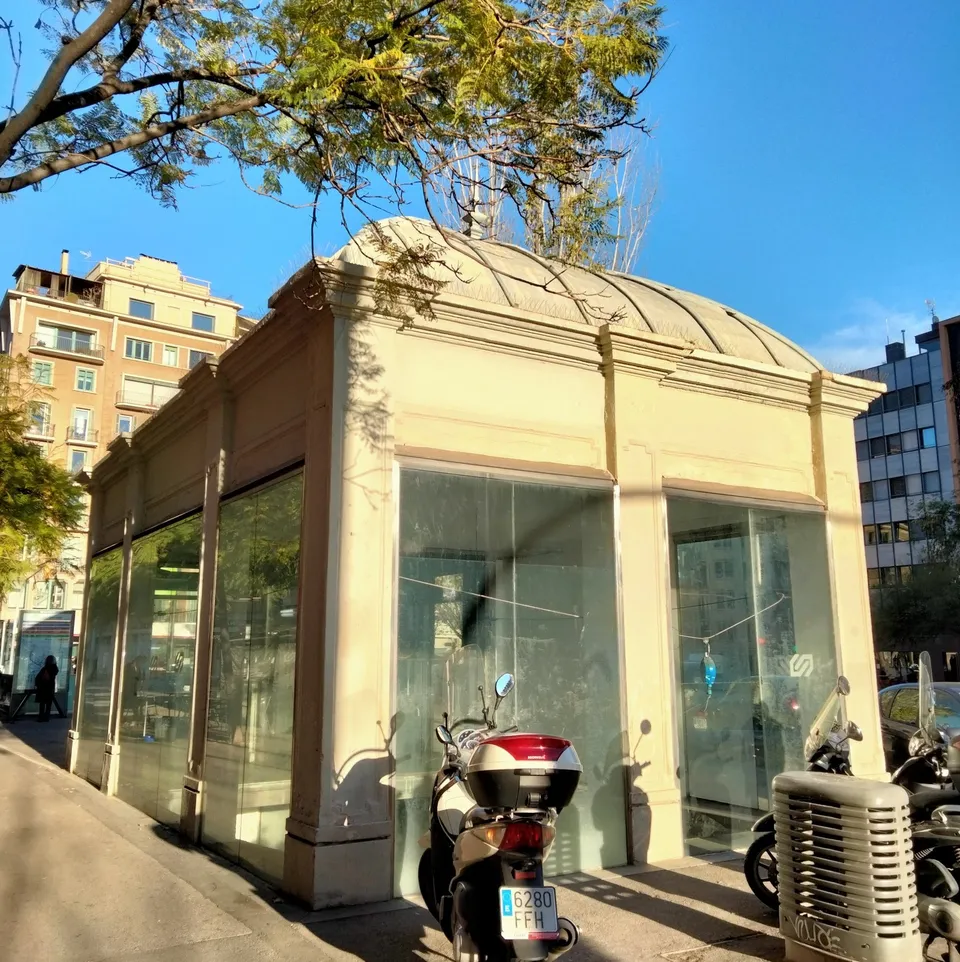
A glass canopy has returned to the entrance of Sant Gervasi station in Barcelona, restoring a feature removed in 1960. The entrance reopened on 2nd November after work to strengthen the building and repair leaks in its roof.
Passengers using the station on Plaça de Molina can again enter through the refurbished street-level pavilion. The canopy around it has been reconstructed with new glass and modern fixings, according to the Catalan government’s announcement.
Ferrocarrils de la Generalitat de Catalunya (FGC), the regional railway operator, began the work in March with a budget of €669,717.80 before VAT. Its president, Carles Ruiz Novella, and its director of rolling stock and railway network, Esther García Torralbo, visited the completed project on 2nd November.
The work also included:
- Improving the pavilion’s structural stability.
- Repairing the façade and roof leaks.
- Renewing the glass enclosure, roof covering and installations.
The pavilion has an exterior area of 58 square metres, including five square metres for lift access. Its four glass-sided façades and zinc roof allow natural light to reach the lower station level.
Sant Gervasi is served by the S1, S2 and L6 lines, and its entrance is next to that of Plaça Molina station on the L7. According to Diari Catalunya, Sant Gervasi recorded 1.47 million journeys in 2025, 4.5% more than in the previous year.
From open-air tracks to a glass entrance
Sant Gervasi station opened in 1863 alongside the rest of the Barcelona-Sarrià line, when its tracks and platforms were outdoors, local broadcaster betevé reports. The tracks were placed underground in 1929, and a street-level entrance was built over the stairs.
The pavilion opened in 1931 with a glass canopy around it. That canopy was removed in 1960, while the pavilion itself underwent a complete refurbishment in 1985 and was later incorporated into the redevelopment of Plaça de Molina.
In 2009, an interchange was created to connect the Barcelona-Tibidabo line with the Vallès branches, according to Diari Catalunya.
Sources: betevé, Diputació de Barcelona, diaricatalunya.cat, Barna.News, Diari Catalunya.