Update, 3rd November 2026: Spokesperson Kiara Monrroy stated the protest would remain in Plaça Catalunya at least until the 29 November general elections, possibly longer, and warned that if evicted, protesters would reoccupy any public or private space, while denouncing threats from fascist and ultra groups and distancing the camp from the Blocus demonstrations, according to Metrópoli Abierta.
Update, 27th October 2026: The encampment has developed into a self-organised settlement with a food warehouse, clothing distribution, first-aid post, tool workshop, and portable toilets, according to ABC Cataluña, which reported that a group attempting to occupy a building at Carrer de Calàbria 177 on 23 October was evicted by Mossos d'Esquadra, with 19 people charged with resistance and disobedience.
Update, 23rd October 2026: The encampment is now fenced with only two access points and guarded by makeshift sentries, according to El País Barcelona, which reported that police have raised concerns over security risks ahead of the 11 November general strike. The City Council cut power to seven lampposts after detecting an unsafe electrical connection, a move protesters deny responsibility for. The Tenants' Union, initially absent, joined later but has since withdrawn to focus on strike preparations.
Protest Enters Third Week Amid Harsh Conditions
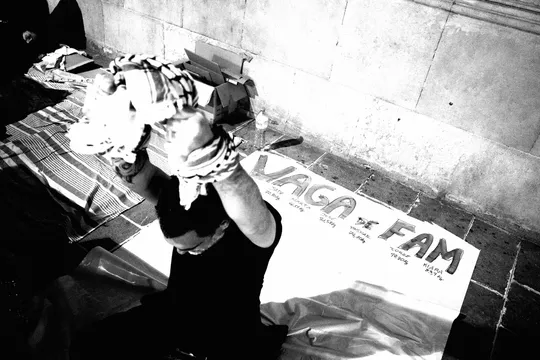
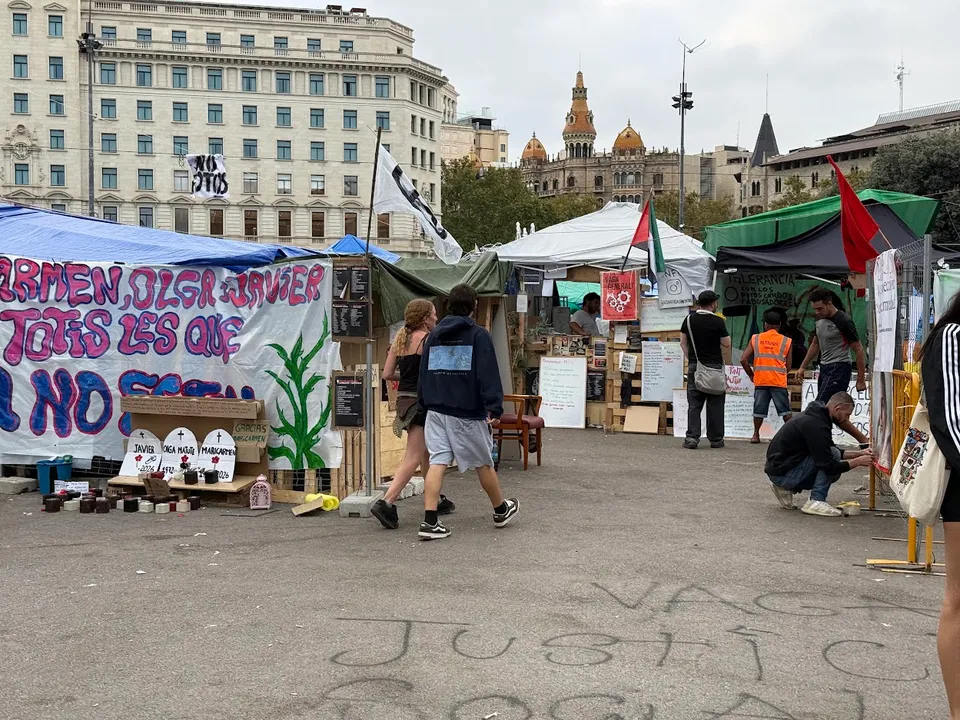
More than 600 tents remain in Plaça de Catalunya, Barcelona, as a housing rights protest marks its third week on Tuesday 20th October 2026. The encampment, which began on 30th September, continues despite persistent rain, strong winds, and physical strain on participants. "We are together, we are organized, and we will continue camping," said León, a school monitor and one of the protest’s spokespeople, speaking to EFE. He joined the demonstration on its third day and continues to balance his teaching duties with nightly presence at the site. León, who lives in the Nou Barris district and is active in several social movements, acknowledged the difficulty of sustaining the protest over 21 days. Multiple rain events have flooded tents, and high winds have damaged tarpaulins and structures across the square.
Shelter and Solidarity for Homeless Residents
While many participants are young activists, the encampment includes workers, parents, and university students. Organisers have established coexistence rules, including a noise curfew after 00:30. At the camp’s centre, a covered area provides shelter for approximately 15 to 20 homeless individuals daily. They receive sleeping bags, mattresses, and meals. The protest’s kitchen commission prepares between 300 and 400 meals each day for those in need. "We don't consider it an encampment without the real campers, who are the homeless people," León emphasized.
We are together, we are organized, and we will continue camping.
Escalating Tensions with City Council
Tensions between protesters and Barcelona City Council have risen. León reported that street lighting was removed from the square, cutting off the encampment’s electricity supply. This morning, two council workers approached the site claiming they needed to repair water infrastructure, but protesters denied them access, fearing the water supply would be severed. In response, another spokesperson, Kiara Monrroy, travelled to Barcelona City Council at midday to meet with political leaders and discuss the situation. The protest is expected to continue at least until the general strike on 11th November or the general elections on 29th November, both key dates cited by organisers as potential turning points. Residents and commuters should expect ongoing disruption in and around Plaça de Catalunya. The square remains a central transport hub, serving multiple bus lines and the Barcelona Metro stations Catalunya and Universitat.
Primary sources: Barcelona City Council. Reported by metropoliabierta.elespanol.com, Catalan News, Barna.News, en.ara.cat, beteve.cat, acn.cat, J.C. Meneses Montserrat, EFE, laciutat.cat, elnacional.cat, Metrópoli Abierta - Urban Life.