Work Underway on Historic Mosaic
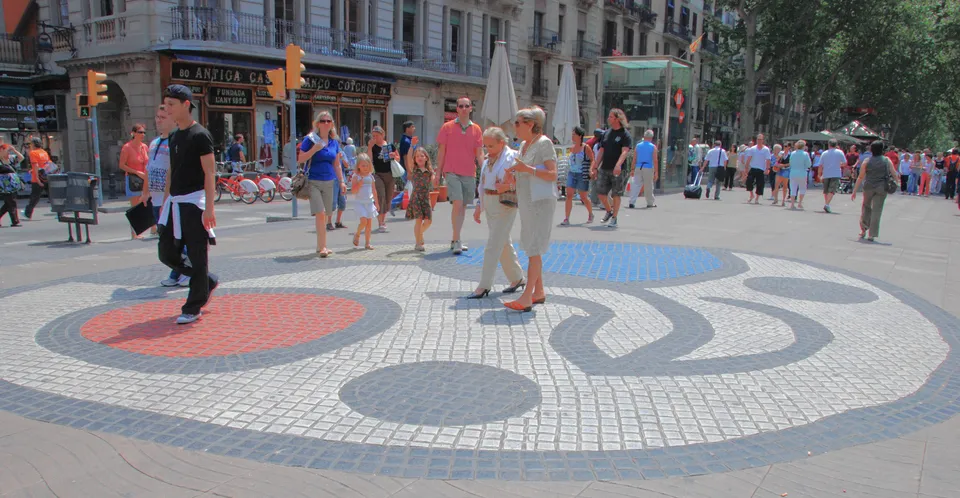
Three conservation specialists are now restoring Joan Miró’s mosaic at Pla de l'Os on La Rambla in Barcelona, using delicate tools such as sponges, paintbrushes and pencils. The restoration work began in November 2026 and is expected to conclude by the end of January 2027, ahead of the full reopening of the boulevard in mid-February for the Santa Eulàlia festivities. Barcelona mayor Jaume Collboni visited the site on Tuesday 24th November at 10:00 to inspect progress, accompanied by Anna Lázaro, head of the Conservation and Restoration Area of Barcelona Archaeology Service. The mosaic, installed on 23rd December 1976, marks its 50th anniversary this year.
Minimal Intervention to Preserve Original Work
The restoration follows a 'minimal intervention' approach, aiming to stabilise damaged areas and improve material cohesion without extensive replacement. The mosaic, made of around 6,000 terrazzo tiles in black, white, red, blue and yellow, has suffered from decades of foot traffic and environmental exposure. According to the city council, none of the original red and blue tiles remain, and very few yellow ones survive. However, most of the black and white tiles are still the originals from 1976. The work is being coordinated by the Conservation and Restoration Area of the Archaeology Service and the Heritage Department of the Municipal Urban Landscape Institute, with input from experts at the Fundació Joan Miró.
“It is one of Miró’s most characteristic works, a gift to the city at its maritime entrance, and part of La Rambla’s history,” said Collboni.
The intervention includes a high-resolution photogrammetric survey, detailed crack mapping, and monitoring of material loss, subsidence and previous repairs. The goal is to ensure the long-term durability and legibility of the artwork.
Broader Heritage Restoration on La Rambla
The mosaic restoration is part of a wider effort to revive cultural features along the boulevard. Other heritage elements being restored include the Canaletes fountain (1892), the Portaferrissa fountain (17th century), the Pla de la Boqueria fountain (1830), the Santpere monument (1995) and Joan Brossa’s Antifaç sculpture (1991). The Pla de l'Os, where the mosaic is located, is one of three new small public squares being created as part of the La Rambla transformation. Collboni emphasised that the project aims to “recover La Rambla for Barcelona residents” and encourage renewed use of the city centre. The site is also near the location of the 17th August 2017 attack, and the city confirmed that the memorial to the victims will remain in place, located a few metres above the mosaic.
Related on Barna.News
Sources: El Periódico, Ajuntament de Barcelona, betevé.