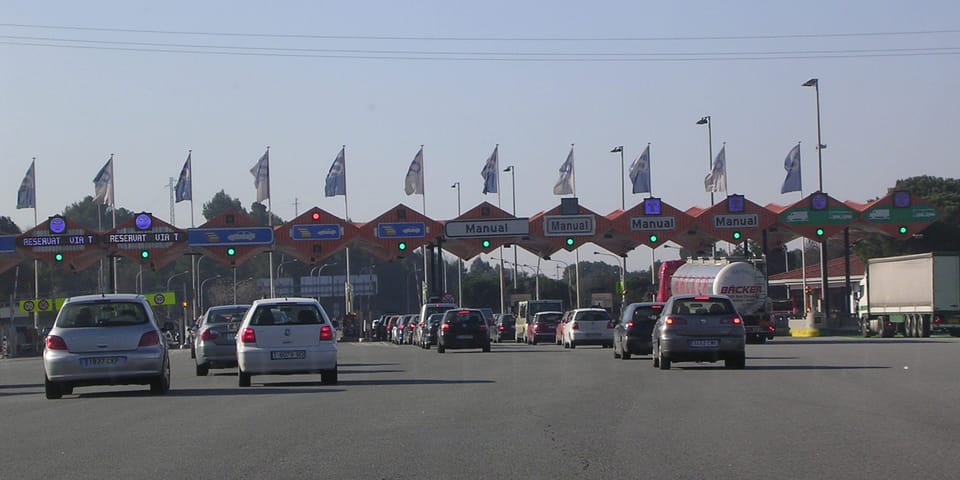
Drivers using the AP-7 through Vallès or La Jonquera could eventually face a new road-use charging system, under options being examined by the Generalitat, Catalonia's regional government. No charge, start date or final scheme has been agreed, and the proposal would require a nationwide approach rather than a Catalonia-only measure.
Manel Nadal, the Generalitat's Secretary for Mobility and Infrastructure, said in reporting published on 3 July that charges on high-capacity roads could return within two or three years if there is political agreement with the Spanish state. The AP-7, AP-2, C-14, C-12 and Eix Transversal are among the routes under consideration.
For motorists and freight operators, there is no immediate change to toll payments or route access. The discussions concern a possible future funding model, not an announced reintroduction of traditional toll barriers.
"It would be incomprehensible for lorries or cars to travel freely throughout Spain and then be made to pay when they enter Catalonia," Nadal said, according to El Periódico.
AP-7 congestion and maintenance are central to the debate
The Govern, Catalonia's executive administration, has linked the discussion to congestion, accidents and maintenance funding on the AP-7. Nadal said about 15,000 lorries a day use the motorway at La Jonquera, close to the French border, while the figure reaches about 35,000 daily in Vallès.
He said increased rail freight capacity, including more trains and logistics terminals, could remove only 2,000 to 3,000 lorries a day from the roads. He also called for more AP-7 capacity in Penedès and Vallès, alongside upgrades to parallel roads and motorway junctions.
Sílvia Paneque, Catalonia's regional minister for Territory, told the Parlament, the Catalan Parliament, that the region needs a stable source of money to maintain high-capacity roads and support public transport. She said the Generalitat currently meets maintenance costs without associated income, according to La Vanguardia's report of her statement.
Annual permit or Basque-style payment model examined
Paneque ruled out a return to conventional barrier tolls. The Generalitat is considering two broad approaches:
- An annual road permit: a charge allowing use of high-capacity roads, potentially varying by a vehicle's weight and emissions.
- A Basque-style model: charges used to fund road maintenance rather than repay the original construction cost.
More than half of Catalonia's high-capacity roads are owned by the Spanish state, Paneque said. For that reason, the Generalitat says any eventual system would have to be capable of being replicated throughout Spain.
Motorists and haulage firms do not currently need to take any action. The reports set out a policy discussion and a possible two-to-three-year timeframe, but do not identify an agreed payment system, tariff or implementation date.
Reported by elpais.com, Pedro Ruiz Claveria, Antonio Fernández, Pablo Gallén, Cristina Sen, David Bricollé, elperiodico.com, larazon.es, Marcos Lamelas, catalannews.com, N.R.M, DP, russpain.com.