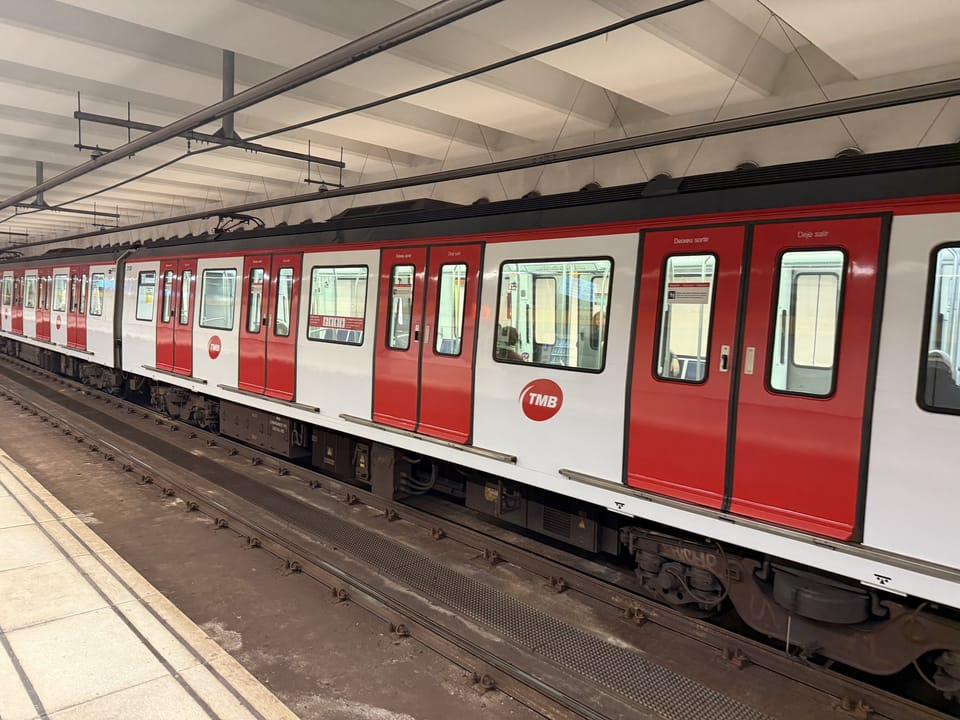
Transports Metropolitans de Barcelona (TMB), the city’s public transport operator, has launched a €330 million tender for 35 new Metro trains. The purchase is intended to add capacity and reduce peak-time waits, particularly for commuters on L1 and L5, with the first trains expected to arrive in 2029.
Twenty-two trains are planned for the central section of L9. The remaining 13 will reinforce conventional lines: four for L1, three for L2, five for L3 and one for L4.
“The first trains are expected to arrive during 2029,” TMB said in its announcement.
TMB said L5 will not receive a new train directly under this tender. Instead, some existing L3 trains are due to be transferred to L5 once the new units enter service.
Peak-time waits planned to fall on five lines
When all the trains are in service, TMB plans peak-hour frequencies of under three and a half minutes on each conventional line covered by the programme. The operator said the changes are designed to absorb projected passenger growth and give travellers more space across services.
- L1: from every 3 minutes to every 2 minutes 38 seconds.
- L5: from every 2 minutes 29 seconds to every 2 minutes 15 seconds.
- L2: from every 3 minutes 15 seconds to every 2 minutes 50 seconds by 2029.
- L3: from every 3 minutes 28 seconds to every 3 minutes 20 seconds.
- L4: from every 3 minutes 57 seconds to every 3 minutes 26 seconds.
For regular passengers, the improvement is not immediate: TMB expects the first deliveries in 2029, and the stated frequency targets apply once the full fleet is in service. L1 and L5 together account for more than half of journeys on the conventional Metro network, according to TMB.
TMB recorded 479.9 million Metro validations in 2025, a 2.4% increase on 2024, the operator said.
New tender follows voided procurement process
TMB said the previous tender was declared void. The revised process allows manufacturers to submit an integrated offer to build all 35 trains, whereas the earlier tender allowed bids for only two of the three planned lots.
The new trains must meet updated accessibility and cybersecurity standards, TMB said. They are also required to be lighter, use recyclable materials and incorporate condition-based maintenance, which the operator says should reduce maintenance costs.
The investment is to be funded through the Autoritat del Transport Metropolità, Barcelona’s integrated transport authority: the Generalitat de Catalunya will provide 51%, Barcelona City Council 25% and the Barcelona Metropolitan Area 24%. Companies can consult TMB’s tenders and awards portal for procurement information.
Primary sources: noticies.tmb.cat, tmb.cat, noticies.tmb.cat, Ramon. Reported by europapress.es, Miguel Bustos, Pere Virgili, barna.news, ARA, salirporbarcelona.com, eib.org, icf.cat, urban-transport-magazine.com, Keith Barrow, Kavya Chivukula, centralcharts.com.