For 30 years, Gràcia Territori Sonor has championed experimental music in Barcelona. Now, a free exhibition at La Virreina brings its archive, artists and history to La Rambla.
By the second half of November, Barcelona's cultural calendar offers plenty of reasons to spend an afternoon indoors. When I heard that La Virreina Centre de la Imatge was hosting an exhibition about experimental music, I was drawn to the idea of having a place where I could disappear for as long as I wanted, take my time and listen. But 30 anys de música normal (30 Years of Normal Music) offered more than a break from the streets. Gràcia Territori Sonor (GTS), the association behind the exhibition, was founded in Barcelona in 1996. Its thirty-year history offered an opportunity to understand what experimental music means, how a scene built around it took shape, and why it became part of the city's cultural life.
What I found at La Virreina
On Wednesday 18 November 2026, I walked into La Virreina Centre de la Imatge, a free public art centre on La Rambla. After the bustle of the street, you step into another world. The exhibition occupies a compact gallery, with texts in Catalan, Spanish and English. Black, white and red walls frame the different installations, while sound runs through the rooms.
From the entrance, you can already see the twelve-screen installation in the room beyond. Each television shows a different concert, offering an immediate glimpse of the musical worlds explored throughout the exhibition.
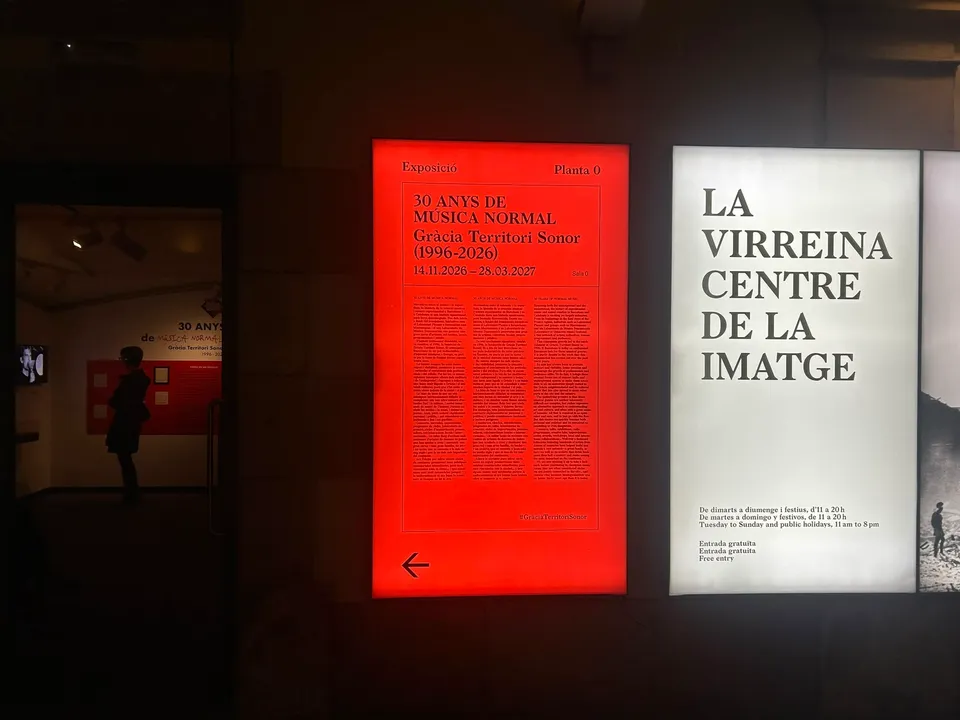
The show, 30 anys de música normal (30 Years of Normal Music), celebrates three decades of Gràcia Territori Sonor, known as GTS, an association founded in 1996 in the Gràcia neighbourhood to promote experimental music. It is free and runs until 28 March 2027. According to the city's cultural guide, it is the first exhibition devoted entirely to the association.
The exhibition moves between recordings, instruments, archival material and ideas about what music can be. It does not assume that visitors already know the artists or the history behind the scene. Instead, it gives you different ways to approach it, whether through a concert recording or an object that makes you reconsider what an instrument can look like.
Why “normal”?
The title comes from a phrase that Víctor Nubla, one of GTS's founders, used to repeat. As Aleix Salvans, the association's artistic director, explained to me by email, the phrase was:
“We programme normal music, because what is not normal is for everyone to listen to the same music.”
The quotation appears alongside others on the exhibition walls, including references to Brian Eno, Victor Hugo and Philip K. Dick. Together, they invite visitors to reflect on how we understand music today, contrasting familiar definitions with Hugo's idea of music as “noise that thinks” and Eno's description of it as something the mind does.
For Salvans, the point is to show that music is much broader than what algorithms, record labels and major management companies dictate. “It is an invitation to step out of this more restricted world and look at what is outside. I am sure that anyone who dares will be pleasantly surprised.”
Twelve screens, twelve worlds
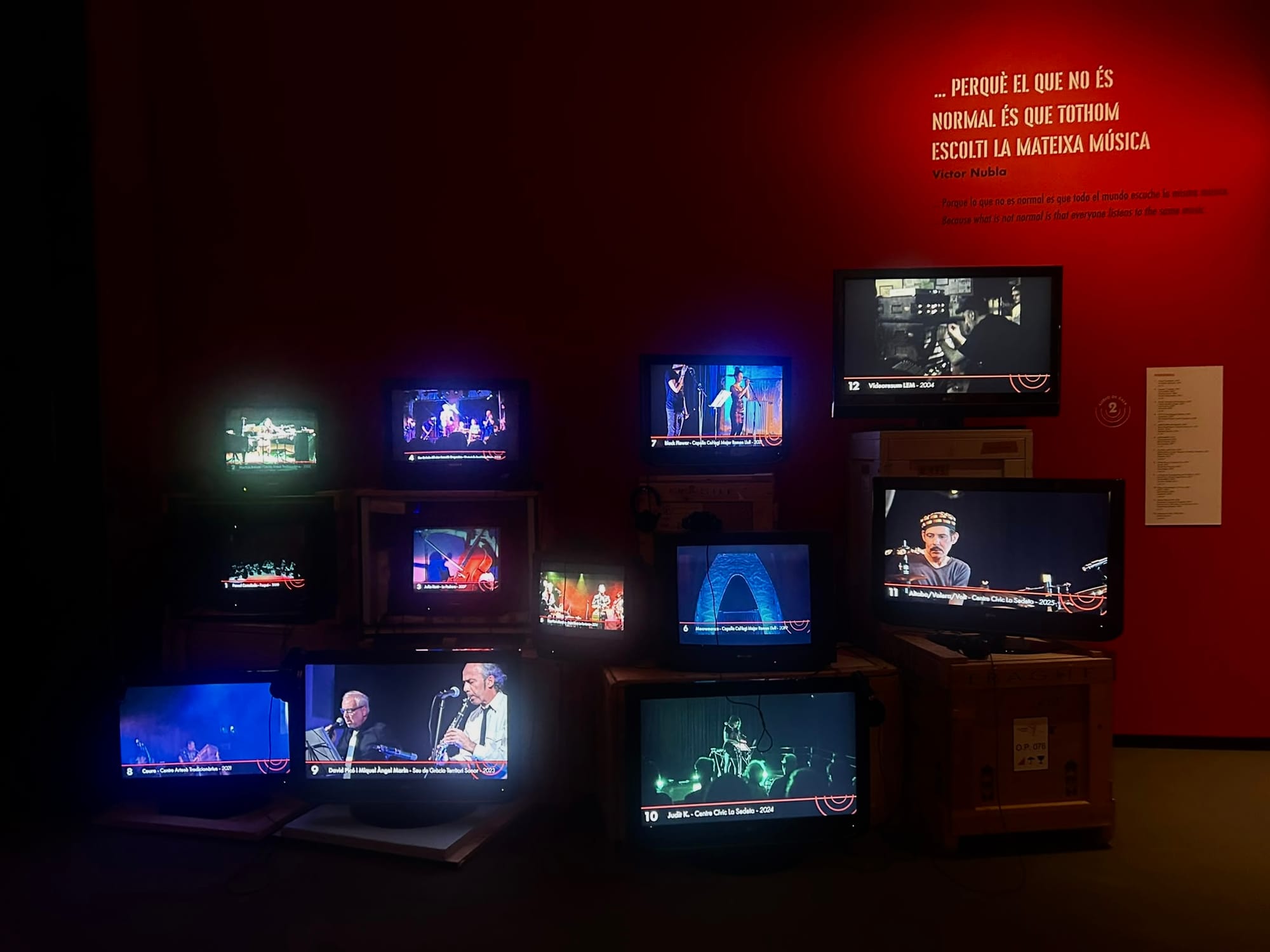
One of the exhibition's most striking installations is a video wall made up of twelve different televisions, each showing a concert from the LEM, GTS's international meeting of experimental music. Put on the headphones and you can step into one of twelve different worlds.
As Salvans explains, the wall brings together fragments of concerts from the 1990s to the present. It is one of the most representative and eye-catching pieces in the exhibition, showing the variety of artists and performances that have passed through the association's programme.
On the fourth television, for example, you can encounter the work of Z'EV and Charlemagne Palestine, including Anamnesia (2007), as well as a performance by Gràcia All-Star Fonetik Orquestra from 2008. The recordings offer a glimpse into a scene that has developed over several decades, with different approaches to sound and performance existing alongside one another.
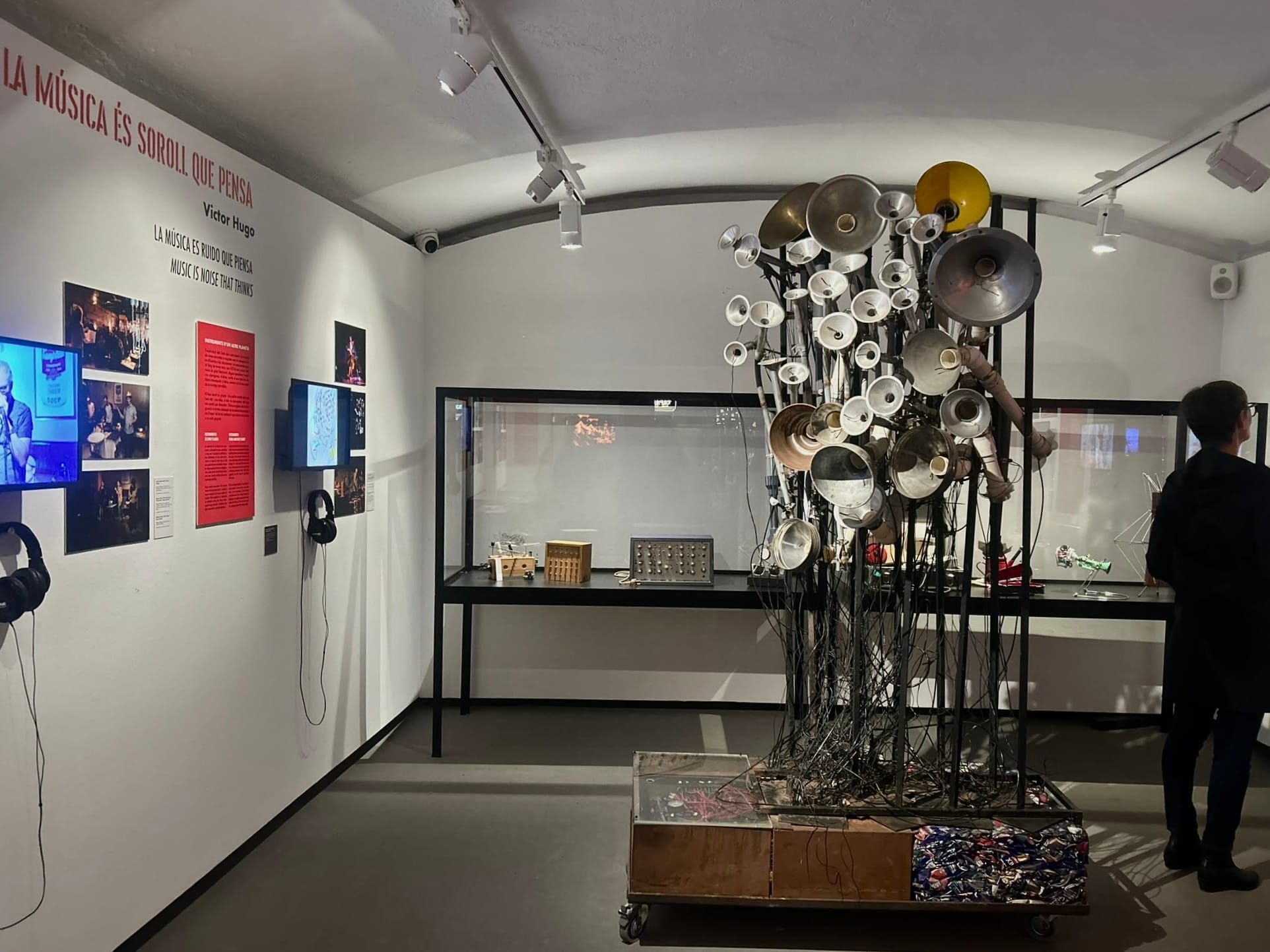
The show also includes a display of instruments. For Salvans, it demonstrates how far experimentation can go in physical terms: building or modifying everyday objects to make music with them.
Seeing these different do-it-yourself instruments was one of the exhibition's most tangible ways of showing what experimental music can be. One example is Agrupació de lliris, part of CaboSanRoque's sound installation Los árboles aullaron (2012), identified in the Arts Santa Mònica programme as one of the work's pieces. The installation was built from reused objects and everyday materials gathered in Mexico, as described in a 2012 account of the project. But what makes the exhibition more than a display of unusual instruments is the history surrounding them. Through the objects, recordings and archive, it becomes possible to understand the people and ideas that shaped this scene, as well as the work involved in keeping a form of music that rarely reaches a wider audience alive.
A city in a hurry
GTS did not come from nowhere. Salvans, who has been involved with the association since 2017/2018 and has served as its artistic director since 2024, describes it as the heir to a tradition of sound experimentation that began in the late 1960s and early 1970s. One strand was academic, rooted in contemporary music. Another emerged from popular music, including free jazz, progressive rock and early electronic music. Later, industrial music and the do-it-yourself spirit of punk joined in.
Barcelona changed considerably in preparation for the 1992 Olympic Games, with major public works and improvements to the city's services. There was also a cultural effervescence, Salvans says, but “with a certain intention of controlling and directing it”. New rules on live music began to appear and, in his view, gradually contributed to the loss of much of the network of venues that had supported the city's experimental scene. The exhibition refers to the “aesthetic cleansing” described by the musician and philosopher Llorenç Barber: art became suspect if it did not serve very specific interests.
In Salvans's view, the city turned into a shop window where everybody could come and take a picture, once for a personal album, now for Instagram or for a TikTok video climbing the stairs at the Sagrada Família metro station. “No offence intended,” he says. “It is what it is.” Salvans's description raises a question about how Barcelona presents itself to the world, and what can get lost when a city becomes a destination as much as a place to live and create. For those discovering Barcelona, there is another side of the city worth seeking out: the neighbourhood associations, independent cultural spaces, artists and small initiatives that have shaped its identity over decades. GTS is one of them. Its history offers a reminder that Barcelona's cultural life is not only found in its most recognisable landmarks or major events, but also in the less visible networks of people who continue to make things happen.
Gràcia, once an independent town before becoming part of Barcelona in 1897, had been developing into a European hub for experimental music since the 1970s, Salvans says. GTS was founded in 1996 to preserve and strengthen that side of the neighbourhood's cultural life. The idea was to create a structure that made it easier to present artistic proposals, energise the cultural life of the whole city and provide support for artists who were losing the spaces they had. The first to believe in the project, he recalls, was the Institut de Cultura de Barcelona, which was founded in the same year.
The scene today
Salvans says the scene has not only survived but grown, with more collectives, artists and audiences. It is also fragmented, which he sees as a good thing because it means variety: groups devoted to improvisation, noise, poetry and spoken word. GTS sits in the middle, working with experimentation in different fields and in relation to other art forms.
Some spaces are even being recovered. Collectives have secured venues, while others organise in squatted spaces. GTS also maintains good relationships with bars, art spaces and the city council's network of civic centres. “In fact, we have even played concerts in churches,” he adds.
The main challenge is money. Working with volunteers shows how involved the experimental community is, he says, but the sector, like the rest of culture, should be able to professionalise. Living in precarious conditions makes people think about the day-to-day and plan fewer long-term projects, which affects programmers and artists alike. And without artists there is no experimental creation: part of GTS's job, he explains, is to pay them to play, so that they have enough stability to keep creating instead of spending their days teaching or doing other work to pay the rent.
What would help? It would be easy to ask for more subsidies, Salvans says, and to criticise multimillion-euro companies in mainstream music, especially mega-festivals, that make profits every year and still receive public money. But he believes small projects, which have a smaller impact in numbers but perhaps a real impact in quality and prestige, need more involvement from private companies through sponsorship. For that, he adds, a clear legal framework would be needed.
Where to start listening
If you have never been to an experimental concert, Salvans recommends three ways in:
- Encontres en l'Espai-Temps: improvisation sessions organised by GTS, held from February to June.
- GTS Presenta: a cycle of concerts held throughout the year.
- Nocturna Discordia: a collective outside GTS whose sessions take place every Thursday at Soda Acústic, a bar in Gràcia.
You can follow GTS on Instagram, X, Bluesky and Facebook, or through its blog.
Thirty years on
For Salvans, turning thirty is first of all a recognition of everyone who has worked at GTS and around it, starting with Nubla. “He was a friend to all of us and someone we learned a lot from, from the work itself to the music and even the way of seeing the world,” he says. His influence is still there in small details of daily life, in how they work and how they talk. “We do not always follow his advice, but we did not before either, and that is why we sometimes argued,” Salvans adds. “But he is always there.”
What comes next? “We will see,” says Salvans. GTS will keep working as it has until now, looking for new alliances with artists and organisations from Barcelona and the rest of Europe. “We have ideas for the future, but the most important thing is the day to day.” For now, the team is already programming the LEM 2027.
I walked back out onto La Rambla and the noise was exactly the same as when I went in. What had changed was that I was listening to it. Noise that thinks, as Hugo put it. That is, I think, what art is for.
The place: La Virreina
La Virreina Centre de la Imatge is a public institution dedicated to contemporary art and the image, and entry is free. It occupies the Palau de la Virreina, an 18th-century palace at La Rambla 99, in Ciutat Vella, at the point where the street opens onto the Raval.

The palace was built between 1772 and 1778 for Manuel Amat i Junyent, Viceroy of Peru, as his residence in Barcelona. After his death, his widow, Maria Francesca de Fiveller i de Bru, remained in the house, and the name Palau de la Virreina gradually became established. The building combines Baroque and Rococo elements. Its highly decorated façade is marked by pilasters and a balustrade topped with twelve vases. Inside, a central courtyard leads to an impressive double staircase. Barcelona Tourism's architectural guide describes these features. It is worth taking a moment to look at the palace itself before heading into the exhibition.
Is it worth visiting?
Yes, and you do not need to know anything about experimental music to enjoy it. I spent around 40 minutes exploring the exhibition, although you could easily stay longer if you wanted to listen to more of the recordings. It is free, right on La Rambla, and as much about people, ideas and the city's cultural history as it is about sound.
I would recommend it particularly to people who are curious about Barcelona beyond its best-known landmarks. The exhibition offers a way to discover a part of the city's cultural life that is easy to miss if you stick to the usual routes. And if it leaves you wanting to hear more, Gràcia and its experimental music scene are only a short journey away.
Good to know
- Exhibition: 30 anys de música normal. Gràcia Territori Sonor (1996–2026) (30 Years of Normal Music), curated by GTS.
- Dates: 14 November 2026 to 28 March 2027.
- Opening hours: Tuesday to Sunday and public holidays, 11:00–20:00. Closed on 25 and 26 December 2026 and on 1 and 6 January 2027.
- Entry: free.
- Languages: the exhibition texts are in Catalan, Spanish and English.
- Location: La Virreina Centre de la Imatge, La Rambla 99, Ciutat Vella. The exhibition is on the ground floor.
- Getting there: Metro L3, Liceu.
- Also in the building: De Calor (1993–1996) and Totes les nostres vides, by Yves Berger, both until 28 March 2027.
A few useful Catalan phrases
- On és l'exposició de Gràcia Territori Sonor? (Where is the Gràcia Territori Sonor exhibition?)
- Què és aquest instrument? (What is this instrument?)
- Puc fer fotografies? (Can I take photographs?)
- Quan és el proper LEM? (When is the next LEM?)