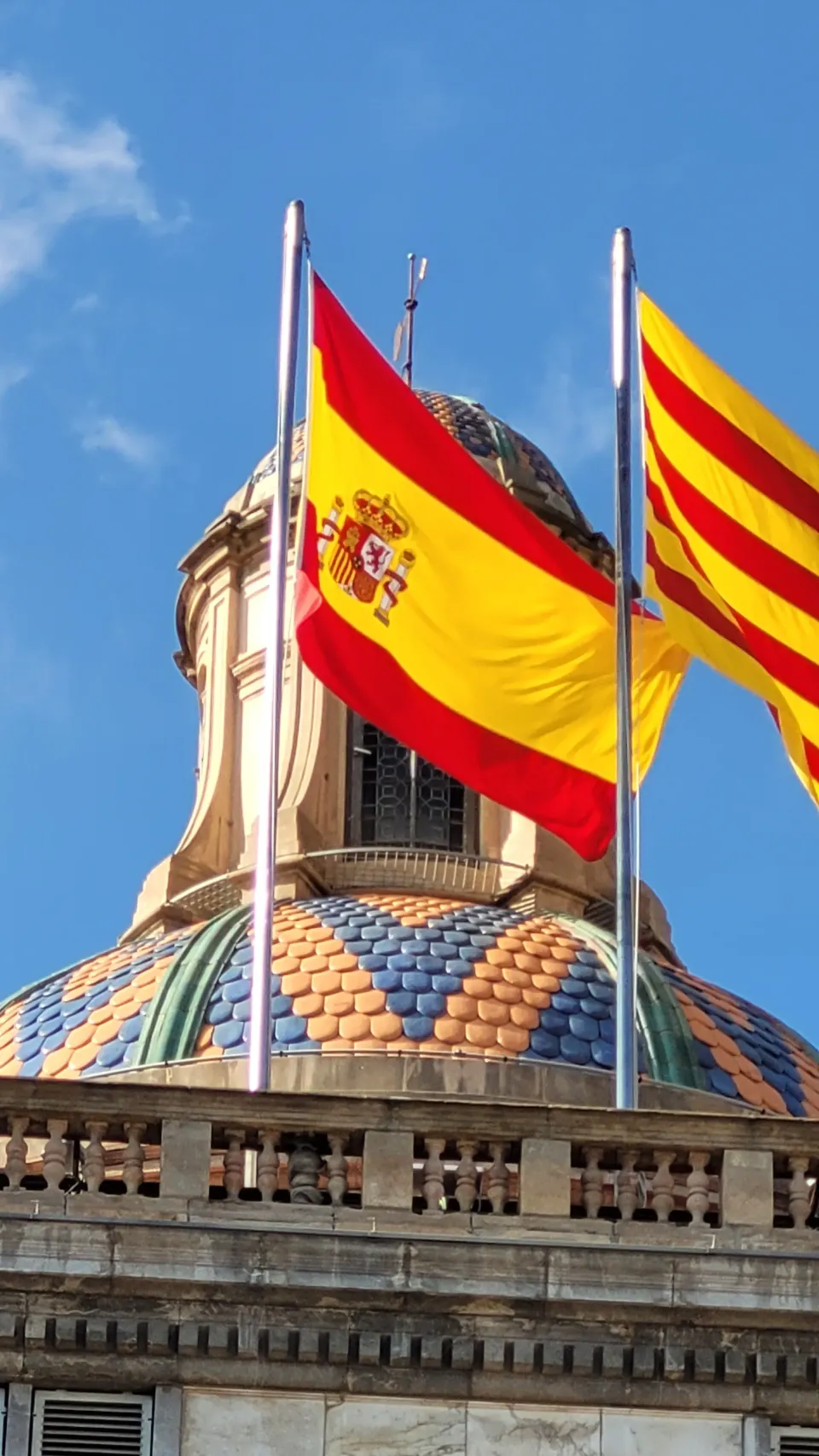
Spain’s Supreme Court has ruled that schools and institutes in Catalonia funded with public money cannot exclude Spanish from their signs. The decision overturns part of the Generalitat’s 2022–2023 school organisation instructions, which said signs in school spaces had to be in Catalan, in Occitan in Arán, and in Catalan sign language where applicable.
For schools, families and staff, the immediate effect is practical rather than curricular: centres will need to check signs on entrances, corridors, offices and other labelled spaces if they currently appear only in Catalan. The ruling concerns signage, not a new timetable for lessons, but the court said the physical space of a school cannot be separated from teaching activity.
The case was brought by the Assembly for a Bilingual School in Catalonia, a parents’ group, after the High Court of Justice of Catalonia rejected this part of its earlier challenge. The Public Prosecutor’s Office supported the appeal, according to the source material.
What the Supreme Court struck down
The challenged wording came from a Departament d'Educació resolution on the organisation and management of educational centres for the 2022–2023 academic year. It stated that “signage in the centre's spaces shall be in Catalan; in Occitan, in Arán; and in Catalan sign language if applicable, as these are the reference languages of the educational system”.
The Supreme Court’s Administrative Chamber found that excluding Spanish from signage at publicly funded schools was not in accordance with the law. In doing so, it reversed the Catalan court’s view that signage was outside teaching activity because it was not classroom instruction or teaching material.
The Supreme Court held that teaching activity is not confined to classrooms or teaching materials, and that the physical space where that activity takes place cannot be treated as something separate from it.
That point matters because it is the legal basis for the signage order. The ruling does not rest on a claim about one specific sign, but on the court’s broader view that language visible across a school site forms part of the educational setting.
What schools and families should do now
The source material does not give a deadline for schools to change signs, and it does not set out a separate enforcement timetable. But the judgment means centres using only Catalan on signs in publicly funded premises may need updated labelling once the ruling is applied administratively.
For headteachers and school managers, the most immediate task is to identify where signs are used across the site. For families, the visible change, if schools act on the ruling, is likely to be in shared spaces rather than in lesson plans.
- School leaders should review permanent and temporary signs in publicly funded school buildings.
- Parents should expect any first changes to appear in entrances, offices, corridors and other common areas, not necessarily in classroom hours.
- If a school sends guidance on updated signage or language-use rules, families should check messages from the centre directly.
The wider language dispute in Catalan education has already produced other court rulings on teaching. In November 2021, the Supreme Court rejected the Generalitat’s appeal against an earlier Catalan High Court ruling requiring at least 25% of teaching hours to be in Spanish, according to reporting by El País, elNacional and other outlets in the source material.
“The Supreme Court has exceeded its powers in taking a position on pedagogical issues,” Catalan education minister Josep González-Cambray said in November 2021 after a separate ruling on classroom teaching hours.
At that time, El País reported that the Catalan government sent a letter to 5,108 school principals advising them not to change their linguistic programmes despite the court decision. The current signage ruling is separate, but it comes from the same long-running legal conflict over the place of Spanish and Catalan in the education system.
According to the source material, the Generalitat’s language model has been in place since 1983, with Catalan generally treated as the main language of instruction except for Spanish-language and foreign-language classes. The Supreme Court’s latest judgment specifically addresses signs in state-funded schools and institutes.
Primary sources: Generalitat de Catalunya. Departament de Cultura. Secretaria de Política Lingüística. Reported by elnacional.cat, Josep Catà Figuls, El País, thelocal.es, catalannews.com, europapress.es, anpecomunidadvalenciana.es, mclibre.org, Departament d'Educació, caib.es, Diana Silva, Laia Galià, Mayte Piulachs, Albert Llimós, El Confidencial.