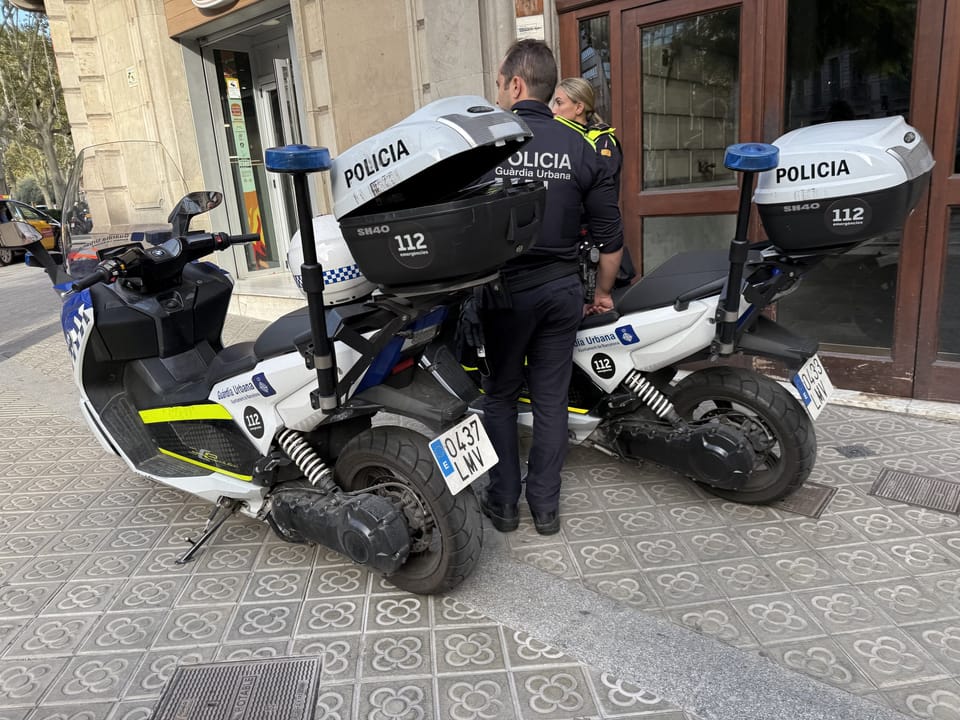
Barcelona City Council is set to make a fresh decision on Wednesday on whether to authorise Tasers for the Guàrdia Urbana, the city’s municipal police force, after the issue returned to the municipal agenda following an earlier failed attempt to secure final approval.
For residents, the immediate consequence is that the vote could change what equipment some city police officers carry during emergency and night-time interventions. The proposal presented by security deputy mayor Albert Batlle says the devices would first go to police commanders in the Unidad de Refuerzo de Emergencias y Proximidad, or UREP, the emergency and neighbourhood reinforcement unit, and to the Guàrdia Urbana night team, with any wider rollout dependent on official annual assessments.
According to the city’s Presidency, Security and Internal Affairs Committee proceedings reported on 18 June by Europa Press, the proposal to incorporate Dispositivos Conductores de Energía, or DCE, meaning conducted energy devices, passed committee stage with the support of the PSC, while Junts, PP and Vox registered reservations ahead of the full council vote. ERC and Barcelona en Comú voted against in committee.
Batlle said the proposed rules were drafted with observations from human rights organisations and described them as the most rights-protective regulation approved in Spain, both for officers and for people who may be subjected to the devices.
The June committee item itself is listed by Barcelona City Council in the Presidency, Security and Internal Affairs Commission information page. However, the material provided does not include a direct City Council publication of Batlle’s full statement about human rights organisations, so that claim remains attributed to his remarks as reported at the meeting rather than to a separate official document.
What the proposal says
Batlle told councillors last week, according to Europa Press, that the Tasers would initially be assigned to commanders in UREP and to the night unit, not to the whole force from day one. He said the scope could later be extended to the full Guàrdia Urbana workforce if annual official reports support that step.
That distinction matters because some reports about the plan refer to eventual use across the whole force, while the committee proposal described by Batlle sets out a phased introduction tied to later evaluations. At this stage, the confirmed fact is the committee move to send the proposal to the full council. Any broader deployment would depend on later assessments and subsequent implementation decisions.
- Initial users proposed: commanders in UREP and the Guàrdia Urbana night team.
- Possible later expansion: the rest of the force, if annual official reports support it.
- Current stage confirmed in the sources: committee approval to take the matter to the June full council vote.
An earlier phase of the process, reported on 19 March by El Periódico, said the initial regulation had received first approval and would go out for 30 working days of public consultation for objections or amendments. That report said the city expected a final approval vote in June and, after that, a procurement process for 22 devices, with the aim of having them operational in April 2026.
The same report said the draft regulation had been tightened in several areas: limiting which police sections could use the devices, requiring automatic recording systems, raising the minimum age threshold for use to 14, and adding both technical and ethical training requirements.
Political positions before the vote
Positions in committee have not been uniform. Europa Press reported that PSC voted in favour in committee, Junts, PP and Vox kept reservations for the plenary vote, and ERC and Barcelona en Comú voted against.
Batlle defended the measure as a regulated option for difficult interventions. Jordi Martí Galbis of Junts said the proposal had arrived late and argued that many police forces elsewhere in Spain already use the devices with training and protocols. PP councillor Juan Bautista also backed the initiative in principle, saying it was a deterrent tool that could save lives, although his group kept its reservation ahead of the full vote.
Separate reporting from elDiario.es on the earlier March committee session said PSC, Junts, PP and Vox supported the initial regulation at that stage, while Barcelona en Comú voted against and ERC abstained. That report also said mental health and human rights groups had objected to several situations in which the draft would allow use of the devices. The sources provided for this article do not include the full text of those organisations’ submissions, so their objections cannot be set out here in detail beyond that reported concern.
What happens next for residents
The next confirmed step is Wednesday’s full council vote. If councillors approve the measure, the city can continue with the regulatory and procurement process already outlined in earlier reporting, including the planned purchase of 22 devices and the stated target of April 2026 for first operational use.
For residents, that means the practical change would not be immediate on the street even if Wednesday’s vote passes. The sources show that implementation would still depend on the final municipal procedure, procurement and officer training.
People who want to follow the item can check the City Council’s commission and municipal information channels through Barcelona City Council’s information page. The latest confirmed timetable in the supplied sources is a council vote on Wednesday and, if the process completes, a possible first deployment in April 2026.
Primary sources: barcelona.cat. Reported by europapress.es, Oriol Solé Altimira, Judith Cutrona, elmundo.es, Arnau Raimundo, Carlos Márquez Daniel, Silvana Antonelli, ABC, radio onda cero, Rubén Pacheco, Tot Barcelona.