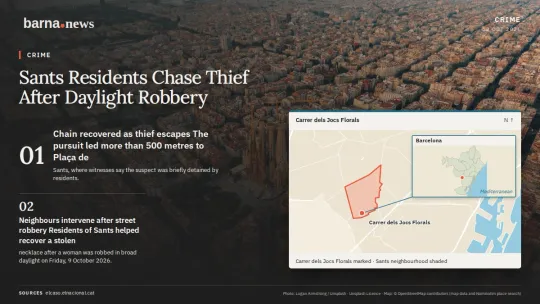
Passengers using Barcelona's busiest stations, interchanges and airport connections face the highest risk of opportunistic theft, according to reporting published on Sunday and recent police data on crime patterns across the city's transport network.
For residents, commuters and visitors, the practical warning is simple: take extra care with phones, wallets and bank cards at large hubs such as Sants and central metro and rail stations, and on buses when vehicles are crowded. Recent Mossos d'Esquadra operations also show that older people, tourists, people with reduced mobility and passengers with prams are among the most frequently targeted victims.
Where police say theft is concentrated
El Periódico reported on 12 July that specialist thieves look for crowds and prioritise victims they believe will be most profitable, focusing on large transport hubs, central metro and train stations, intermodal interchanges and links to major infrastructure such as the airport.
Separate figures released by the Generalitat on the public bus network point to the same pattern in places with heavy passenger flows. According to the Mossos d'Esquadra, the regional police, criminal activity on buses has been concentrated in high-footfall parts of Barcelona, including Plaça Catalunya and Parc Güell.
- Large stations and central interchanges
- Routes and stops serving the airport
- Crowded buses in high-footfall areas such as Plaça Catalunya
- Moments when vehicles are full and passengers are distracted
The most common methods identified by investigators
Police investigations into theft on buses in Barcelona and Terrassa say offenders often work alone or in small groups and deliberately exploit crowding. In the six-day bus operation announced by the Generalitat, officers said suspects approached mainly older people when buses were busiest and stole valuables from handbags at close range.
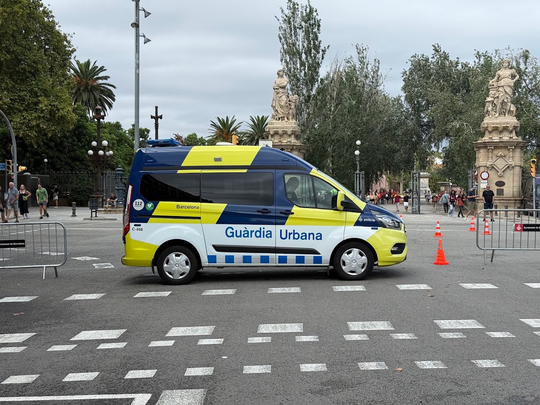
In a separate joint investigation in Barcelona and Terrassa, Mossos d'Esquadra, Guàrdia Urbana and Transports Metropolitans de Barcelona (TMB) identified repeated use of the "crutch" method, coordinated group action, the deliberate creation of crowds and false offers of help, especially towards elderly passengers.
"The detainees acted in small groups or alone and usually looked for elderly victims, taking advantage of their vulnerability," the Generalitat said in its note on the April bus operation.
The items most often stolen were mobile phones, wallets and bank cards, according to the police investigations. The Terrassa and Barcelona case also found that stolen cards and phones were later used for fraud and unauthorised purchases.
Recent police operations and what they found
Between 22 and 27 April, Mossos d'Esquadra, working with Barcelona's Guàrdia Urbana and TMB, arrested 28 people linked to 133 thefts and robberies on Barcelona's bus network, according to the Generalitat statement. The first day of that operation led to 14 arrests.
The same statement says those arrested were aged 22 to 61, had 164 police records between them and appeared before the courts between 24 and 28 April. TMB supported the operation with a video surveillance system covering the full bus fleet with more than 4,500 cameras.
Police later said wider operations under the Pla Kanpai had reduced offences on the TMB bus network by 40.7% in the first part of 2026 compared with the same period a year earlier. According to figures reported from the Mossos statement, the monthly average fell from 605 to 359 crimes in the first four months of 2026.
Those same figures say 85 persistent offenders were arrested, with 628 police records between them, and five criminal groups specialising in bus theft were dismantled. Police investigated 136 people in total, and said 91.5% of offences recorded in 2026 were thefts, 3.3% were robberies with violence or intimidation, and 2.2% were fraud.
What passengers should do if they are targeted
If you discover a theft on a bus or elsewhere on the transport network, report it to Mossos d'Esquadra as quickly as possible and keep any bank cards or mobile services secure. The police investigations cited in these cases relied on complaints from victims, TMB images, surveillance work and identification of repeat offenders.
For bus incidents, passengers should also alert TMB staff or the driver when possible, especially if the theft has just happened and the vehicle is still in service. Police and TMB said their joint work uses onboard video from the network's more than 4,500 bus cameras, so early reporting can help investigators identify suspects and timings.
Recent operations indicate that thieves often exploit ordinary distractions rather than force. That means the highest-risk moments are crowded boarding, standing near doors, offering unsolicited help, or being jostled in packed vehicles and stations, particularly around central hubs and airport links.
Primary sources: govern.cat. Reported by Germán González, Pere Roca Soler, 20M EP, El País, europapress.es, Arnau Raimundo, Ángela Vázquez, El Periódico, elperiodico.com, Glòria Ayuso, Barna Diario, Carlos Márquez Daniel, El Periódico Barcelona.