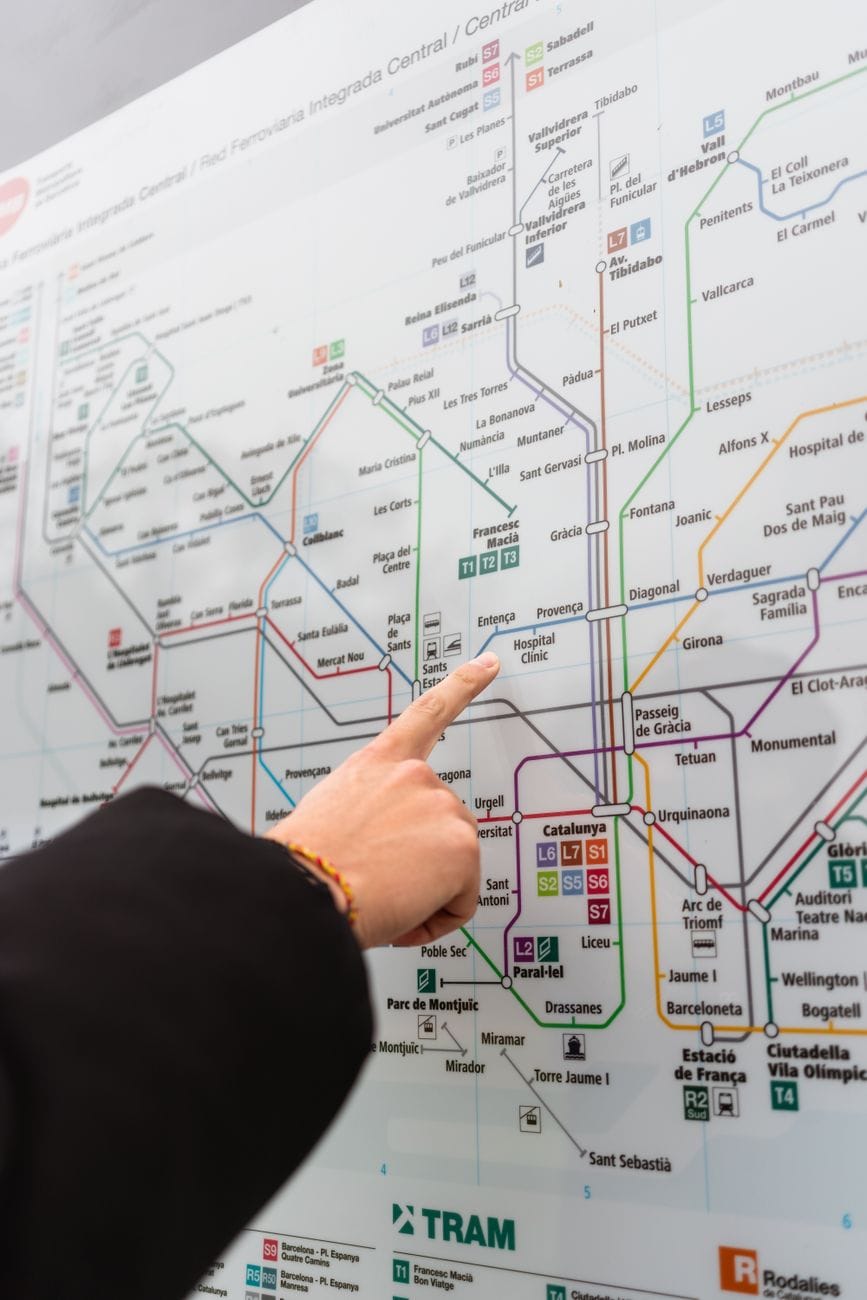
Transports Metropolitans de Barcelona, the public transport operator known as TMB, has launched a free interactive microsite as part of the Barcelona Metro centenary, showing how the network grew during the second half of the 20th century. For daily passengers, the most immediate value is practical and local: it explains how the lines many people now use, including today's L1, L3, L4 and L5, were extended to newer districts and to nearby municipalities such as l'Hospitalet and Cornellà.
The site, Chronicle of a Journey. History of the Barcelona Metro Network, forms part of TMB's wider Centenary of the Barcelona Metro programme. TMB says the microsite lets users explore 100 years of service through three sections and follow the network's growth from fragmented private lines to a unified metropolitan system.
TMB says the microsite allows users to choose between Route, Stories and Timeline to explore the metro's 100 years of service.
Readers can use the site in three ways:
- Route, which sets out the history in seven stages
- Stories, which focuses on specific episodes and themes
- Timeline, which places the metro's development in chronological order
The section TMB highlights for this period is the Route path, especially the chapters covering growth from 1951 to 1967 and the major expansion from 1968 to 1982. The microsite is available online and can be accessed directly from a phone or computer through TMB's centenary pages.
How the 1950s expansion reshaped the network
TMB links the metro's post-war growth to the economic recovery of the 1950s under Francoism, a period often described in Spain as developmentalism. The operator says Barcelona expanded rapidly and unevenly, with large immigration flows, shantytowns on the outskirts and transport shortages in new urban areas.
In that context, the metro was extended to reach developing districts, in some cases before neighbourhood urbanisation was complete. TMB's historical material points to the 1953 Comarcal Plan, a regional urban planning framework for Barcelona and its surrounding area, which was approved that year and later replaced in 1976, according to the official planning record in the Spanish state gazette and the Barcelona city archive.
According to TMB, the old Transversal line opened stations at Glòries and Clot in 1951, Navas in 1953, and Sagrera and Fabra i Puig in 1954. A new branch between Sagrera and Vilapicina opened in July 1959, the start of what later became L5.
That branch included Sagrera, Congrés, Maragall, Virrei Amat and Vilapicina. TMB says these were the first stations under a new management model introduced in 1959 after the lines were merged and municipalised, meaning brought under public municipal control, during the mayoralty of Josep Maria de Porcioles.
The Catalunya interchange and the move to one public operator
TMB identifies the link between the Gran Metro and Metro Transversal platforms at Catalunya as one of the most important improvements of the merger period. After that reorganisation, lines I and II of the Gran Metro were renamed line III, a step TMB describes as the start of a unified metropolitan network.
By the end of the 1950s, TMB says the Transversal had already expanded from Marina to Sant Andreu. In July 1959, the first section of its second line, now L5, connected La Sagrera with Horta.
A further institutional change followed in 1961, when the two private companies were merged into the single public enterprise Ferrocarril Metropolità de Barcelona. TMB says that public takeover opened a new expansion phase and that, two years later, extensions to the old lines, now L1, L3 and L5, were approved along with the creation of today's L4.
How L1, L3, L4 and L5 reached more districts and nearby towns
Between 1968 and 1982, during the final years of Francoism and the start of the democratic transition, the metro became a key tool in shaping both Barcelona and its wider urban area, according to TMB and the Generalitat, the Catalan government. Existing lines were extended, territorial coverage improved, and the network reached new neighbourhoods and neighbouring municipalities including l'Hospitalet and Cornellà.
TMB says this period also saw the birth of L4 and the start of a more coordinated public transport stage with the creation of Transports Municipals de Barcelona and the transfer of powers to the Generalitat. For current riders, the historical material explains why routes that now seem continuous were built in separate stages over several decades.
The centenary microsite's central takeaway is simple: Barcelona's metro was not built in a single push, but through successive extensions that connected new housing areas, older districts and neighbouring municipalities into one system.
Primary sources: noticies.tmb.cat, tmb.cat, historia.tmb.cat, boe.es, Comisión Superior de Ordenación Provincial de Barcelona, Floyd, Priya N, 4.tmb.cat, DAU - Arxiu Digital de la URL, territori.gencat.cat. Reported by gramenet.cat, institutmetropoli.cat, historyofbarcelona.weebly.com, recyt.fecyt.es, V�a Libre, lahemerotecadelbuitre.com, en.wikipedia.org, metropoliabierta.elespanol.com, infrapppworld.com, va-rcm.co.uk.