You move into a flat in Gràcia, change the name on the bills, and carry on. Six months later someone in a WhatsApp group looks at your invoice and tells you you've been overpaying the whole time. This is the single most common money story in Barcelona's expat housing chat, and almost all of it comes down to a handful of lines on your bill you were never told to check, plus a few quirks that are specific to this city and nowhere else in Spain.
Sorting the utilities is one of the first jobs once you've found a place, so it sits naturally alongside the rest of the settling-in checklist for a new arrival in Barcelona. Get the bills right early and you stop the slow leak before it adds up.
TL;DR: Switching electricity or gas supplier is free and now takes 10 working days. Right-size your potencia (you change it once a year, and in Barcelona the local grid operator e-distribución handles the meter side). For gas, ask for the regulated TUR rate by name. Shift heavy appliances into the cheap valle hours. And know the Barcelona-only catches: you can't switch your water supplier, your bill carries the Catalan cànon de l'aigua, some flats are locked into a district heating network, and that old Eixample block may be sharing one boiler.
First, work out what you can and can't change in Barcelona
Most of this guide is about choice: pick a cheaper supplier, pick a smaller power level, pick the right tariff. But a few Barcelona flats take some of that choice away, and it is worth knowing which camp you are in before you spend an evening comparing quotes.
Water has no market at all. Unlike electricity and gas, you cannot switch your water supplier here. Domestic water across the Barcelona metropolitan area is run under a single concession by Aigües de Barcelona, the metropolitan operator that serves roughly three million people across the wider area, so there is no competing retailer to move to and no cheaper company to chase. The only levers you have on the water bill are how much you use and, if you qualify, the social tariff (more on both below).
Some newer flats are on a district heating network. If you live in Poblenou, the 22@ tech district, or the Fòrum area, your block may be connected to Districlima, a network that pipes centrally produced heat and cooling into the building from a plant rather than each flat having its own gas boiler. It is efficient and you don't maintain a boiler, but it also means you can't simply shop around for a cheaper gas or heat supplier the way a flat with its own boiler can. Your heating and hot water come from the network your building signed up to, full stop. Check your contract or ask the administrador de la finca (the building manager) before you assume a TUR gas switch is even possible.
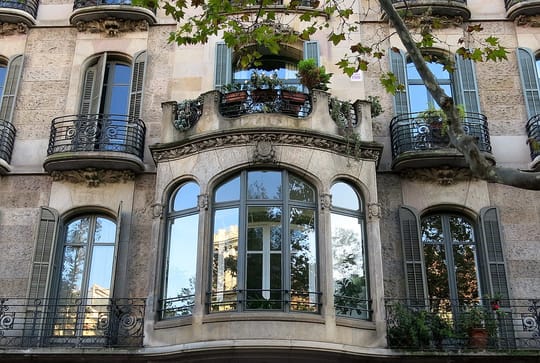
Old Eixample and Ciutat Vella blocks often share one boiler. A lot of the grand pre-war blocks in the Eixample and the old town run a comunidad de vecinos (residents' association) central boiler: one big gas boiler in the basement heats the whole building, and the cost is split through your community fees, not a gas contract in your name. If that's your set-up, there's no individual gas tariff for you to optimise. Where you can push is at the residents' meeting, on the contract the community holds collectively. If you are still flat-hunting and want to keep your options open, it is worth weighing this against the housing stock when you pick a neighbourhood.
If none of that applies and you have your own meters and your own boiler, the rest of this guide is all yours.
Switching supplier: free, and the old company never hears from you
The fear that keeps people stuck is the phone call. People assume they have to ring their current provider, argue, maybe pay to leave. You don't.
Switching electricity or gas supplier in Spain is free, and the new comercializador (the retailer you're moving to) handles every administrative step. You never contact the old one. The regulator, the CNMC (Comisión Nacional de los Mercados y la Competencia, Spain's markets watchdog), states this plainly in its official switching guide.
Two things to know before you sign.
First, speed. As of 12 February 2026, under Real Decreto 88/2026, an electricity switch must complete within 10 working days of you signing the new contract. That's down from the old 21-day limit, so if a comparison site or the CNMC's own page still quotes 21 days, it's out of date. In rare cases involving complex on-site work it can stretch by another five working days.
Second, the only thing that can cost you on the way out: permanencia, a lock-in penalty. Since RD 88/2026, an individual on the standard home tariff (the 2.0TD, which covers supplies up to 15 kW) can generally leave at any time without penalty. The exception is a fixed-price deal before its first annual renewal, and even then the law caps the penalty at 5% of the energy you've still got left to be supplied. The regulated tariffs carry no lock-in at all.
So the legacy-giant contract you inherited from the previous tenant is almost never something you're trapped in. Check what you're on, and if it looks expensive, move. This is also worth a look before you sign a tenancy, since utilities sit alongside the deposit and the other costs covered in the Barcelona renting and contracts guide.
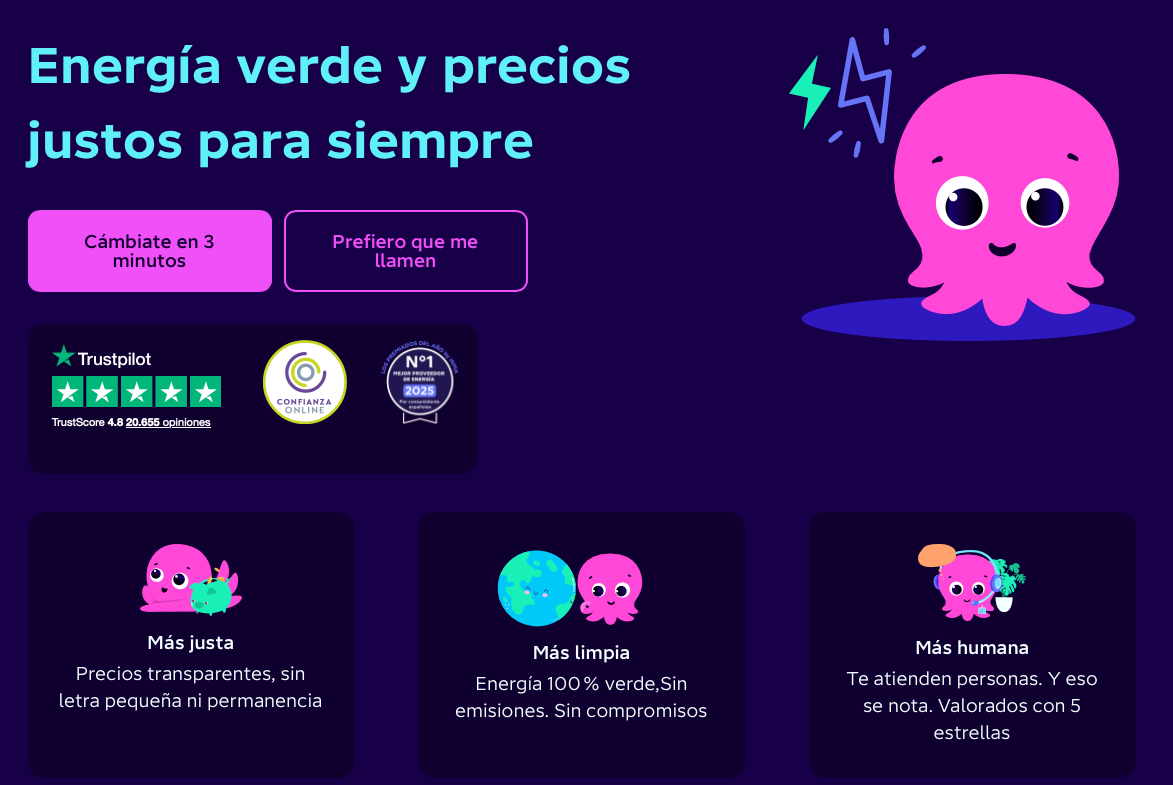
Through the various discussions that happen in our Barcelona English Speakers community - Octopus energy seems to constantly rank as one of the best value suppliers, with other group buys from websites such as Spock offering often market best pricing.
Potencia: the line that costs you whether you use power or not
Potencia is contracted power, measured in kilowatts, and it's the part of the bill newcomers find most confusing. It's a fixed charge for the capacity sitting on standby in your flat, billed separately from the energy you actually burn. Pay for more kW than you need and you're lighting money on fire every single day, used or not.
On the 2.0TD tariff there are two power periods, not three: punta (weekday daytime) and valle (overnight on weekdays plus all weekend and national holidays). You can set a different power level for each, so a flat that only needs full capacity in the evening doesn't have to pay for it round the clock. (Keep this distinction in your head: the power side of the bill splits the day into two bands, while the energy side, covered further down, splits it into three. Same tariff, two different clocks.)
Here's the rule that makes getting it right matter: you can only change your contracted power once every 12 months. Lowering it costs the regulated derechos de enganche fee of 9.04 EUR plus VAT, set in the access-tolls framework and listed in the CNMC's guide on modifying your contract. Raising it costs more, because that involves access and extension rights. So if you over-shoot down and find you keep tripping the meter, you're stuck for a year.
In Barcelona the meter and connection side of all this sits with e-distribución, the Endesa-group distributor that runs the physical electricity grid across the city. You don't choose your distributor (it's fixed by your zone), and it's a separate company from whichever retailer you buy your energy from. When you lower or raise potencia, your retailer puts the request through to e-distribución, which actually adjusts the limit at your meter. Worth knowing, because if a job needs a technician on site, that's e-distribución's crew, not your retailer's. That same grid operator is the one pouring tens of millions into upgrading Barcelona's network, partly to cope with rising summer cooling demand, which is the very load that pushes households to bump their potencia up in the first place.
This is where Barcelona's housing stock bites. The pre-war flats of Ciutat Vella and the older Eixample blocks were not wired for modern loads, and a fair few have had their potencia bumped up over the decades by previous tenants chasing an extra heater or an induction hob the old wiring wasn't really built for. These are the same dense old districts where the grid operator now schedules its reinforcement works out of high season, precisely because the network underneath them is ageing and under strain. Picture a typical one-bed in the Eixample: lights, a fridge, a laptop, the odd appliance, and you rarely run the oven and the washing machine at the same moment. A flat like that often sits comfortably on 3.3 to 4.4 kW, yet you'll routinely inherit one contracted at 5.5 kW or more, paying every day for capacity it never draws. Before you change anything, look at the "maximum power demanded" (maxímetro) figure your smart meter records over recent months and use that real number as your guide rather than guessing. And if you're in one of these older flats and tempted to crank the potencia up rather than down, get an electrician to look at the installation first.
Gas: ask for the regulated TUR rate by name
For domestic gas, assuming you have your own boiler and aren't on the district network or a shared community boiler, the cleanest money-saving move in Barcelona is the TUR, the Tarifa de Último Recurso, Spain's regulated gas tariff. The Government sets the price and reviews it every three months (1 January, 1 April, 1 July, 1 October), and the State controls how far it can move. That cap is the whole point.
The TUR can only be contracted through four designated reference retailers (the comercializadores de referencia). All four charge the identical regulated price, so pick whichever is least painful to deal with:
- Energía XXI (Endesa group)
- Curenergía (Iberdrola group)
- Comercializadora Regulada de Naturgy (Naturgy group)
- Baser COR (TotalEnergies group)
Which TUR you get depends on how much gas you burn:
- TUR 1: consumption under 5,000 kWh a year. This is most flats that only use gas for hot water and cooking.
- TUR 2: 5,000 to 15,000 kWh a year.
- TUR 3: 15,000 to 50,000 kWh a year.
As of the rate in force from 1 July 2026, TUR 1 is a fixed term of €3.93 a month plus €0.043298 per kWh before tax. With 21% VAT the fixed term is about €4.76 a month, and the variable term rose about 13% at the July reset, so with VAT and the hydrocarbon tax on top the unit price is well above where it sat in the spring. Because the price resets every quarter, check the current figure on the regulated-provider site before you sign rather than trusting any number, including this one, months after publication.
Two things the salespeople won't volunteer. The TUR has no permanencia, so no lock-in. And it does not include, and does not require, a maintenance contract. If a rep tells you a boiler-maintenance plan is mandatory to get the rate, they're wrong, and the CNMC says so in its consumer gas guide. Refusing it does not affect your right to the TUR. Want maintenance? Fine, but contract it separately on the open market.
Time bands: run the washing machine when the meter's asleep
If you're on a time-of-use electricity plan, the day splits into three energy periods on the 2.0TD tariff, and knowing them is free money. (Yes, this is three bands where the power charge earlier had only two. The power side of your bill uses a simpler two-band split; the energy side, which is what you're charged for what you actually use, uses the three bands below. Both are correct, they just measure different things.)
These bands are set nationally for the mainland by the CNMC in Circular 3/2020, the rule that created the 2.0TD tariff, so they're the same wherever you are on the peninsula:
- Punta (peak, most expensive): weekdays 10:00 to 14:00 and 18:00 to 22:00.
- Llano (mid): weekdays 08:00 to 10:00, 14:00 to 18:00, and 22:00 to midnight.
- Valle (off-peak, cheapest): weekdays midnight to 08:00, and all day every weekend and national holiday.
So the washing machine, the dishwasher, the dryer: push them to after midnight on a weeknight, or to any point on a Saturday or Sunday. The whole weekend is valle. That's the single easiest habit change on this list.
If watching the clock isn't your thing, a flat fixed rate exists for peace of mind, and people who've done the maths often find the gap between fixed and time-of-use is small enough that they happily pay it to stop thinking about it. Your call.
One more option worth knowing: the PVPC (Precio Voluntario para el Pequeño Consumidor), the regulated electricity tariff. It's available only through the reference retailers, only for contracted power up to 10 kW, and it tracks the wholesale market directly. The wholesale market itself now settles in 15-minute blocks, a change the CNMC phased in through 2024 and 2025, but a normal home meter still records by the hour, so a household on the PVPC is in practice billed against roughly 24 hourly prices a day rather than a separate price every quarter of an hour. It rewards people who can genuinely shift their use and unsettles people who can't.
Water: you can't switch, so play the levers you do have
Since there's no competing water supplier to chase in Barcelona, the savings come from how the bill is built. Aigües de Barcelona uses a rising-block tariff: a fixed service charge plus a variable part split into consumption bands, where the more cubic metres you use, the higher the unit price climbs on the upper bands. Use less, and you stay in the cheaper bands.
A couple of Barcelona-specific things on the water bill catch everyone out.
First, the cànon de l'aigua. This is a Catalan regional water tax owned by the Agència Catalana de l'Aigua (part of the Generalitat), levied on your water use and collected for them by Aigües de Barcelona right there on your bill. Every Spanish region runs its own water levies, so this is one concrete reason a Barcelona water bill doesn't look like a Madrid one. It isn't a mistake and it isn't your supplier padding the total. It sits alongside the other distinctly local charge on the city's households, the rubbish tax, as one of the line items newcomers don't see coming.
Second, the water-meter charge. Plenty of people get an unexpected yearly direct debit from a company like MUSA they don't remember signing with, for "maintenance of the measurement equipment". It's legitimate. A maintenance contract for the meter with an authorised company is required to formalise your water supply with Aigües de Barcelona, and it's billed separately from your water consumption, which is why it looks like it came out of nowhere. For a standard 15 mm domestic meter, MUSA's published tariff is 44.84 EUR for the first year (the initial rental, which includes that first year of maintenance) and 21.85 EUR a year to renew the maintenance after that. Don't treat it as a scam and don't ignore it.
If money is genuinely tight, Aigües de Barcelona runs a social tariff that, for qualifying households, exempts you from the fixed service charge and reduces the rate on the first consumption bands. That's a real saving, not a token one, and it's worth asking about.
When the bill is wrong, here's where you go in person
National rules explained in English are useful, but they don't tell you where to physically stand when a supplier won't fix an overcharge. In Barcelona you have a local route, and it's free.
Your first stop for a billing dispute is the OMIC, the municipal consumer office run by the Ajuntament de Barcelona (Oficina Municipal d'Informació al Consumidor). By its own description it processes complaints from residents and carries out mediation between the consumer and the company, and utilities (water, electricity and gas) have long been the single biggest category of cases it handles. The usual order is to complain to the company first and give it 30 days to reply; if that goes nowhere, you take it to the OMIC. The service costs nothing.
If mediation doesn't settle it, the next step up is consumer arbitration through a Junta Arbitral de Consum, the public arbitration body attached to the Catalan Consumer Agency. According to the Junta Arbitral de Consum de Barcelona, arbitration is free for both sides and ends in a laudo, a ruling the bodies describe as binding and enforceable on both parties. In plain terms, you can often resolve a dispute this way without going to court. Note that arbitration only works if the company has agreed to submit to the system, which not every utility does, so it is not a guaranteed route, just a free one worth trying.
And if the problem is that you simply can't afford the bills, not that they're wrong, the route is different. The bono social is the national vulnerability discount on electricity, and per the official bono social information it is applied for directly through the reference retailers (the same comercializadores de referencia that offer the regulated PVPC tariff), not through the council. What the Ajuntament can do is help: your local Serveis Socials office can check whether you qualify and help you get the paperwork moving. For water, that's the Aigües de Barcelona social tariff mentioned above. None of this requires you to suffer in silence or pay a professional to intervene.
A note on tax, because the goalposts moved
Your electricity bill got more expensive on 1 June 2026, and it isn't your supplier's fault. The temporary tax cuts on electricity ended early on that date, and bills rose accordingly. Two taxes moved at once.
First, VAT (IVA) on household electricity went back up from 10% to the standard 21% on 1 June 2026. The 10% reduced rate had applied since 22 March 2026 to all electricity contracts with contracted power of 10 kW or below, so most flats benefited, not only vulnerable households (those kept their separate bono social discount regardless).
Second, the special electricity tax (the IEE) returned to its standard 5.11% (precisely 5.11269632%) on 1 June 2026, up from the reduced 0.5% that had also run from 22 March.
The cuts were originally meant to last until 30 June, but they lapsed a month early: an inflation trigger written into the decree (a condition tied to the April 2026 electricity price index) was met, so both rates reverted from 1 June. The Agencia Tributaria spells this out. For the same consumption, the change adds roughly 10 euros a month to a typical domestic bill. So if you compared an old bill to a recent one and the rate per kWh looks similar but the total jumped, that's the tax, not a con.
The practical wrap-up
Open your most recent electricity bill and find three numbers: the supplier name, the contracted power in kW, and whether you're on a fixed or time-of-use rate. If the supplier is one you never chose, get a couple of quotes and switch, it's free and done in 10 working days. If your potencia looks high and you never trip the breaker, plan to lower it (remember: once a year, so don't rush it blind, check the maxímetro reading, and check the wiring first in an old flat). If you're on time bands, move the heavy appliances into the weekend and the small hours.
Then do the gas, if it's actually yours to control: one phone call to a reference retailer, ask for the TUR by name, say no to maintenance, done. If your block is on the Districlima network or runs a shared community boiler, your fight is at the building level, not the supplier level.
On water, there's no switch to make, so use less to stay in the cheap bands, expect the cànon and the meter charge, and ask about the social tariff if you need it.
And if any bill is plain wrong, you don't argue alone: the OMIC consumer office at the Ajuntament will take it up for you, for free, and free arbitration sits behind it if mediation stalls.
None of this needs a gestor or a lawyer. It needs ten minutes with your bill and the nerve to actually make the switch.
Sources
- CNMC, official supplier-switching guide (free switching, the new retailer handles everything): https://www.cnmc.es/sectores-que-regulamos/energia/cambio-de-comercializador-en-espana/guia-informativa
- BOE, Real Decreto 88/2026 (10-working-day switch limit; permanencia rules): https://www.boe.es/buscar/act.php?id=BOE-A-2026-3212
- CNMC, Circular 3/2020 establishing the 2.0TD tariff (two power periods, three energy periods, and the mainland punta/llano/valle bands): https://www.boe.es/buscar/doc.php?id=BOE-A-2020-1066
- CNMC, resolution adapting settlement to the 15-minute (quarter-hourly) market: https://www.boe.es/diario_boe/txt.php?id=BOE-A-2024-20995
- CNMC, consumer guidance on modifying contract conditions (one power change per 12 months; derechos de enganche of 9.04 EUR plus VAT): https://www.cnmc.es/sites/default/files/editor_contenidos/Energia/Consumidores/5.%20C%C3%B3mo%20modificar%20las%20condiciones%20del%20contrato.pdf
- CNMC, consumer gas guide (TUR rules; no mandatory maintenance): https://www.cnmc.es/facil-para-ti/que-hace-la-cnmc-para-consumidores/consumidores-gas
- Comercializadora Regulada (official regulated-provider portal), TUR 1 price and bands: https://www.comercializadoraregulada.es/regulada/gas/tur_1
- MITECO, official PVPC page: https://www.miteco.gob.es/en/energia/energia-electrica/electricidad/contratacion-suministro/precio-voluntario.html
- Bono social eléctrico, official information (national discount, applied for through the reference retailers): https://www.bonosocial.gob.es/
- OMIC Barcelona (Ajuntament de Barcelona), what the municipal consumer office does and how to make a claim: https://ajuntament.barcelona.cat/omic/en/omic/what-we-do
- Junta Arbitral de Consum de Barcelona, how consumer arbitration works and the binding laudo: https://juntarbitral.bcn.cat/es/sistema-arbitral-de-consumo/columna/como-se-tramita-el-arbitraje
- Aigües de Barcelona, supply tariffs (rising-block structure and social tariff): https://www.aiguesdebarcelona.cat/ca/el-teu-servei-daigua/la-teva-factura-i-tarifes/tarifes-de-subministrament
- Aigües de Barcelona, water-meter maintenance charge: https://www.aiguesdebarcelona.cat/es/servicio-agua/contrato-agua/mantenimiento-equipos-de-medida
- MUSA, official meter rental and maintenance tariff (44.84 EUR initial, 21.85 EUR renewal): https://www.musa.cat/tarifas/
- Agència Catalana de l'Aigua, the cànon de l'aigua: https://aca.gencat.cat/ca/laca/canon-i-altres-tributs/canon-de-laigua/
- Agencia Tributaria, tax measures (electricity IVA from 10% back to 21% and the IEE from 0.5% back to its standard rate, both from 1 June 2026): https://sede.agenciatributaria.gob.es/Sede/todas-noticias/2026/marzo/23/medidas-materia-tributacion.html
- Agencia Tributaria, special electricity tax under Real Decreto-ley 7/2026 (IEE standard rate 5.11269632% restored from 1 June 2026): https://sede.agenciatributaria.gob.es/Sede/impuestos-especiales-medioambientales/novedades-impuestos-especiales-medioambientales/2026/marzo/25/medidas-extraordinarias-impuesto-especial-sobre-medio.html
Working out your potencia, the TUR rate or a dodgy water charge is exactly the sort of thing residents compare notes on every week, and a second pair of eyes on your bill often spots the overpayment fastest. If you want people who have already sorted theirs, join the Barcelona English Speakers community, with 4,000+ members across 20+ free, moderated WhatsApp groups covering flats, neighbourhoods and daily life here.
If you are just moving in, setting up utilities, internet and the stuff nobody tells you covers the first-week admin.