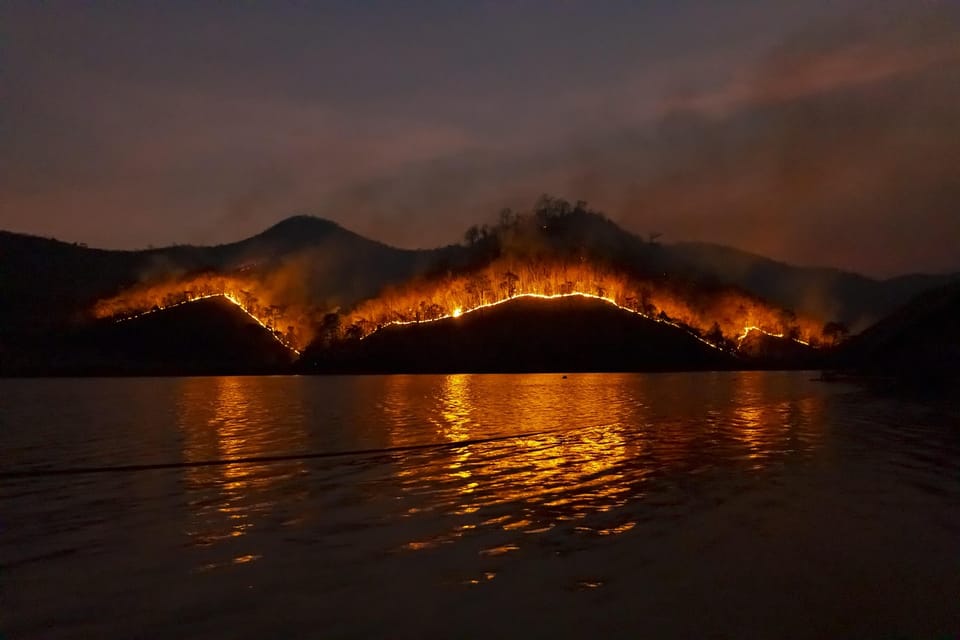
Firefighters in Catalonia are still working to extinguish the Les Gavarres wildfire in Girona after it burned more than 2,300 hectares, while a wider wave of fires across southern Europe had destroyed about 19,000 hectares by Monday morning, according to reporting by Diari ARA citing emergency developments across France, Portugal, Greece and Spain.
For residents and holidaymakers in Catalonia, the immediate consequence is that a major fire remains active in a densely visited area of the Costa Brava hinterland, after earlier confinement orders affected thousands of people in nearby municipalities. The blaze has already scorched an area larger than many Barcelona neighbourhoods combined, and officials are watching closely as another heatwave is forecast this week.
Les Gavarres remains the main fire concern in Catalonia
The wildfire in Les Gavarres, the mountain massif between Baix Empordà and Gironès, had burned more than 2,300 hectares by Monday. Earlier coverage from Diari ARA reported that the fire led to the confinement of 45,000 people as it spread into the Gavarres area.
Subsequent reporting said emergency crews had stabilised the fire but were still monitoring difficult sections, including a so-called "green island" of unburned vegetation inside the perimeter and the right flank, which Bombers de la Generalitat, Catalonia's fire service, said had to be fully extinguished to avoid flare-ups.
Bombers de la Generalitat warned that the right flank of the Les Gavarres fire "must be extinguished no matter what", according to reporting published on 6 July.
The scale of the fire matters locally because Les Gavarres sits close to residential areas, campsites and summer travel routes in Girona province. With high temperatures returning, any reactivation could affect nearby residents, second-home owners and visitors moving through the Costa Brava area.
Southern Europe faces a broader wildfire surge
The Catalan fire is part of a wider pattern. Diari ARA reported that fires across southern Europe had consumed roughly 19,000 hectares by Monday morning, nearly twice the surface area of the city of Barcelona.
The countries most affected were reported as:
- France
- Portugal
- Greece
- Spain
European fire monitoring has already pointed to sustained risk. The European Commission's Joint Research Centre, which tracks the current wildfire situation in Europe, has documented continued pressure on fire services after the EU's destructive 2025 fire season.
Heatwave deaths sharpen concern as new hot spell approaches
The fires come after an intense June heatwave across Europe. France's public health agency, Santé publique France, reported excess mortality during the hot spell, and French authorities have linked the episode to thousands of deaths.
That matters in Catalonia because heat, low humidity and wind can sharply raise the risk of new ignitions and of existing fires flaring up again. Protecció Civil, Catalonia's civil protection authority, and Bombers de la Generalitat are typically among the agencies monitoring these episodes alongside the Mossos d'Esquadra, the regional police, when restrictions or confinements are needed.
For now, the clearest local fact remains the condition of the Les Gavarres fire: more than 2,300 hectares have burned, and crews are still watching the most fragile sections as another heatwave approaches this week.
Primary sources: joint-research-centre.ec.europa.eu. Reported by Por Enzo Iriarte Agregar Infobae en Agrega Infobae a tus medios preferidos en Google, Eva Batlle, Tony Di Marino, Redacción, Aniol Costa-Pau, Albert Llimós, News Desk, copernicus.eu, Marzia Bianchi, Guillaume Corradino, euronews.com, santepubliquefrance.fr, inpes.santepubliquefrance.fr, bbc.com, france24.com, Santé publique France, Matt Ford Reporter for DW News and Fact Check, Diari ARA.